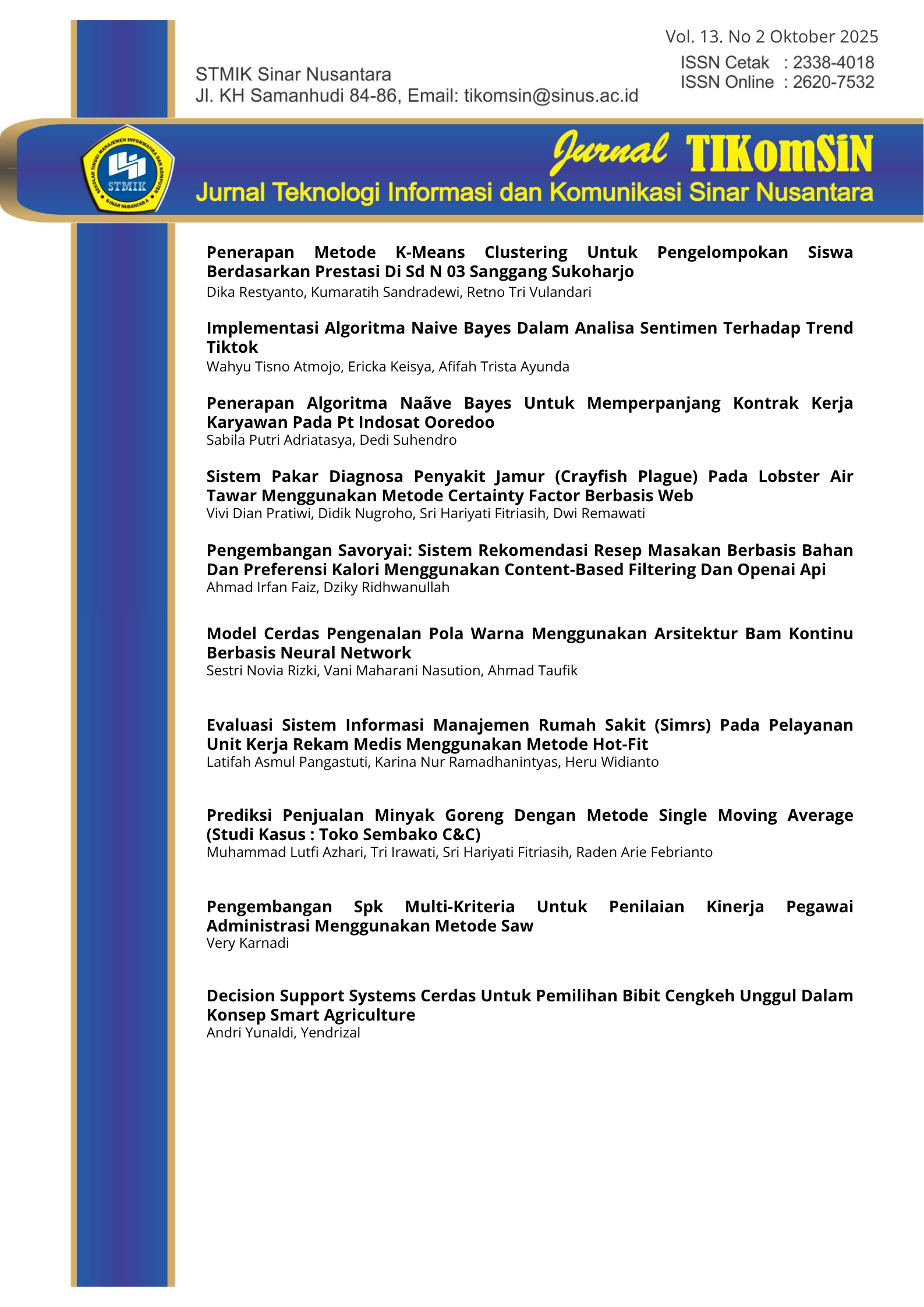
IMPLEMENTASI ALGORITMA NAIVE BAYES DALAM ANALISA SENTIMEN TERHADAP TREND TIKTOK
DOI:
https://doi.org/10.30646/tikomsin.v13i2.1015Abstract
Social networking is becoming more and more important. Social media's purpose has evolved from its first appearance as a place just for self-actualization to include online buying and selling, self-actualization, and other functions. Tik tok is one of the social media platforms that is currently in high demand; opinions about its rise are mixed and include both positive and negative aspects. The goal of this study is to closely examine and comprehend how people react to the phenomena of Tiktok's development by keeping an eye on user-generated material in tweets and the evolution of sentiment over time. This experimental study suggests using the Naïve Bayes Algorithm as a sentiment analysis method to examine how Twitter users are responding to the TikTok craze. In-depth insights into the dynamics of Twitter users' reactions to the TikTok trend are sought by this research, which combines sentiment analysis technology with Confusion Matrix performance evaluation. According to the sentiment analysis results, the majority of user comments are neutral (57.03%), followed by critical (33.20%) and affirmative (9.77%) remarks. This illustrates the nuanced reactions that people have had to the TikTok movement, in which the majority of users share their ideas in an unbiased manner. The significance of this research lies in its ability to provide an answer.
Downloads
Published
How to Cite
Issue
Section
Citation Check
License
Authors who publish with this journal agree to the following terms:
- Authors retain copyright and grant the journal right of first publication with the work simultaneously licensed under a Creative Commons Attribution License that allows others to share the work with an acknowledgement of the work's authorship and initial publication in this journal.
- Authors are able to enter into separate, additional contractual arrangements for the non-exclusive distribution of the journal's published version of the work (e.g., post it to an institutional repository or publish it in a book), with an acknowledgement of its initial publication in this journal.
- Authors are permitted and encouraged to post their work online (e.g., in institutional repositories or on their website) prior to and during the submission process, as it can lead to productive exchanges, as well as earlier and greater citation of published work (See The Effect of Open Access).
Â

This work is licensed under a Creative Commons Attribution-NonCommercial-ShareAlike 4.0 International License.