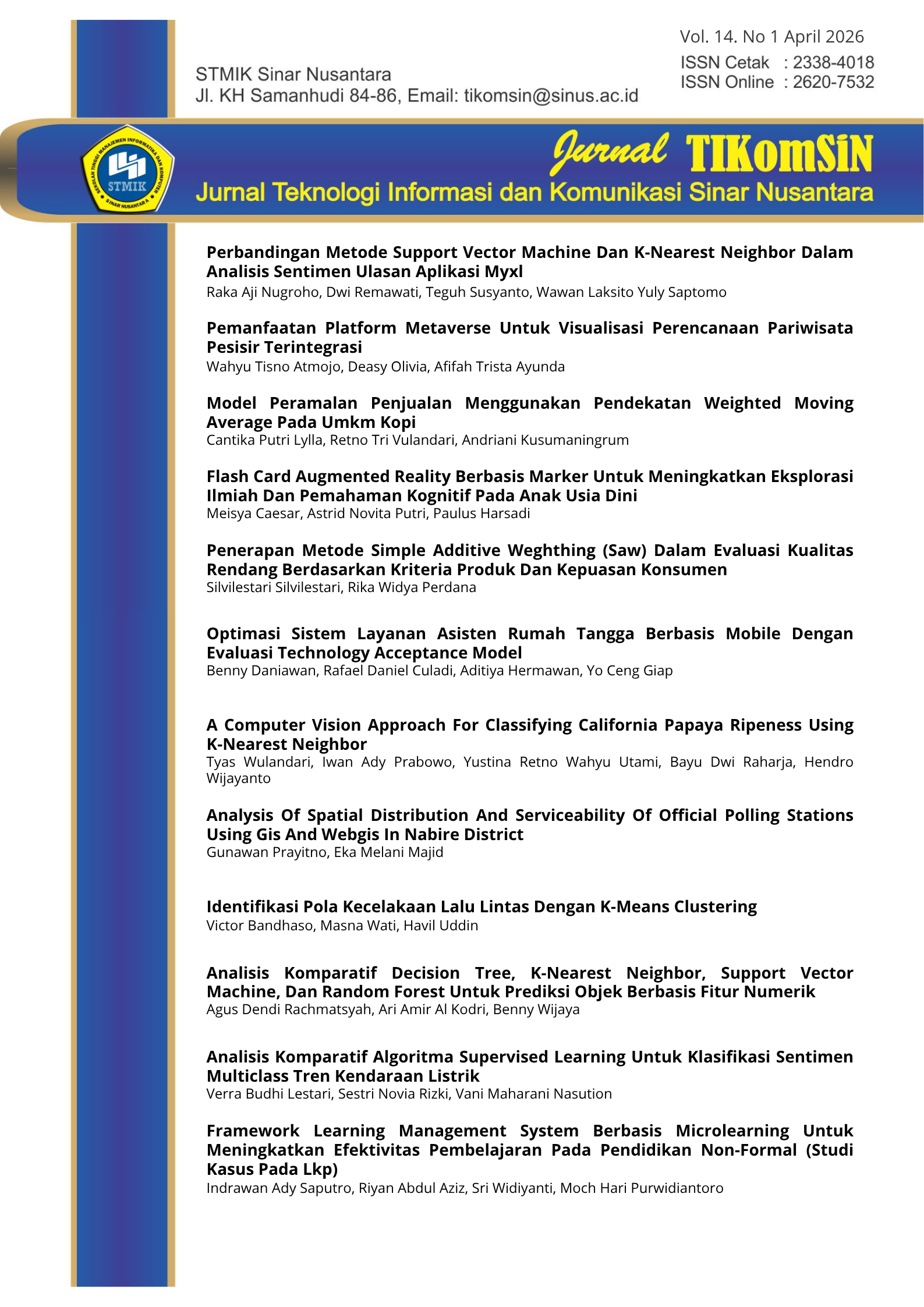
PENERAPAN METODE SIMPLE ADDITIVE WEGHTHING (SAW) DALAM EVALUASI KUALITAS RENDANG BERDASARKAN KRITERIA PRODUK DAN KEPUASAN KONSUMEN
DOI:
https://doi.org/10.30646/tikomsin.v14i1.1089Keywords:
Decision Support System, Simple Additive Weighting, Rendang Evaluation, Product Ranking, Consumer PreferenceAbstract
The increasing variety of rendang products available in the market has created challenges for consumers in identifying products with the best quality. Product evaluation cannot be based on a single aspect, as rendang quality is influenced by multiple criteria, including taste, aroma, color, spice composition, shelf life, price, and consumer satisfaction. The involvement of numerous assessment criteria often leads to subjective and inconsistent judgments. This study aims to develop a Decision Support System (DSS) for evaluating rendang quality and identifying the most suitable product based on measurable criteria. The method applied in this research is Simple Additive Weighting (SAW), selected for its capability to process multi-criteria decision-making through weighted evaluation. Data were collected from observations and respondent assessments of several rendang alternatives, followed by normalization and weighted calculations to determine preference values. The findings demonstrate that the SAW method can generate an objective and systematic ranking of rendang products. The highest preference score was obtained by alternative XIII with a value of 0.97, while the lowest score was recorded by alternative IV with 0.56. These results indicate that the proposed method is effective in distinguishing product quality based on the established evaluation criteria.
Â
References
S. O. Prastika, W. Gusnita. Kualitas Rendang Daging Dengan Penggunaan Santan Kelapa Segar Dan Santan Instan. Jurnal Pendidikan Tata Boga dan Teknologi, Vol 3 (2): pp. 199-203, 2022, DOI: 10.24036/jptbt.v3i1.290
M. F. D. Rozi, “Pemilihan Pembelian Mobil Bekas Sesuai Dengan Kebutuhan Menggunakan Metode Simple Additive Weighting (SAW),†Jurnal Teknologi Sistem Informasi, vol. 6, no. April, pp. 127–140, 2025, doi: 10.35957/jtsi.v6i1.10367.
A. Kurnia and A. H. Mirza, “Implementasi Metode Simple Additive Weighting (SAW) pada Sistem Pendukung Keputusan dalam Pemilihan Pegawai Terbaik,†JOSH (Journal Information System Research), vol. 99, no. 99, pp. 174–185, 2024, doi: 10.47065/josh.v9i9.999.
R. A. Taufik Kurnialensya1, “Sistem Pendukung Keputusan Pelanggan Terbaik Dan Pemberian Diskon Menggunakan Metode Saw & Topsis,†Jurnal Elektronika dan Komputer, vol. 13, no. 1, pp. 18–33, 2020, doi: 10.51903/elkom.v13i1.135
K. Wijak, A. Marwah, and A. H. Hasugian, “Penerapan Metode Simple Additive Weighting (SAW) Dalam Pemilihan Oli Mesin Sepeda Motor Matic Terbaik di Bengkel Sepeda Motor,†Jurnal Sistem Informasi TGD, vol. 5, no. 4, pp. 1403–1414, 2024, doi: 10.47065/josh.v5i4.5686.
P. J. Komara, “Sistem Pendukung Keputusan Pemberian Bonus Tahunan Karyawan Dengan Metode Simple Additive Weighting ( Saw ) ( Studi Kasus : PT . Mega Fortris Indonesia ),†Jurnal Satya Informatika, vol. 5, no. 1, pp. 53–64, 2020, 10.59134/jsk.v5i01.45
D. Magdalena Sundari, “Sistem Pendukung Keputusan Penilaian Dosen Terbaik Menggunakan Metode Analytical Hierarchy Process ( AHP ),†JURITEK, vol. 4, no. 1, 2024, doi: 10.51903/juritek.v4i1.2884
D. Galva, “Penerapan Metode SAW dalam Sistem Pendukung Keputusan Pemilihan Parfum pada Rancangan Aplikasi E-Commerce (Studi Kasus: Parfum Tridaya),†ISAINTEK, vol. 7, no. 2, 2024, 10.55606/isaintek.v7i2.271
R. F. Yoga, Y. Litanianda, and G. A. Buntoro, “Pengembangan Sistem Pendukung Keputusan Berbasis SAW untuk pemilihan penerimaan beasiswa,†SAINTEK, vol. 7, no. 3, 2025, doi: 10.32877/bt.v7i3.2236.
S. N. Rizki, A. Yunaidi, V. M. Nasution, M. U. Neli, A. Fitrianto, and A. Ariawan, “Pengembangan Spk Seleksi Perangkat Nagari Berbasis Metode Saw Di Desa Kumango Utara,†Jurnal Teknologi Informasi dan Komunikasi, vol. 13, no. 1, p. 59, 2025, doi: 10.30646/tikomsin.v13i1.947.
Remawati, D., Harsadi, P. and Nugroho, R.D.“Penerapan Sistem Penunjang Keputusan Menggunakan Algoritma Naive Bayes Pada konsep Human Resource Information System (HRIS) (Studi kasus :Penerusan Kontrak Kerja Karyawan di PT. XYZ),†Jurnal Ilmiah SINUS, 18(1), p. 63, 2020. Available at: https://doi.org/10.30646/sinus.v18i1.440.
F. I. Yanti and R. P. Manalu, “Sistem Pendukung Keputusan Dalam Perangkingan Bedak Terbaik Menerapkan Metode MOORA,†TIN (Terapan Informatika Nasional) vol. 3, no. 8, pp. 294–301, 2023, doi: 10.47065/tin.v3i8.4126,
Yoshima, A.D., Remawati, D. and Hasbi, M. “Sistem Pendukung Keputusan Pengadopsian Anak Menggunakan Metode Analytical Hierarchy Process dan Metode Perbandingan Eksponensial,†Jurnal Teknologi Informasi dan Komunikasi (TIKomSiN), 9(1), p. 51, 2021. Available at: https://doi.org/10.30646/tikomsin.v9i1.544
R. Meri, “Simple Additive Weighting (SAW) Method on The Selection of New Teacher Candidates at Integrated Islamic Elementary School,†IJISTECH, vol. 4, no. 1, pp. 428–435, 2020, doi 10.31763/ijist.v4i1.232
R. R. Yusran, “Sistem Pendukung Keputusan Kepuasan Pelanggan Terhadap Pelayanan Toko Gypsum Dan Platform Keshya Menggunakan Metode (SAW),†Jurnal Teknologi Informasi dan Komunikasi (TIKomSiN), vol. 8, no. 1, pp. 40–47, 2023.
DOI: http://dx.doi.org/10.30646/tikomsin.v13i2.1039
Pamungkas, P.D., Remawati, D. and Widada, B.“Penerapan Metode Fuzzy Tsukamoto Untuk Penentuan Jurusan Sesuai Minat Bakat Penerimaan Siswa Baru Pada SMK,†Jurnal Teknologi Informasi dan Komunikasi (TIKomSiN), Vol.10, No. 1, 2022, https://doi.org/10.30646/tikomsin.v10i1.599.
Silvilestari, “Decision Support System Promotion Criteria For Increasing Sales of Randang Minang Hj. Fatimah Uses Fuzzy Sugeno,†IJISTECH vol. 6, no. 158, pp. 1–8, 2022, doi 10.31763/ijist.v4i1.232
Downloads
Published
How to Cite
Issue
Section
Citation Check
License
Authors who publish with this journal agree to the following terms:
- Authors retain copyright and grant the journal right of first publication with the work simultaneously licensed under a Creative Commons Attribution License that allows others to share the work with an acknowledgement of the work's authorship and initial publication in this journal.
- Authors are able to enter into separate, additional contractual arrangements for the non-exclusive distribution of the journal's published version of the work (e.g., post it to an institutional repository or publish it in a book), with an acknowledgement of its initial publication in this journal.
- Authors are permitted and encouraged to post their work online (e.g., in institutional repositories or on their website) prior to and during the submission process, as it can lead to productive exchanges, as well as earlier and greater citation of published work (See The Effect of Open Access).
Â

This work is licensed under a Creative Commons Attribution-NonCommercial-ShareAlike 4.0 International License.