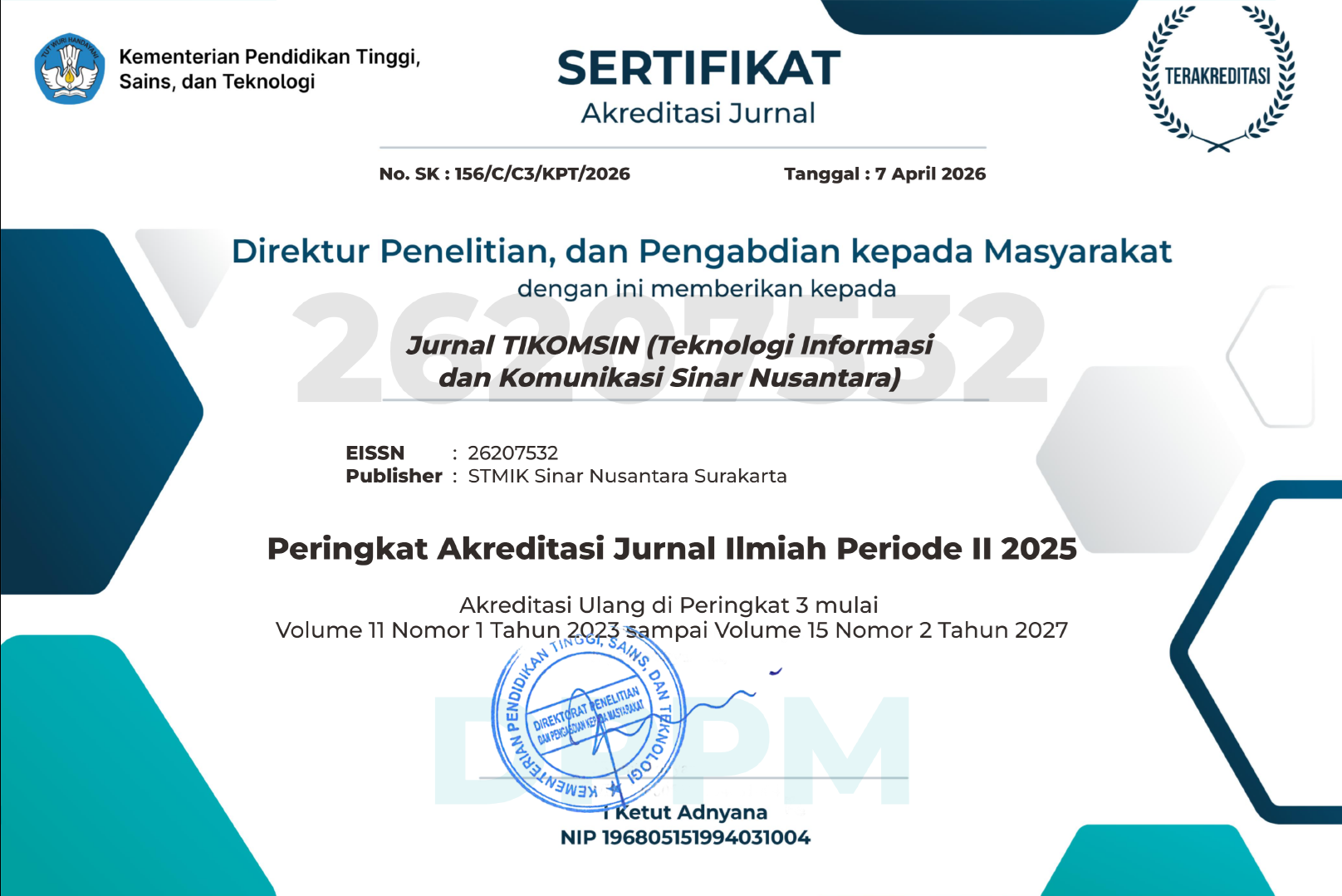
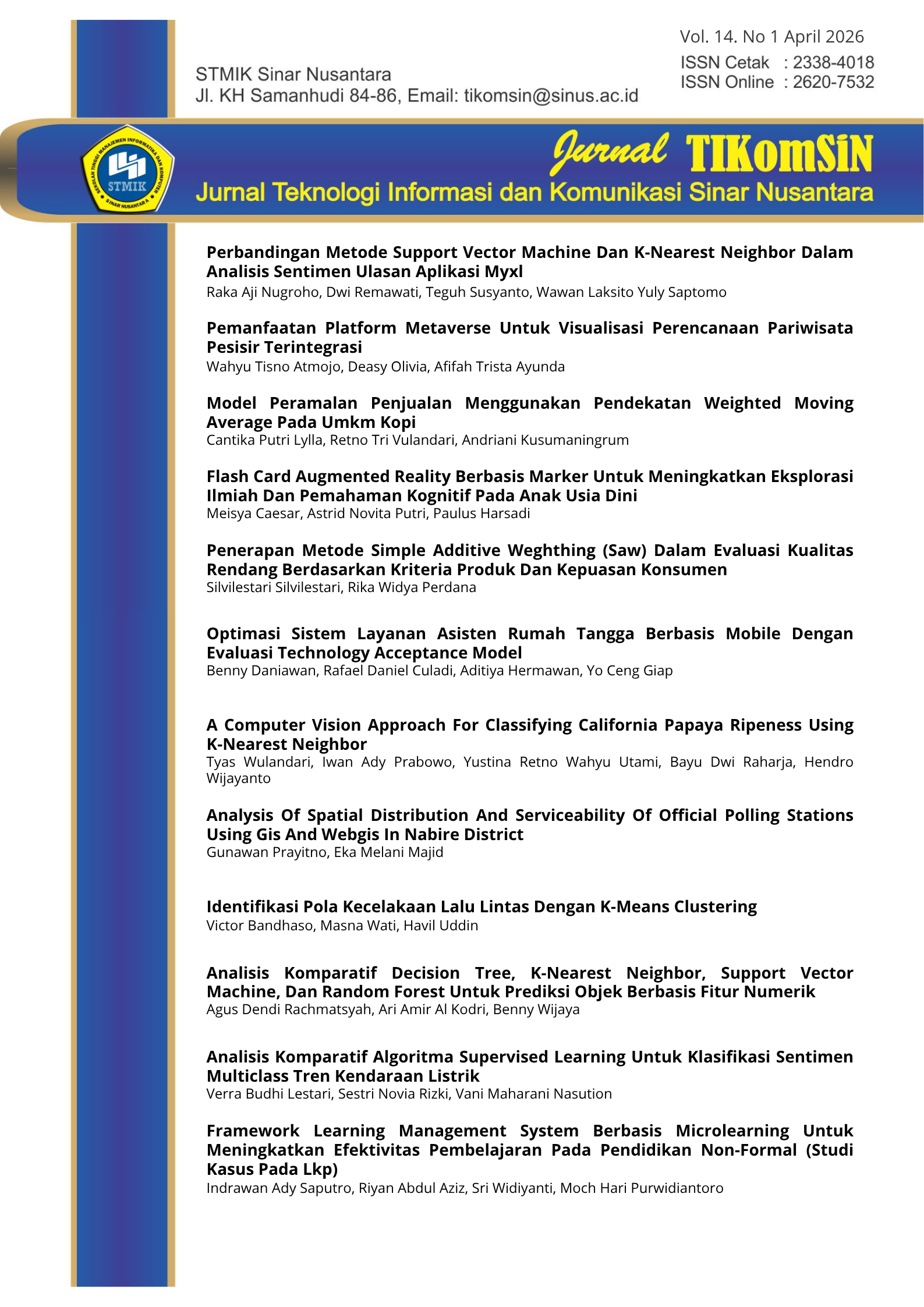
OPTIMASI SISTEM LAYANAN ASISTEN RUMAH TANGGA BERBASIS MOBILE DENGAN EVALUASI TECHNOLOGY ACCEPTANCE MODEL
DOI:
https://doi.org/10.30646/tikomsin.v14i1.1096Keywords:
Household Assistant Services, Mobile Service System, Technology Acceptance Model, User Acceptance, Perceived UsefulnessAbstract
References
A. Siaha Widodo, “Peran Internet dalam Meningkatkan Jumlah Pekerja Lepas di Indonesia,†NYIMAK J. Commun., vol. 3, no. 2, pp. 191–202, 2019.
R. Bugis et al., “Rongo-Rongo Dalam Pemenuhan Kebutuhan Rumah Tangga,†Jispo, vol. 9, no. 2, pp. 135–150, 2019.
R. R. Susilowati, “Perlindungan Hukum Bagi Pekerja Rumah Tangga,†Huk. Dan Din. Masy., vol. 15, no. 2, pp. 1–9, 2018, doi: 10.36356/hdm.v15i2.681.
R. Pratama, “Menyoal Relasi Asisten Rumah Tangga dan Majikan,†ANUVA, vol. 3, no. 3, pp. 241–245, 2019.
A. Nurhadi, “Penerapan Metode Waterfall Dalam Sistem Informasi Penyedia Asisten Rumah Tangga Secara Online,†J. Khatulistiwa Inform., vol. 6, no. 2, pp. 97–106, 2018, doi: 10.31294/khatulistiwa.v6i2.150.
R. Sopandi, A. Christian, D. Kelvin, K. Victorio Sumolang, A. Taufik, and M. Tabrani, “Penerapan Pendekatan Agile dalam Pengembangan Aplikasi CareCrew untuk Menemukan Asisten Rumah Tangga Terpercaya,†Technol. J. Ilm., vol. 15, no. 1, p. 62, 2024, doi: 10.31602/tji.v15i1.13383.
M. F. Alwi, A. Ardiansyah, and A. R. Irawati, “Aplikasi Pencarian Asisten Rumah Tangga ‘Asistenku’ Berbasis Android,†J. Pepadun, vol. 2, no. 2, pp. 237–246, 2021, doi: 10.23960/pepadun.v2i2.63.
M. McCord, “Technology acceptance model,†Handb. Res. Electron. Surv. Meas., pp. 306–308, 2023, doi: 10.4018/978-1-59140-792-8.ch038.
B. A. Stefany, F. M. Wibowo, and C. Wiguna, “Analisis Kepuasan Pengguna Aplikasi Wisata Brebes Dengan Metode Technology Acceptance Model (TAM),†J. Inf. Syst. Informatics, vol. 3, no. 1, pp. 172–184, 2021, doi: 10.33557/journalisi.v3i1.107.
H. A. Alfadda and H. S. Mahdi, “Measuring Students’ Use of Zoom Application in Language Course Based on the Technology Acceptance Model (TAM),†J. Psycholinguist. Res., vol. 50, no. 4, pp. 883–900, 2021, doi: 10.1007/s10936-020-09752-1.
I. Ventre and D. Kolbe, “The Impact of Perceived Usefulness of Online Reviews, Trust and Perceived Risk on Online Purchase Intention in Emerging Markets: A Mexican Perspective,†J. Int. Consum. Mark., vol. 32, no. 4, pp. 287–299, 2020, doi: 10.1080/08961530.2020.1712293.
A. Tahar, H. A. Riyadh, H. Sofyani, and W. E. Purnomo, “Perceived ease of use, perceived usefulness, perceived security and intention to use e-filing: The role of technology readiness,†J. Asian Financ. Econ. Bus., vol. 7, no. 9, pp. 537–547, 2020, doi: 10.13106/JAFEB.2020.VOL7.NO9.537.
W. M. Al-Rahmi, N. Yahaya, M. M. Alamri, I. Y. Alyoussef, A. M. Al-Rahmi, and Y. Bin Kamin, “Integrating innovation diffusion theory with technology acceptance model: supporting students’ attitude towards using a massive open online courses (MOOCs) systems,†Interact. Learn. Environ., vol. 29, no. 8, pp. 1380–1392, 2021, doi: 10.1080/10494820.2019.1629599.
C. M. Chao, “Factors determining the behavioral intention to use mobile learning: An application and extension of the UTAUT model,†Front. Psychol., vol. 10, no. JULY, pp. 1–14, 2019, doi: 10.3389/fpsyg.2019.01652.
L. Kennedy-Shaffer, X. Qiu, and W. P. Hanage, “Snowball Sampling Study Design for Serosurveys Early in Disease Outbreaks,†Am. J. Epidemiol., vol. 190, no. 9, pp. 1918–1927, 2021, doi: 10.1093/aje/kwab098.
E. S. Park and M. S. Park, “Factors of the technology acceptance model for construction IT,†Appl. Sci., vol. 10, no. 22, pp. 1–15, 2020, doi: 10.3390/app10228299.
M. Rönkkö and E. Cho, An Updated Guideline for Assessing Discriminant Validity, vol. 25, no. 1. 2022. doi: 10.1177/1094428120968614.
I. Kennedy, “Sample Size Determination in Test-Retest and Cronbach Alpha Reliability Estimates,†Br. J. Contemp. Educ., vol. 2, no. 1, pp. 17–29, 2022, doi: 10.52589/bjce-fy266hk9.
S. A. Salloum, A. Qasim Mohammad Alhamad, M. Al-Emran, A. Abdel Monem, and K. Shaalan, “Exploring students’ acceptance of e-learning through the development of a comprehensive technology acceptance model,†IEEE Access, vol. 7, pp. 128445–128462, 2019, doi: 10.1109/ACCESS.2019.2939467.
Y. Liu and J. Xie, “Cauchy Combination Test: A Powerful Test With Analytic p-Value Calculation Under Arbitrary Dependency Structures,†J. Am. Stat. Assoc., vol. 115, no. 529, pp. 393–402, 2020, doi: 10.1080/01621459.2018.1554485.
F. Hilkenmeier, C. Bohndick, T. Bohndick, and J. Hilkenmeier, “Assessing Distinctiveness in Multidimensional Instruments Without Access to Raw Data – A Manifest Fornell-Larcker Criterion,†Front. Psychol., vol. 11, no. March, pp. 1–9, 2020, doi: 10.3389/fpsyg.2020.00223.
W. Lee, C. L. Mulliss, and H.-C. Chiu, “On the standard rounding rule for addition and subtraction,†Chinese J. Phys., vol. 38, no. 1, pp. 36–41, 2000, [Online]. Available: http://www.angelfire.com/oh/cmulliss/rraddsub.pdf
U. Schepsmeier, “A goodness-of-fit test for regular vine copula models,†LECR, vol. 0, no. 0, pp. 1–22, 2017, doi: 10.1080/07474938.2016.1222231.
J. Yuniato, “Titik Persentase Distribusi t,†Http://Junaidichaniago.Wordpress.Com, 2012.
S. P. Saragih, “Desain Sistem Informasi Penyaluran Tenaga Kerja (studi kasus: PT. xyz Penyalur Asisten Rumah Tangga),†J. Desain Dan Anal. Teknol., vol. 3, no. 2, pp. 163–168, 2024, doi: 10.58520/jddat.v3i2.65.
R. Rasman, P. Purnawansayah, and H. Azis, “Perancangan Aplikasi Penyedia Jasa Asisten Rumah Tangga Berbasis Web,†Bul. Sist. Inf. dan Teknol. Islam, vol. 2, no. 1, pp. 6–11, 2021, doi: 10.33096/busiti.v2i1.697.
J. Lee and S. P. Saragih, “Computer Based Information System Journal Rancang Bangun Penyaluran Jasa Asisten Rumah Tangga Be8rbasis Web Pada Pt Mangga Raya Makmur,†Cbis J., vol. 12, no. 01, pp. 84–99, 2024, [Online]. Available: http://ejournal.upbatam.ac.id/index.php/cbishttp://ejournal.upbatam.ac.id/index.php/cbis
B. Daniawan and I. Darmawan, “Singme Music Entertainment Services Marketing Information System with Content-Based Filtering Method and TAM Testing,†Tech-E, vol. 7, no. 1, pp. 1–9, 2023, doi: 10.31253/te.v7i1.1500.
M. Rohman et al., “Sistem Informasi Pencatatan Meter Air Berbasis Web,†vol. 9, no. 1, pp. 39–45, 2025.
Downloads
Published
How to Cite
Issue
Section
Citation Check
License
Authors who publish with this journal agree to the following terms:
- Authors retain copyright and grant the journal right of first publication with the work simultaneously licensed under a Creative Commons Attribution License that allows others to share the work with an acknowledgement of the work's authorship and initial publication in this journal.
- Authors are able to enter into separate, additional contractual arrangements for the non-exclusive distribution of the journal's published version of the work (e.g., post it to an institutional repository or publish it in a book), with an acknowledgement of its initial publication in this journal.
- Authors are permitted and encouraged to post their work online (e.g., in institutional repositories or on their website) prior to and during the submission process, as it can lead to productive exchanges, as well as earlier and greater citation of published work (See The Effect of Open Access).
Â

This work is licensed under a Creative Commons Attribution-NonCommercial-ShareAlike 4.0 International License.