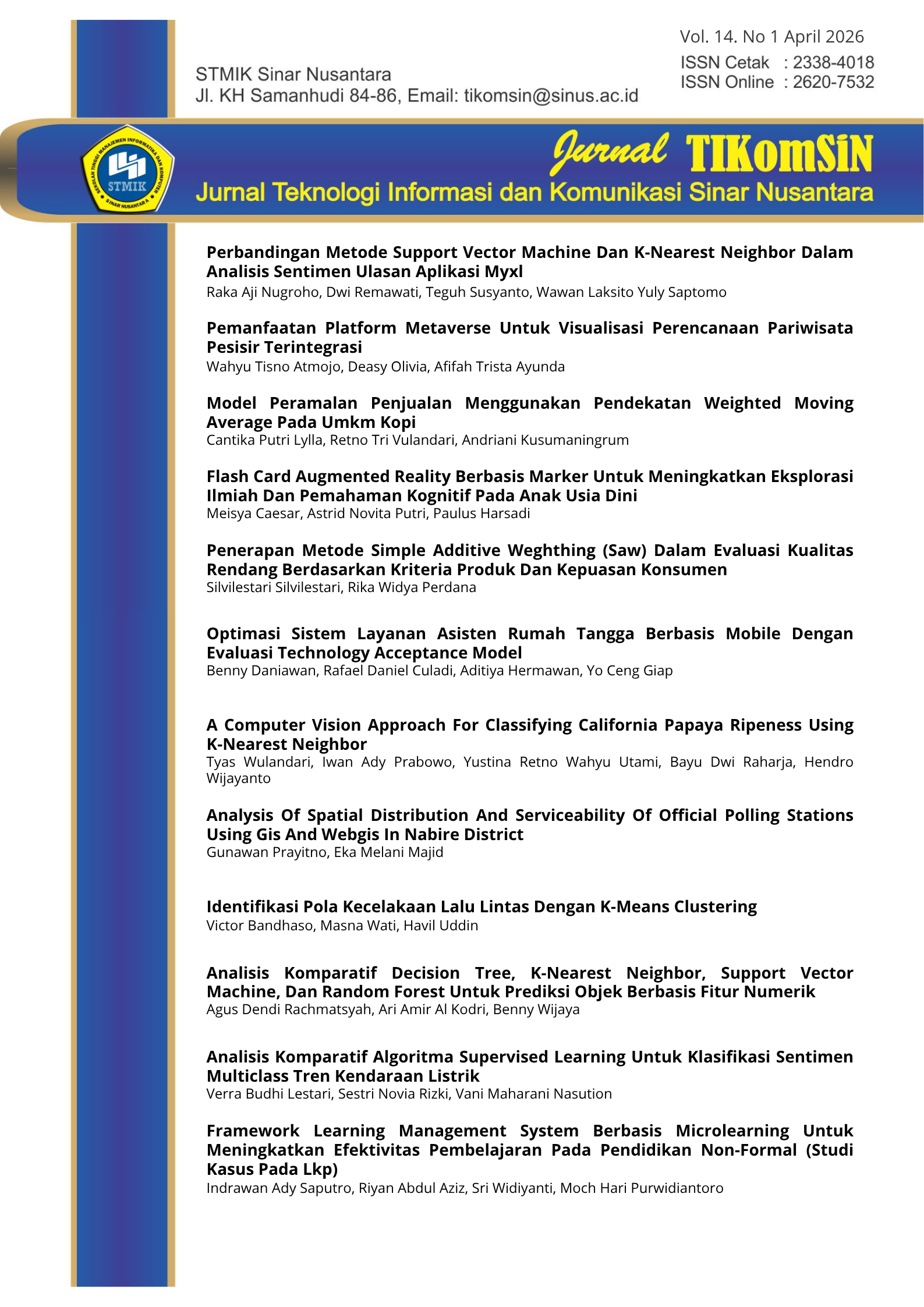
ANALISIS KOMPARATIF ALGORITMA SUPERVISED LEARNING UNTUK KLASIFIKASI SENTIMEN MULTICLASS TREN KENDARAAN LISTRIK
DOI:
https://doi.org/10.30646/tikomsin.v14i1.1100Keywords:
Sentiment Analysis, Naive Bayes, Support Vector Machine, Logistic Regression, Electric VehicleAbstract
This research is motivated by the high complexity of public opinion regarding electric vehicle (EV) trends, which can no longer be adequately represented through binary classification; however, a gap remains in the literature regarding the most efficient multiclass classification models within this domain. The study aims to conduct a comparative analysis of Support Vector Machine (SVM), Logistic Regression (LR), Multinomial Naive Bayes (MNB), and K-Nearest Neighbor (KNN) to determine the best model based on accuracy, precision, recall, and computational efficiency. Data consisting of 1,517 textual public opinions from social media were processed through stages including data cleaning, tokenization, stopword removal, and TF-IDF feature extraction. The results indicate that SVM achieved the best performance with an accuracy of 0.781 and an F1-score of 0.595, reflecting model stability and a good balance between precision and recall. Logistic Regression demonstrated superior precision (0.843) but lower recall, while MNB showed good computational efficiency despite moderate performance. Conversely, KNN yielded the lowest performance due to limitations in handling high-dimensional and sparse data. Further analysis reveals that all models struggled with the neutral class, indicating data imbalance and class similarity. This study contributes to the limited literature on multiclass sentiment evaluation in the EV domain and provides strategic insights into the trade-offs between model complexity, efficiency, and performance. These findings serve as a foundation for developing effective sentiment analysis systems to support decision-making related to electric vehicle trends.
References
A. J. Paramitha and S. Kristiyanto, "EV Adoption in Surabaya: Social, Economic, Environmental Impact," Jurnal Samudra Ekonomika, vol. 9, no. 2, pp. 1-15, Sep. 2025, doi: 10.33059/jse.v9i2.11514.
M. L. Souma, I. P. Hakim, R. N. Rizki, N. L. Fitriani, and Mushawir, "Dampak Electric Vehicle Terhadap Lingkungan dan Ekonomi Berkelanjutan," Journal of Economics, Business and Entrepreneurship (JEBER), vol. 2, no. 4, pp. 12-18, Agt. 2025, doi: 10.69714/03cm9274.
R. Hidayat, Imran, and R. Ramadhan, "Peran Media Sosial dalam Mengkonstruksi Opini Publik Terkait Kebijakan Pemerintah: Studi Kasus Wacana Publik Tahun 2025," CORE: Journal of Communication Research, vol. 3, no. 2, pp. 62-75, Jul. 2025, doi: 10.47650/core.v3i2.2223.
H. M. U. Ali, Q. Farooq, A. Imran, et al., "A systematic literature review on sentiment analysis techniques, challenges, and future trends," Knowl Inf Syst, vol. 67, pp. 3967–4034, 2025, doi: 10.1007/s10115-025-02365-x.
Y. A. Firdaus, M. N. Annabil, E. P. P. A. Wibawa, and M. Y. T. Sulistyono, "Perbandingan Algoritma Naive Bayes dan Decision Tree pada Analisis Sentimen Media Sosial Terhadap Kendaraan Listrik Indonesia Menggunakan Metode TF-IDF," Jurnal MNEMONIC, vol. 8, no. 2, pp. 88-94, Sep. 2025, doi: 10.36040/mnemonic.v8i2.14873.
Sehabudin, A. I. Purnamasari, A. Bahtiar, and E. Wahyudin, "Peningkatan Model Klasifikasi Sentimen Publik di Youtube CNBC Indonesia Terhadap Mobil Listrik Menggunakan Algoritma Support Vektor Machine," JATI (Jurnal Mahasiswa Teknik Informatika), vol. 9, no. 4, pp. 2680-2687, Agt. 2025, doi: 10.36040/jati.v9i4.14184.
V. B. Lestari, E. Utami, and Hanafi, "Combining Bi-LSTM And Word2vec Embedding for Sentiment Analysis Models of Application User Reviews," Indonesian Journal of Computer Science (IJCS), vol. 13, no. 1, pp. 311-325, Feb. 2024, doi: 10.33022/ijcs.v13i1.3647.
V. B. Lestari and C. A. Hutagalung, "Evaluation of TF-IDF Extraction Techniques in Sentiment Analysis of Indonesian-Language Marketplaces Using SVM, Logistic Regression, and Naive Bayes," J-KOMA (Journal of Computer Science and Applications), vol. 8, no. 1, pp. 36-44, Jun. 2025, doi: 10.21009/j-koma.v8i1.05.
F. Farasalsabila, V. B. Lestari, D. D. N. Cahyo, Hanafi, T. Lestari, F. R. A. Islami, and M. A. Maulana, "Sentiment Analysis for IMDb Movie Review Using Support Vector Machine (SVM) Method," Inform: Jurnal Ilmiah Bidang Teknologi Informasi dan Komunikasi, vol. 8, no. 2, pp. 60-66, Jul. 2023, doi: 10.25139/inform.v8i2.5700.
E. S. Shindy, “Evaluasi Kinerja Machine Learning dalam Memprediksi Kemampuan Adaptasi Mahasiswa pada Lingkungan Pembelajaran Daring,†Eval. Kinerja Mach. Learn. dalam Memprediksi Kemamp. Adapt. Mhs. pada Lingkung. Pembelajaran Daring, vol. 5, no. 1, pp. 50–57, 2025, doi: 10.55382/jurnalpustakaai.v5i1.901.
I. Akbar, F. Supriadi, and D. Indra Junaedi, “Pemanfaatan Machine Learning Di Bidang Kesehatan,†JATI (Jurnal Mhs. Tek. Inform., vol. 9, no. 1, pp. 1744–1749, 2025, doi: 10.36040/jati.v9i1.12663.
M. Ichsan, “Machine Learning Deteksi Penyakit Pada Kucing Menggunakan RANDOM FOREST,†vol. 13, no. 3, 2000, doi: 10.23960/jitet.v13i3S1.8164.
I. K. N. Ananda, N. P. N. P. Dewi, N. W. Marti, and L. J. E. Dewi, "Klasifikasi Multilabel Pada Gaya Belajar Siswa Sekolah Dasar Menggunakan Algoritma Machine Learning," Journal of Applied Computer Science and Technology, vol. 5, no. 2, pp. 144–154, 2024, doi: 10.52158/jacost.v5i2.940.
R. G. Wardhana, G. Wang, and F. Sibuea, "Penerapan Machine Learning dalam Prediksi Tingkat Kasus Penyakit di Indonesia," Journal of Information System Management (JOISM), vol. 5, no. 1, pp. 40-45, 2023, doi: 10.24076/joism.2023v5i1.1136.
M. Mirafuddin, “Penerapan Machine Learning pada Aplikasi Kesehatan HEALTIME,†vol. 7, no. 6, pp. 1601–1606, 2024, doi.org/10.32672/jnkti.v7i6.8233
Y. D. Amritha, N. Luh, P. Ika, and W. P. Dananjaya, “Model Machine Learning yang Dioptimalkan untuk Prediksi Penyakit Jantung Menggunakan R Shiny,†vol. 8, no. 01, pp. 1–10, 2026, doi: 10.1109/ICCPCT.2014.7054837
H. Utami, “Analisis Sentimen dari Aplikasi Shopee Indonesia Menggunakan Metode Recurrent Neural Network,†Indones. J. Appl. Stat., vol. 5, no. 1, p. 31, 2022, doi: 10.13057/ijas.v5i1.56825.
D. Mustikasari, I. Widaningrum, R. Arifin, and W. H. E. Putri, “Comparison of Effectiveness of Stemming Algorithms in Indonesian Documents,†Proc. 2nd Borobudur Int. Symp. Sci. Technol. (BIS-STE 2020), vol. 203, pp. 154–158, 2021, doi: 10.2991/aer.k.210810.025.
H. Zhao, Z. Liu, X. Yao, and Q. Yang, “A machine learning-based sentiment analysis of online product reviews with a novel term weighting and feature selection approach,†Inf. Process. Manag., vol. 58, no. 5, p. 102656, 2021, doi: 10.1016/j.ipm.2021.102656.
A. Iqbal, R. Amin, J. Iqbal, R. Alroobaea, A. Binmahfoudh, and M. Hussain, “Sentiment Analysis of Consumer Reviews Using Deep Learning,†Sustain., vol. 14, no. 17, 2022, doi: 10.3390/su141710844.
C. Colón-Ruiz and I. Segura-Bedmar, “Comparing deep learning architectures for sentiment analysis on drug reviews,†J. Biomed. Inform., vol. 110, no. February, p. 103539, 2020, doi: 10.1016/j.jbi.2020.103539.
R. A. Nugroho, D. Remawati, T. Susyanto, W. Laksito, and Y. Saptomo, “Perbandingan Metode Support Vector Machine dan K-Nearest Neighbors dalam Analisis Sentimen Ulasan Aplikasi MyXL,†vol. 14, no. 1, 2026, doi: 10.30646/tikomsin.v14i1.1062.
W. Hidayat, M. Ardiansyah, and A. Setyanto, “Pengaruh Algoritma ADASYN dan SMOTE terhadap Performa Support Vector Machine pada Ketidakseimbangan Dataset Airbnb,†Edumatic J. Pendidik. Inform., vol. 5, no. 1, pp. 11–20, 2021, doi: 10.29408/edumatic.v5i1.3125.
F. I. R. Firamadhina and H. Krisnani, “PERILAKU GENERASI Z TERHADAP PENGGUNAAN MEDIA SOSIAL TIKTOK: TikTok Sebagai Media Edukasi dan Aktivisme,†Share Soc. Work J., vol. 10, no. 2, p. 199, 2021, doi: 10.24198/share.v10i2.31443.
W. T. Atmojo, E. Keisya, and A. T. Ayunda, "Implementasi Algoritma Naïve Bayes dalam Analisis Sentimen terhadap Trend TikTok," Jurnal TIKomSiN, vol. 13, no. 2, pp. 25-34, Okt. 2025, doi: 10.30646/tikomsin.v13i2.1015.
D. Remawati, H. Wijayanto, Y. R. W. Utami, and B. D. Raharja, "Pengelompokkan Film Trending di Youtube Menggunakan TF-IDF dan K-Means Clustering," Jurnal Sistem Informasi TGD, vol. 4, no. 1, pp. 65-74, Jan. 2025, doi: 10.53513/jursi.v4i1.10614.
D. Remawati, E. Noersasongko, Pujiono, and A. Marjuni, "Mental Health Detection with TF-IDF Feature Extraction," dalam 2024 IEEE International Conference on Artificial Intelligence and Mechatronics Systems (AIMS), Surakarta, Indonesia, 2024, hlm. 1-6, doi: 10.1109/AIMS61812.2024.10512480.
Downloads
Additional Files
Published
How to Cite
Issue
Section
Citation Check
License
Authors who publish with this journal agree to the following terms:
- Authors retain copyright and grant the journal right of first publication with the work simultaneously licensed under a Creative Commons Attribution License that allows others to share the work with an acknowledgement of the work's authorship and initial publication in this journal.
- Authors are able to enter into separate, additional contractual arrangements for the non-exclusive distribution of the journal's published version of the work (e.g., post it to an institutional repository or publish it in a book), with an acknowledgement of its initial publication in this journal.
- Authors are permitted and encouraged to post their work online (e.g., in institutional repositories or on their website) prior to and during the submission process, as it can lead to productive exchanges, as well as earlier and greater citation of published work (See The Effect of Open Access).
Â

This work is licensed under a Creative Commons Attribution-NonCommercial-ShareAlike 4.0 International License.