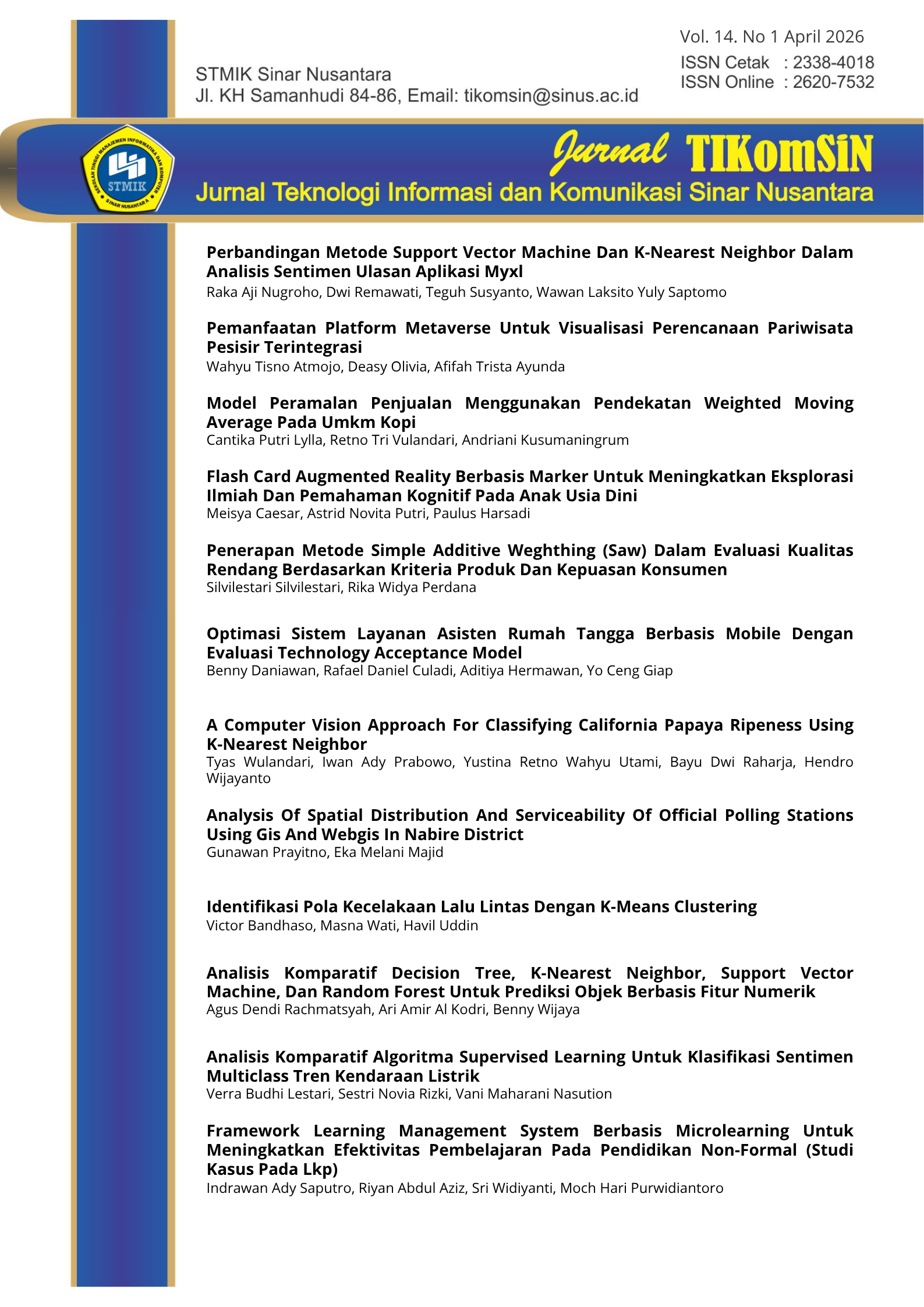
FRAMEWORK LEARNING MANAGEMENT SYSTEM BERBASIS MICROLEARNING UNTUK MENINGKATKAN EFEKTIVITAS PEMBELAJARAN PADA PENDIDIKAN NON-FORMAL (STUDI KASUS PADA LKP)
DOI:
https://doi.org/10.30646/tikomsin.v14i1.1101Keywords:
Microlearning, Learning Management System, Sequential Mastery, Usability, Efektivitas PembelajaranAbstract
The rapid development of digital learning technologies requires innovative systems that can improve learning effectiveness, particularly in non-formal education institutions such as Training and Course Centers (LKP). However, existing learning systems often lack structured mechanisms to ensure gradual, measurable mastery of competencies. Therefore, a microlearning-based Learning Management System (LMS) integrated with a sequential mastery approach is proposed. This study aims to design and implement a microlearning-based LMS to enhance learning effectiveness in non-formal education settings. The system supports step-by-step delivery of learning to ensure progressive achievement of competency. The research methodology includes requirements analysis, system design using the Unified Modeling Language (UML), web-based implementation, and system evaluation using Black-Box Testing, the System Usability Scale (SUS), and pre- and post-test assessments. The results show that all system functions operate as intended. The usability evaluation obtained a SUS score of 78.33, categorized as Good and Acceptable. Learning effectiveness increased significantly, with an average score improvement of 25.67 points (45.03%) and an N-Gain value of 0.60 (moderate category), while achieving a 100% completion rate. In conclusion, the developed LMS is feasible and effective in improving learners’ competencies in non-formal education environments and offers a practical solution for digital learning transformation in LKP.
References
J. Mella-Norambuena and others, “Theoretical and empirical models of LMS in higher education: A systematic review,†J. Comput. Educ., 2024, doi: 10.1007/s40692-024-00336-9.
G. Akpen and others, “Impact of online learning on students’ performance and engagement: a systematic review,†Discov. Educ., 2024, doi: 10.1007/s44217-024-00253-0.
A. Jainuri, Kamid, Syaiful, and N. Huda, “Microlearning Effectiveness in Higher Education: A Systematic Review and Meta-Analysis of Student Retention and Learning Outcomes,†J. Mathema, vol. 7, no. 2, pp. 630–642, 2025, doi: 10.33365/jm.v7i2.517.
W. K. Monib, A. Qazi, and R. A. Apong, “Microlearning beyond boundaries: A systematic review and a novel framework for improving learning outcomes,†Heliyon, vol. 11, no. 1, 2025, doi: 10.1016/j.heliyon.2024.e41413.
M. F. Aliasa and N. A. Razak, “Revolutionizing learning in the digital age: A systematic literature review of microlearning strategies,†Interact. Learn. Environ., 2024, doi: 10.1080/10494820.2024.2331638.
D. Al-Fraihat, M. Joy, R. Masa’deh, and J. Sinclair, “Evaluating E-learning systems success: An empirical study,†Comput. Human Behav., vol. 102, pp. 67–86, 2020, doi: https://doi.org/10.1016/j.chb.2019.08.004.
R. A. Aziz, M. H. Purwidiantoro, and S. Widiyanti, “Pemodelan Aplikasi Learning Management System (LMS) bagi Lembaga Kursus dan Pelatihan (LKP),†vol. 09, no. 02, pp. 1–6, 2024, doi: https://doi.org/10.30869/jtii.v9i2.1392.
S. Santoso, I.; Iskandar, I.; Setiadi; and B. Inggris, “Microlearning,†2025.
E. Clark, R. C.; Mayer, R, “e-Learning: Promise and Pitfalls,†in eâ€Learning and the Science of Instruction, John Wiley & Sons, Ltd, 2016, pp. 7–28. doi: https://doi.org/10.1002/9781119239086.ch1.
J. Sweller, “Chapter Two - Cognitive Load Theory,†vol. 55, J. P. Mestre and B. H. Ross, Eds. Academic Press, 2011, pp. 37–76. doi: https://doi.org/10.1016/B978-0-12-387691-1.00002-8.
M. S. Shail, “Using Micro-learning on Mobile Applications to Increase Knowledge Retention and Work Performance : A Review of Literature,†vol. 11, no. 8, 2019, doi: 10.7759/cureus. 5307.
J. C. De Gagne, H. K. Park, A. Woodward, S. Yamane, and S. S. Kim, “Microlearning in Health Professions Education : Scoping Review Corresponding Author :,†vol. 5, pp. 1–10, 2019, doi: 10.2196/13997.
D. Darwin, I. W. Safitri, S. H. Fitri Arianti Saputri, dan S. K. Eric Krisna Sandi, Efektivitas Micro Learning dalam Meningkatkan Pemahaman Siswa di Era Digital. PT. Nawala Gama Education, 2025.
R. A. Aziz, S. Widiyanti, and M. H. Purwidiantoro, “Perancangan Desain Antarmuka Aplikasi Learning Management System (LMS) Lembaga Kursus dan Pelatihan (LKP),†vol. 14, no. 1, pp. 25–33, 2025, doi: https://doi.org/10.55600/jipa.v14i1.321.
A. Muhson, “Pengembangan Media Pembelajaran Berbasis Teknologi Informasi,†J. Pendidik. Akunt. Indones., vol. 8, no. 2, 2010, doi: 10.21831/jpai.v8i2.949.
Y. C. Windrianto and E. Suryani, “Perancangan User Interface pada Website untuk Digitalisasi Proses Bisnis Layanan Manajemen Pendidikan di Sekolah Menengah Menggunakan Design Thinking,†vol. 4, no. 3, pp. 1952–1973, 2025.
A. Suhaimah, A. Triayudi, and E. T. Esthi Handayani, “Cyber Library: Pengembangan Perpustakaan Online Berbasis Web Menggunakan Metode Prototyping (Studi Kasus Universitas Nasional),†J. JTIK (Jurnal Teknol. Inf. dan Komunikasi), vol. 5, no. 1, pp. 41–48, 2021, doi: 10.35870/jtik.v5i1.199.
W. Lamine, J. H. Sarker, N. Ghanmi, and S. Biglari, “AI-Powered Machine Learning Regulated Emotions in Entrepreneurial Pitching on Investors’ Funding Decision,†Colloq. Inf. Sci. Technol., pp. 193–198, 2023, doi: 10.1109/CIST56084.2023.10409972.
C. A. Prawastiyo and I. Hermawan, “Pengembangan Front-End Website Perpustakaan Politeknik Negeri Jakarta dengan menggunakan Metode User Centered Design,†J. Teknol. Terpadu, vol. 6, no. 2, pp. 89–95, 2020, doi: 10.54914/jtt.v6i2.280.
D. A. Rusanty, H. Tolle, and L. Fanani, “Perancangan User Experience Aplikasi Mobile Lelenesia (Marketplace Penjualan Lele) Menggunakan Metode Design Thinking,†J. Pengemb. Teknol. Inf. dan Ilmu Komput., vol. 3, no. 11, pp. 10484–10493, 2019.
Downloads
Additional Files
Published
How to Cite
Issue
Section
Citation Check
License
Authors who publish with this journal agree to the following terms:
- Authors retain copyright and grant the journal right of first publication with the work simultaneously licensed under a Creative Commons Attribution License that allows others to share the work with an acknowledgement of the work's authorship and initial publication in this journal.
- Authors are able to enter into separate, additional contractual arrangements for the non-exclusive distribution of the journal's published version of the work (e.g., post it to an institutional repository or publish it in a book), with an acknowledgement of its initial publication in this journal.
- Authors are permitted and encouraged to post their work online (e.g., in institutional repositories or on their website) prior to and during the submission process, as it can lead to productive exchanges, as well as earlier and greater citation of published work (See The Effect of Open Access).
Â

This work is licensed under a Creative Commons Attribution-NonCommercial-ShareAlike 4.0 International License.