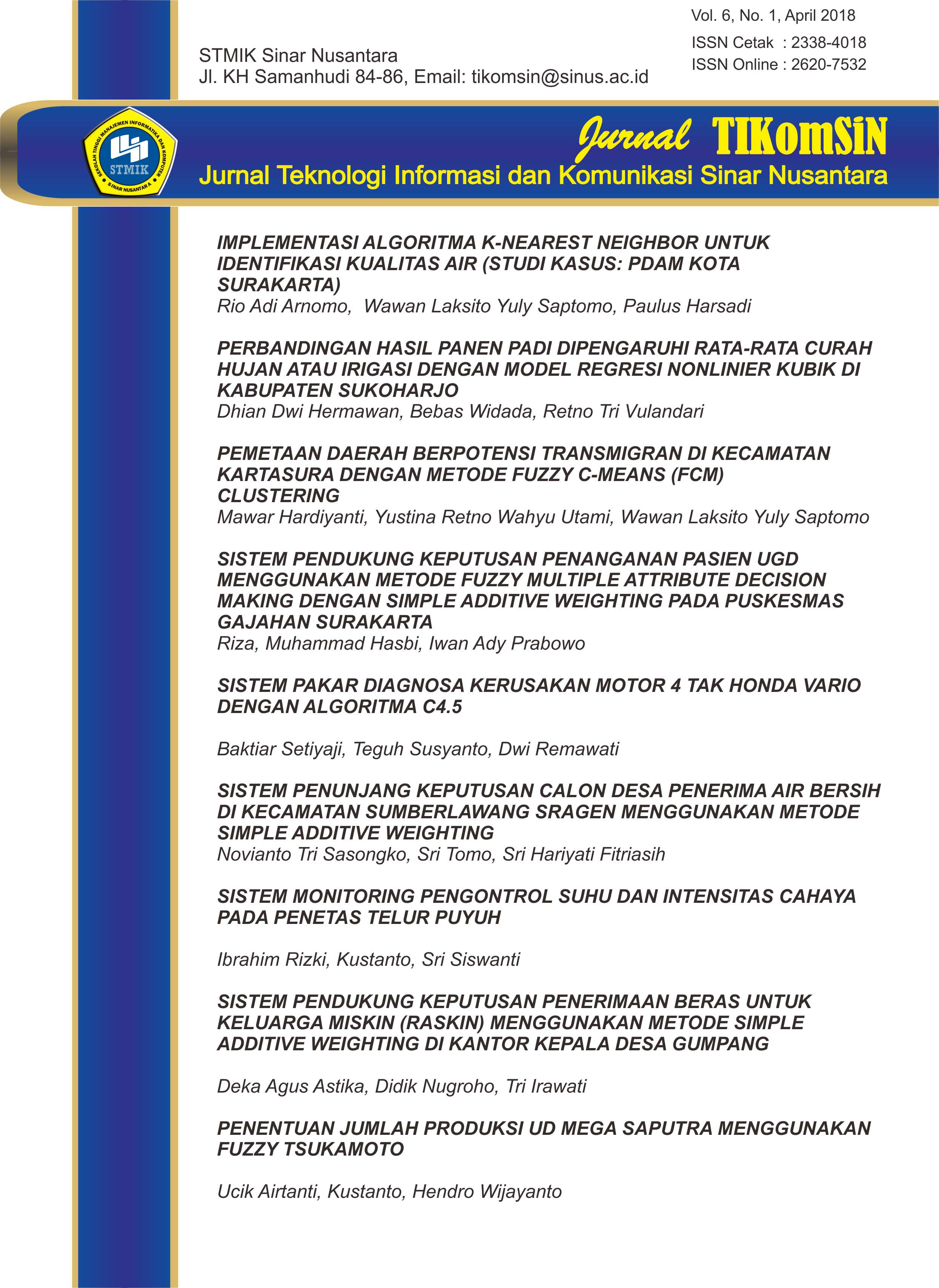
SISTEM PENUNJANG KEPUTUSAN CALON DESA PENERIMA AIR BERSIH DI KECAMATAN SUMBERLAWANG SRAGEN MENGGUNAKAN METODE SIMPLE ADDITIVE WEIGHTING
DOI:
https://doi.org/10.30646/tikomsin.v6i1.346Abstract
The purpose of this study is to make a decision support system that makes it easier for Sumberlawang District in terms of determining candidate villages receiving clean water in the area. So that the determination of distribution becomes faster and precise. The system built by the author uses a decision support method that is Simple Additive Weighting (SAW). In performing attribute selection, the author uses 4 criteria in determining the selection of water recipient village candidates. The programming language of the author uses the programming language HyperText Preprocessor (PHP). The software that supports in making applications that Macromedia Dreamweaver, Mysql, and Adobe Photoshop. The author in terms of performing performance calculations of the system using Blackbox method by applying the method, then the performance of the application built by the author has a system performance level of 100%. The result of the use of SAW method is the creation of a Decision Supporting System Support System for Water Recipient Village in Sumberlawang Sragen Using Simple Additive Weighting Method which is very helpful to Sumberlawang Sub-District in Determination of Potential of Recipient of Clean Water.
Keywords: Decision Support System, SAW Method, Water Distributor.
References
J. G. Brookhear, Computer Science: an Overview, Jakarta: Erlangga, 2010.
Y.-J. Wang, “A fuzzy multi-criteria decision-making model based on simple additive weighting method and relative preference relation,†Appl. Soft Comput., vol. 30, pp. 412–420, May 2015.
H. Shakouri G., M. Nabaee, and S. Aliakbarisani, “A quantitative discussion on the assessment of power supply technologies: DEA (Data Envelopment Analysis) and SAW (simple additive weighting) as complementary methods for the ‘Grammar,’†Energy, vol. 64, pp. 640–647, Jan. 2014.
J. Tamošaitienė, E. K. Zavadskas, and Z. Turskis, “Multi-criteria Risk Assessment of a Construction Project,†Procedia Comput. Sci., vol. 17, pp. 129–133, Jan. 2013.
M. Jaberidoost et al., “Pharmaceutical supply chain risk assessment in Iran using analytic hierarchy process (AHP) and simple additive weighting (SAW) methods,†J. Pharm. Policy Pract., vol. 8, no. 1, pp. 1–10, Feb. 2015.
I. Kaliszewski and D. Podkopaev, “Simple additive weighting—A metamodel for multiple criteria decision analysis methods,†Expert Syst. Appl., vol. 54, pp. 155–161, Jul. 2016.
Fathansyah, Basis Data. Bandung: Informatika, 2010.
Y.-S. Huang, W.-C. Chang, W.-H. Li, and Z.-L. Lin, “Aggregation of utility-based individual preferences for group decision-making,†Eur. J. Oper. Res., vol. 229, no. 2, pp. 462–469, Sep. 2013.
Z.-P. Fan, X. Zhang, F.-D. Chen, and Y. Liu, “Multiple attribute decision making considering aspiration-levels: A method based on prospect theory,†Comput. Ind. Eng., vol. 65, no. 2, pp. 341–350, Jun. 2013.
S. Kusumadewi, Aplikasi Logika Fuzzy Untuk Pendukung Keputusan. Yogyakarta: Graha Ilmu, 2010.
Downloads
Published
How to Cite
Issue
Section
Citation Check
License
Authors who publish with this journal agree to the following terms:
- Authors retain copyright and grant the journal right of first publication with the work simultaneously licensed under a Creative Commons Attribution License that allows others to share the work with an acknowledgement of the work's authorship and initial publication in this journal.
- Authors are able to enter into separate, additional contractual arrangements for the non-exclusive distribution of the journal's published version of the work (e.g., post it to an institutional repository or publish it in a book), with an acknowledgement of its initial publication in this journal.
- Authors are permitted and encouraged to post their work online (e.g., in institutional repositories or on their website) prior to and during the submission process, as it can lead to productive exchanges, as well as earlier and greater citation of published work (See The Effect of Open Access).
Â

This work is licensed under a Creative Commons Attribution-NonCommercial-ShareAlike 4.0 International License.