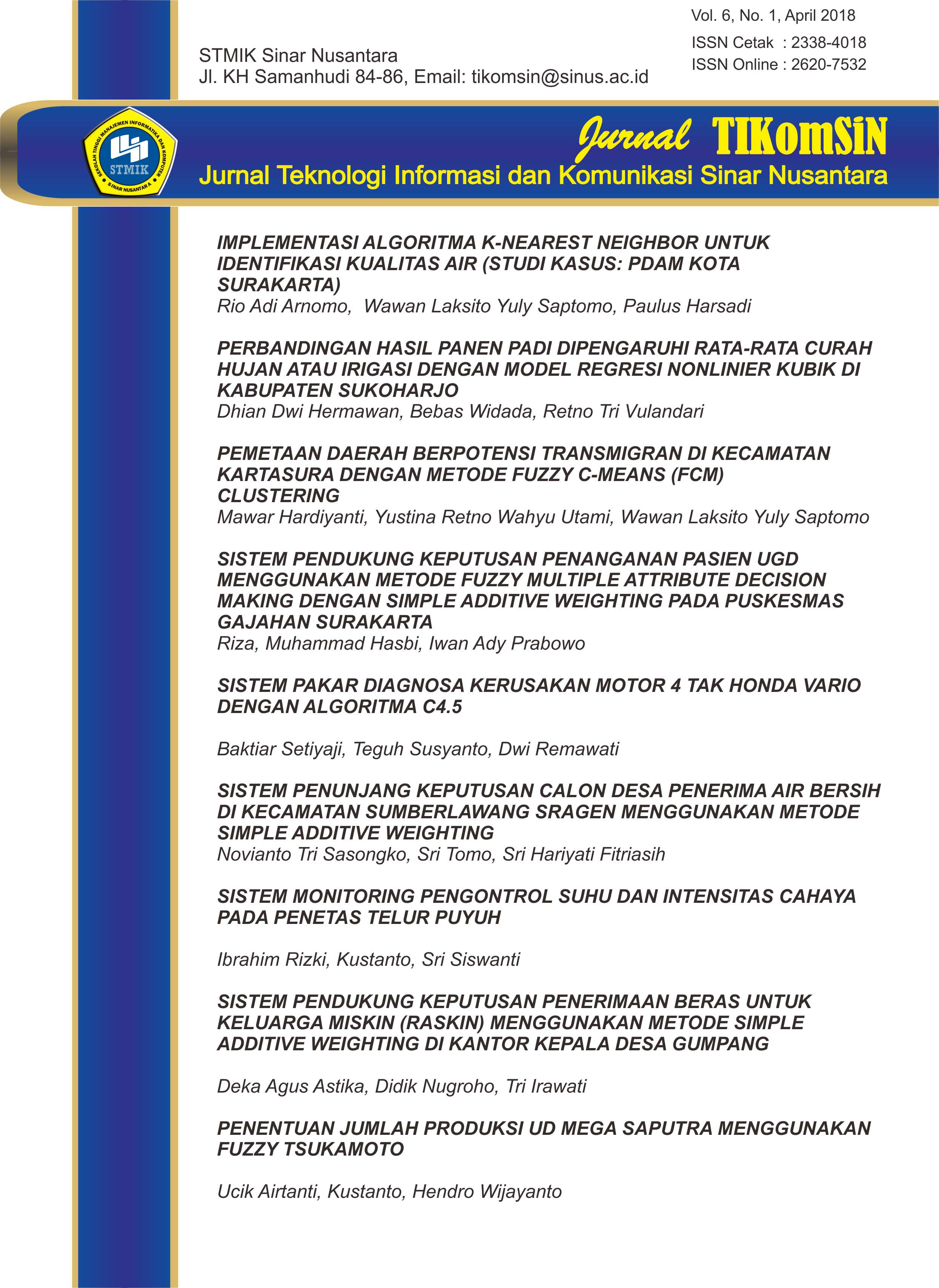
SISTEM PENDUKUNG KEPUTUSAN PENANGANAN PASIEN UGD MENGGUNAKAN METODE FUZZY MULTIPLE ATTRIBUTE DECISION MAKING DENGAN SIMPLE ADDITIVE WEIGHTING PADA PUSKESMAS GAJAHAN SURAKARTA
DOI:
https://doi.org/10.30646/tikomsin.v6i1.348Abstract
In the Public Health Center, the handling of patients of the Emergency Unit is classified as not much happening because now many hospitals are ready to handle all forms of patient complaints. At the Public Health Center, the handling of patients in the Emergency Unit occurs only for mild illness and with outpatient treatment. To decide the condition of the patient should be treated in the room or should be referred to what hospital, the Center for Public Health has not been able to determine it so that for regular referrals addressed directly to a fully equipped hospital. The number of hospital types and the poor condition of the patient makes the decision making must be clear and appropriate to the actual patient condition. To overcome these problems, the authors make an application decision system with FMADM SAW method to determine where the patient should be handled further, surgery, ICU, road or hospitalization, a referral must be in accordance with the condition of the patient. The method used in the form of data analysis methods in the form of data collection techniques, data types, and system design. This application also has advantages in making report analysis results that can be done quickly and easily. To facilitate the implementation of the system, the authors limit the problem only on the problem of determining the purpose of treatment alone. The system that the author designed the decision-making system with FMADM SAW method. The result of analysis and design in the form of decision support system of patient handling of new Emergency Unit with computer-based and application of FMADM SAW method. The tested system will produce patient data information and result of decision support process of patient handling. From another process is given a form of separate data collection process according to the needs of the process of supporting patient handling decisions and considered feasible if the process is stored completely. It is hoped that this system can assist the Public Health Center admin in dealing with Emergency Room patients.
Keywords: Decision Support System, Emergency Room, FMADM (SAW), Public Health CenterReferences
Sutrisno, Keperawatan Kegawat Daruratan, Jakarta: Media Aesculapins, 2013.
A. Farich, Manajemen Pelayanan Kesehatan Masyarakat, Yogyakarta: Gosyen Publishing , 2012.
J. A. Boswick, Perawatan Gawat Darurat, Jakarta: EGC, 2013.
Hatmoko, Manajemen Kesehatan, Samarinda: Universitas Mulawarman, 2010.
Pedoman Pelayanan Gawat Darurat, Jakarta: DepKes Ri, 1992.
I. A. Prabowo, "Sistem Informasi Penerimaan Peserta Didik Baru SMA Negeri 1 Ngemplak Kabupaten Boyolali," Jurnal Ilmiah SINUS Vol 13, No 2, pp. 65-82, 2015.
S. Kusumadewi, S. Hartati, A. Harjoko and R. , Fuzzy Multi-Attribute Decision Making (Fuzzy MADM), Yogyakarta: Graha Ilmu, 2006.
N. Hermanto, "Sistem Pendukung Keputusan Menggunakan Metode Simple Additive Weighting (SAW) Untuk Menentukan Jurusan Pada SMK Bakti Purwokerto," Semantik 2012, pp. 52-62, 2012.
Downloads
Published
How to Cite
Issue
Section
Citation Check
License
Authors who publish with this journal agree to the following terms:
- Authors retain copyright and grant the journal right of first publication with the work simultaneously licensed under a Creative Commons Attribution License that allows others to share the work with an acknowledgement of the work's authorship and initial publication in this journal.
- Authors are able to enter into separate, additional contractual arrangements for the non-exclusive distribution of the journal's published version of the work (e.g., post it to an institutional repository or publish it in a book), with an acknowledgement of its initial publication in this journal.
- Authors are permitted and encouraged to post their work online (e.g., in institutional repositories or on their website) prior to and during the submission process, as it can lead to productive exchanges, as well as earlier and greater citation of published work (See The Effect of Open Access).
Â

This work is licensed under a Creative Commons Attribution-NonCommercial-ShareAlike 4.0 International License.