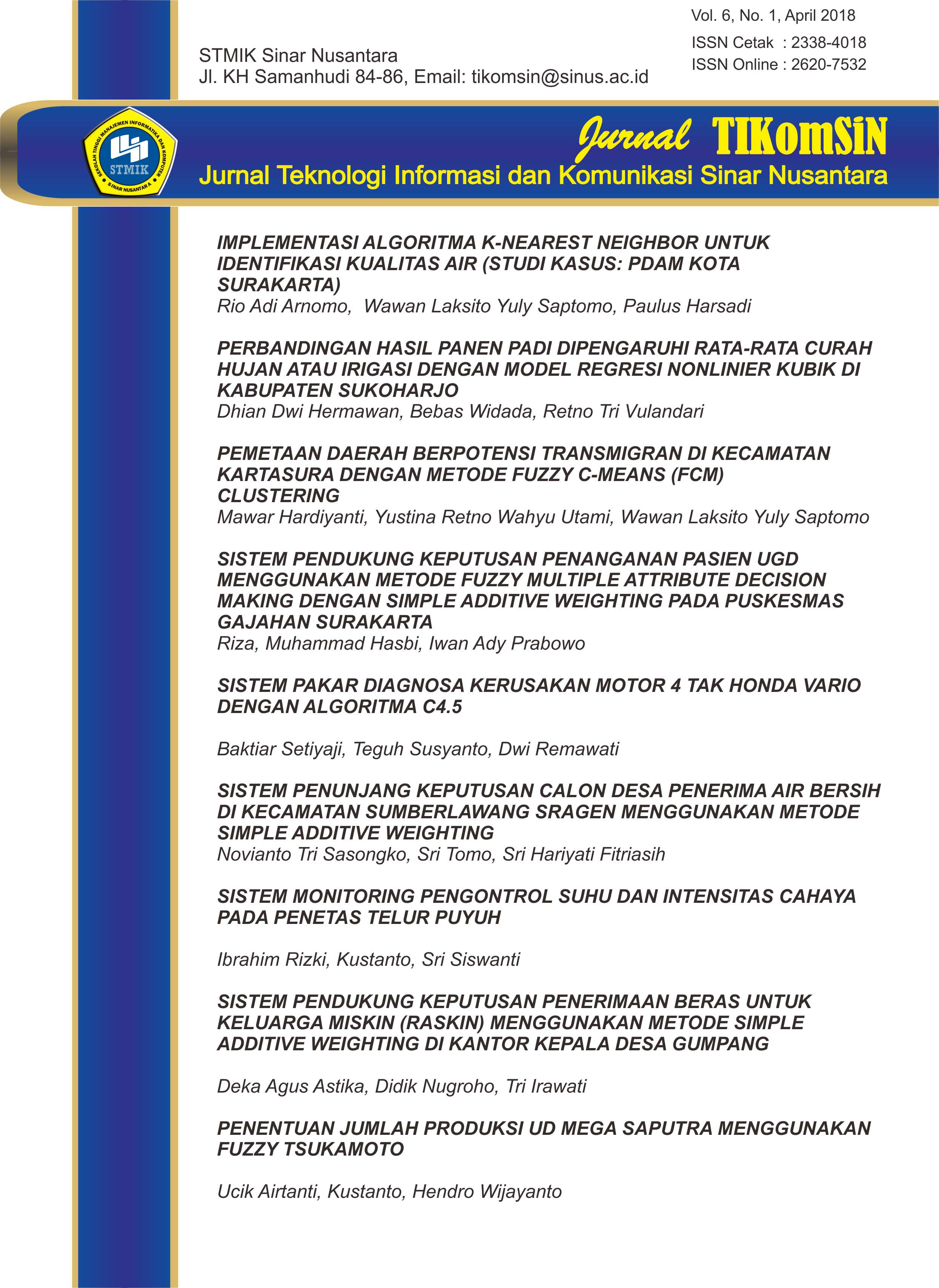
PENENTUAN JUMLAH PRODUKSI UD MEGA SAPUTRA MENGGUNAKAN FUZZY TSUKAMOTO
DOI:
https://doi.org/10.30646/tikomsin.v6i1.350Abstract
The breaking of bread production at UD Mega Saputra always rely on estimation only. Where with the many deficiencies found that resulted in losses for the company. Based on the inventory data and the number of requests, then designed a system of determining the amount of production using Tsukamoto method. In this system of production determination, there are three variables that are modeled, namely: demand, supply, and production. Steps to make Determination of Production Amount UD Mega Saputra Using Fuzzy Tsukamoto include designing the concept, collecting data, preparation of hardware and software, making modeling diagram, making application, testing, repairing, and completion. One example calculation using Tsukamoto method with type of mocca bread produce70 bread, banana bread produce as many as 244Â and donat produce an amount of 291 of bread per week.
Keywords: fuzzy Tsukamoto, production amount, bread production, fuzzy
References
F. A. Minarni, “Prediksi Jumlah Produksi Roti Menggunakan Metode Logika Fuzzy (Studi Kasus : Roti Malabar Bakery),†TeknoIf, vol. 4, 2016.
A. H. Ali Mulyanto, “Penerapan Metode Fuzzy Tsukamoto Untuk Menentukan Jumlah Jam Overtime Pada Produksi Barang di PT Asahi Best Base Indonesia (ABBI) Bekasi,†J. Inform. SIMANTIK, vol. 1, 2016.
S. Maryaningsih, “Metode Logika Fuzzy Tsukamoto Dalam Sistem Pengambilan Keputusan Penerimaan Beasiswa,†J. Media Infotama, vol. 9, 2013.
Mustika, “Fuzzy Inference System Tsukamoto untuk pemilihan hotel bagi pendukung Asean Games 2018 di Palembang,†Semin. Nas. Teknol. Informasi, Bisnis, dan Desain, 2016.
H. A. Adani Dharmawati, “Penerapan Metode Fuzzy Tsukamoto Untuk Prediksi Nilai Tukar Rupiah,†JUTISI, vol. 3, 2014.
A. Juliansyah, “Penerapan metode Fuzzy Tsukamoto untuk memprediksi hasil kepala sawit (Studi Kasus di PT. Amal Tani Perkembunan Tanjung Putri– BAHOROK),†Pelita Inform. Budi Darma, vol. IX, 2015.
Downloads
Published
How to Cite
Issue
Section
Citation Check
License
Authors who publish with this journal agree to the following terms:
- Authors retain copyright and grant the journal right of first publication with the work simultaneously licensed under a Creative Commons Attribution License that allows others to share the work with an acknowledgement of the work's authorship and initial publication in this journal.
- Authors are able to enter into separate, additional contractual arrangements for the non-exclusive distribution of the journal's published version of the work (e.g., post it to an institutional repository or publish it in a book), with an acknowledgement of its initial publication in this journal.
- Authors are permitted and encouraged to post their work online (e.g., in institutional repositories or on their website) prior to and during the submission process, as it can lead to productive exchanges, as well as earlier and greater citation of published work (See The Effect of Open Access).
Â

This work is licensed under a Creative Commons Attribution-NonCommercial-ShareAlike 4.0 International License.