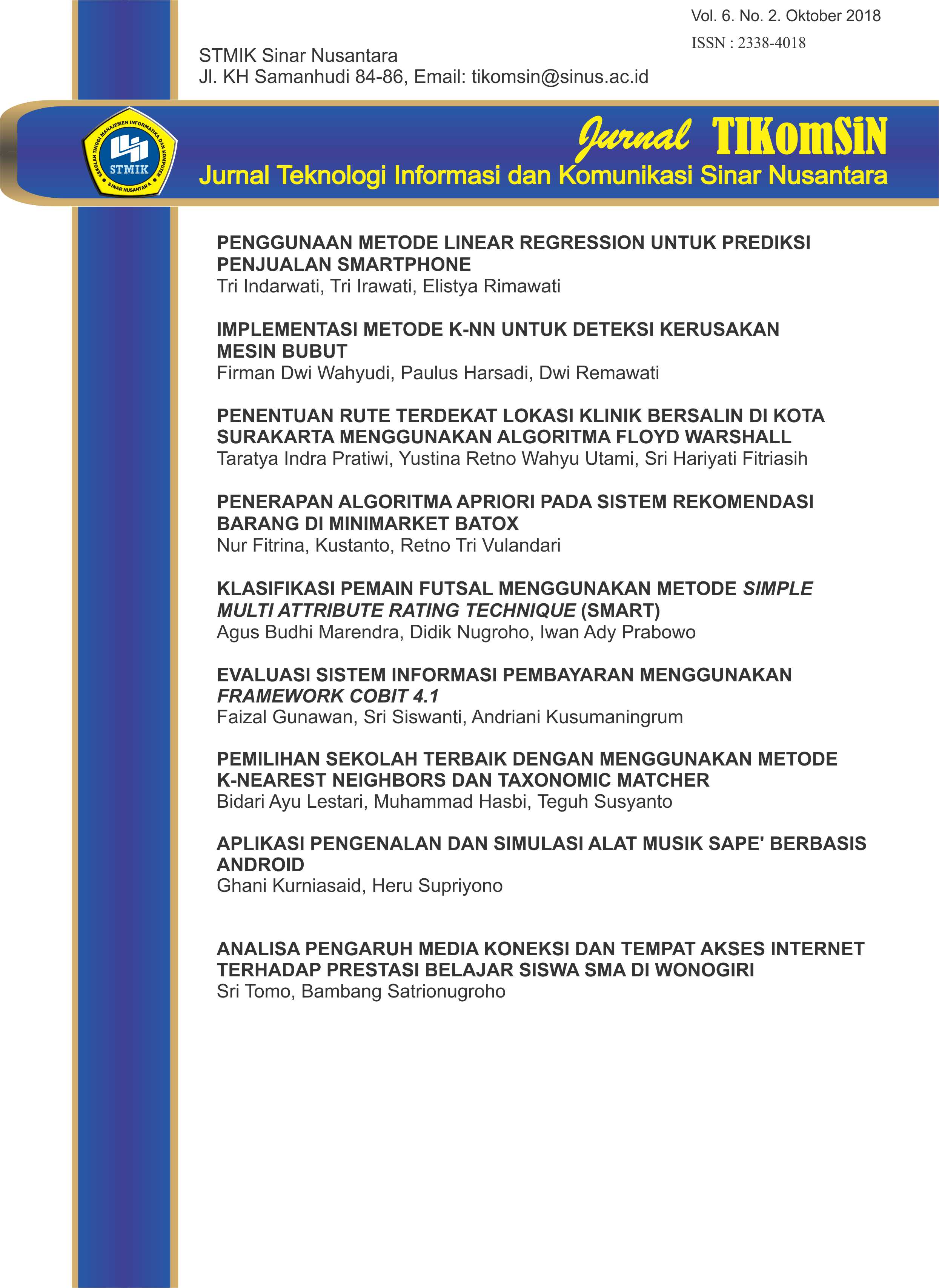
PENGGUNAAN METODE LINEAR REGRESSION UNTUK PREDIKSI PENJUALAN SMARTPHONE
DOI:
https://doi.org/10.30646/tikomsin.v6i2.369Abstract
Planning and analyzing market needs precisely and efficiently if managed optimally is needed to achieve company success. In practice, existing transaction data used as a reference in planning and analyzing market needs. This company needs a tool to predict future sales. This information is needed because a good sales prediction will help understand what items must be distributed according to market needs so that companies can reduce uncertainty in decision making. The purpose of this study is to create an information system can do smartphone sales forecasting at 82 Cell Mayang with the Linear Regression method. The sales forecasting system is using the Linear Regression method, The goal to create a sales forecasting system by determining the sales volume with a certain period by looking at the cost of advertising and the number of sales. The research method used includes observation, interviews and literature studies. Designing using DAD includes entity relation diagrams, context diagrams, the hierarchy of input process output and data flow diagrams. The programming language used is Visual Basic.Net and the sql server 2008 database. Features in the sales forecasting application include processing data items, customer data, incoming product data, sales data, and forecasting data. The test results show the MAPE value is 0.032 and the MSE value is 5.16. From this value, it can be said that the prediction of smartphone sales with the Linear Regression method on 82 Cell Mayang is categorized as very good. Whereas for the blackbox testing that has been carried out, it shows that the smartphone sales forecasting system in 82 Cell Mayang, Sukoharjo has been going well.
Keywords: forecasting, sales prediction, incoming product data, linear regression, visual basic
References
R. Soemarso, Pengantar Akuntansi. Jakarta: Salemba Empat, 2009.
R. Heizer J, Operations management (Manajemen Operasi). Jakarta: Salemba Empat, 2009.
M. Manivel, “Profit Planning of an NGO run enterprise using linear programming approach International Research Journal of Finance and Economics,†Int. Res. J. Financ. Econ., p. 23, 2009.
Y. Subari, Boom. Visual Studio.Net 2010 meledak. Jakarta: Cerdas Pustaka Publisher, 2010.
B.T. Connoly, A Practical Approach to design, Implementation, and management. Americca: Pearson Education, 2010.
Inti Sariani Jiantra Djie, “Analisis Peramalan Penjualan Dan Penggunaan Metode Linear Programming Dan Decision Tree Guna Mengoptimalkan Keuntungan,†The Winners, pp. 113–119, 2013.
M. F. Safitri, “Analisa Data Penjualan Menggunakan Metode Regresi Linier Untuk Prediksi Persediaan Barang,†Skripsi, Prodi Teknik Informatika, Universitas Dian Nuswantoro, 2016.
Z. Rival, W. S. J. Saputra, and N. K. Sari, “Aplikasi Peramalan Penjualan Menggunakan Metode Regresi Linier,†Scan - J. Teknol. Inf. Dan Komun., vol. 7, no. 3, pp. 41–45, 2012.
Rahmadeni dan D. Anggreni, “Analisis Jumlah Tenaga Kerja Terhadap Jumlah Pasien RSUD Arifin Achmad Pekanbaru menggunakan Metode Regresi Gulud,†SiTekIn, vol. 12, no. 1, pp. 48–57, 2014.
Downloads
Published
How to Cite
Issue
Section
Citation Check
License
Authors who publish with this journal agree to the following terms:
- Authors retain copyright and grant the journal right of first publication with the work simultaneously licensed under a Creative Commons Attribution License that allows others to share the work with an acknowledgement of the work's authorship and initial publication in this journal.
- Authors are able to enter into separate, additional contractual arrangements for the non-exclusive distribution of the journal's published version of the work (e.g., post it to an institutional repository or publish it in a book), with an acknowledgement of its initial publication in this journal.
- Authors are permitted and encouraged to post their work online (e.g., in institutional repositories or on their website) prior to and during the submission process, as it can lead to productive exchanges, as well as earlier and greater citation of published work (See The Effect of Open Access).
Â

This work is licensed under a Creative Commons Attribution-NonCommercial-ShareAlike 4.0 International License.