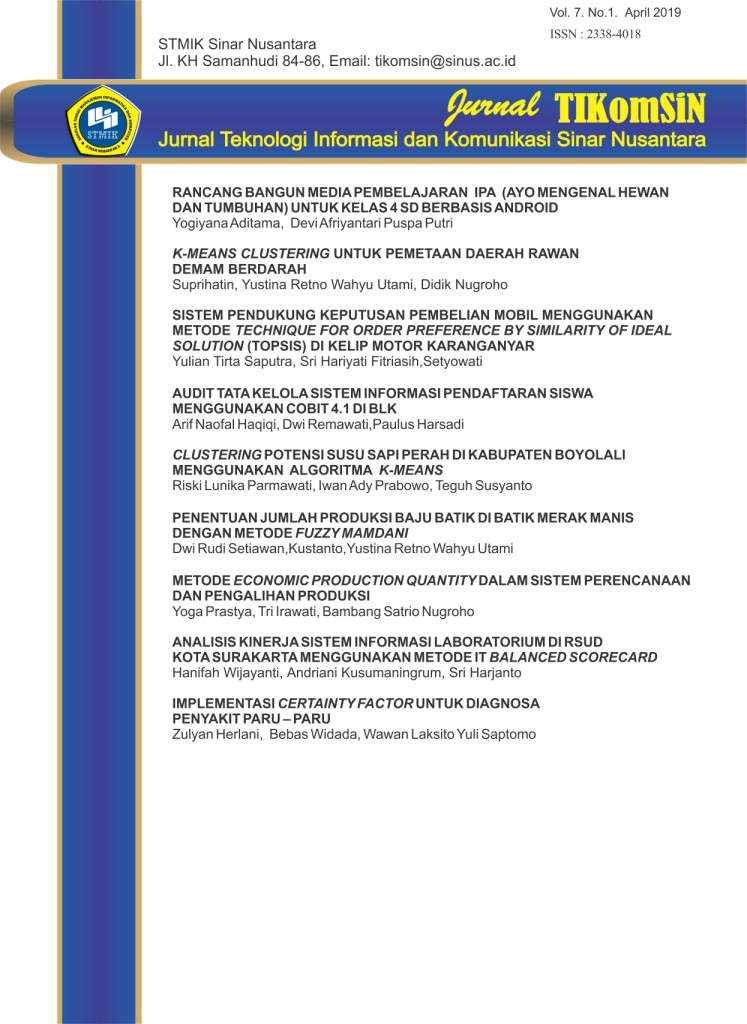
METODE ECONOMIC PRODUCTION QUANTITY DALAM SISTEM PERENCANAAN DAN PENGALIHAN PRODUKSI
DOI:
https://doi.org/10.30646/tikomsin.v7i1.418Abstract
Over Production and developing modes require companies to issue new products before the old product is sold out. The company problem is that the company loses and many products are damaged so the product cannot be sold because the product is stored too long and the storage costs and selling value fall product because of similar product competition. The product control phase began to be implemented to anticipate the swelling of new inventories, with the method of economic production quantity being one of the efforts to suppress production and control production so that the value of these products could be maintained and the company would not suffer losses due to damage to manufactured goods. Types of Data consist of Primary Data, There are 2 kinds of primary data that the authors do, namely: Observation Method, Interview Method, and Secondary Data in the form of Library Studies Browsing the Internet. Data analysis by analyzing the system using UML, input-output design and system testing From another process, one form of a separate data collection process is provided according to the production data control needs of the EPQ Method and is feasible if the process is stored in full. And the data displayed is in accordance with the testing of Production control validity and the results of the test can be concluded that the software built is free of syntax errors for results that are as expected. All functions in the production control application with the Algorithm method can be valid.
Keywords: Production Control, Pola, Economic Production Quantity
References
B. Senator Nur, Sistem Inventori. Bandung: Departemen Teknik Industri Institut Teknologi Bandung, 2003.
E. Fibriani, D. Cahyadi, and A. Farid H, “Model Economic Production Quantity (EPQ) dengan Sinkronisasi Demand Kontinu Dan Demand Diskrit pada Produksi Kerupuk Ikan Sungai Khas Kalimantan Timur,†JST (Jurnal Sains Ter., vol. 4, no. 1, p. 1, 2018.
A. Widayanti and S. Si, “Aplikasi Perhitungan Jumlah Pesanan Produksi dan Frekuensi Produksi per Tahun dengan Metode Economic Production Quantity,†vol. 2, no. 2, pp. 661–665, 2016.
M. N. A. dwi Nurul izzahati, Dwi Eko Wahyono, “Program Teknik Industri Universitas Dian Nuswantoro.†pp. 5–8, 2007.
W. Prabowo P, Pemodelan Sistem Berorientasi Obyek dengan UML. Yogyakarta: Ghraha Ilmu, 2011.
A. Nugroho, Rekayasa Perangkat Lunak Berbasis Objek dengan Metode USDP. Yogyakarta: Andy Offset, 2010.
Downloads
Published
How to Cite
Issue
Section
Citation Check
License
Authors who publish with this journal agree to the following terms:
- Authors retain copyright and grant the journal right of first publication with the work simultaneously licensed under a Creative Commons Attribution License that allows others to share the work with an acknowledgement of the work's authorship and initial publication in this journal.
- Authors are able to enter into separate, additional contractual arrangements for the non-exclusive distribution of the journal's published version of the work (e.g., post it to an institutional repository or publish it in a book), with an acknowledgement of its initial publication in this journal.
- Authors are permitted and encouraged to post their work online (e.g., in institutional repositories or on their website) prior to and during the submission process, as it can lead to productive exchanges, as well as earlier and greater citation of published work (See The Effect of Open Access).
Â

This work is licensed under a Creative Commons Attribution-NonCommercial-ShareAlike 4.0 International License.