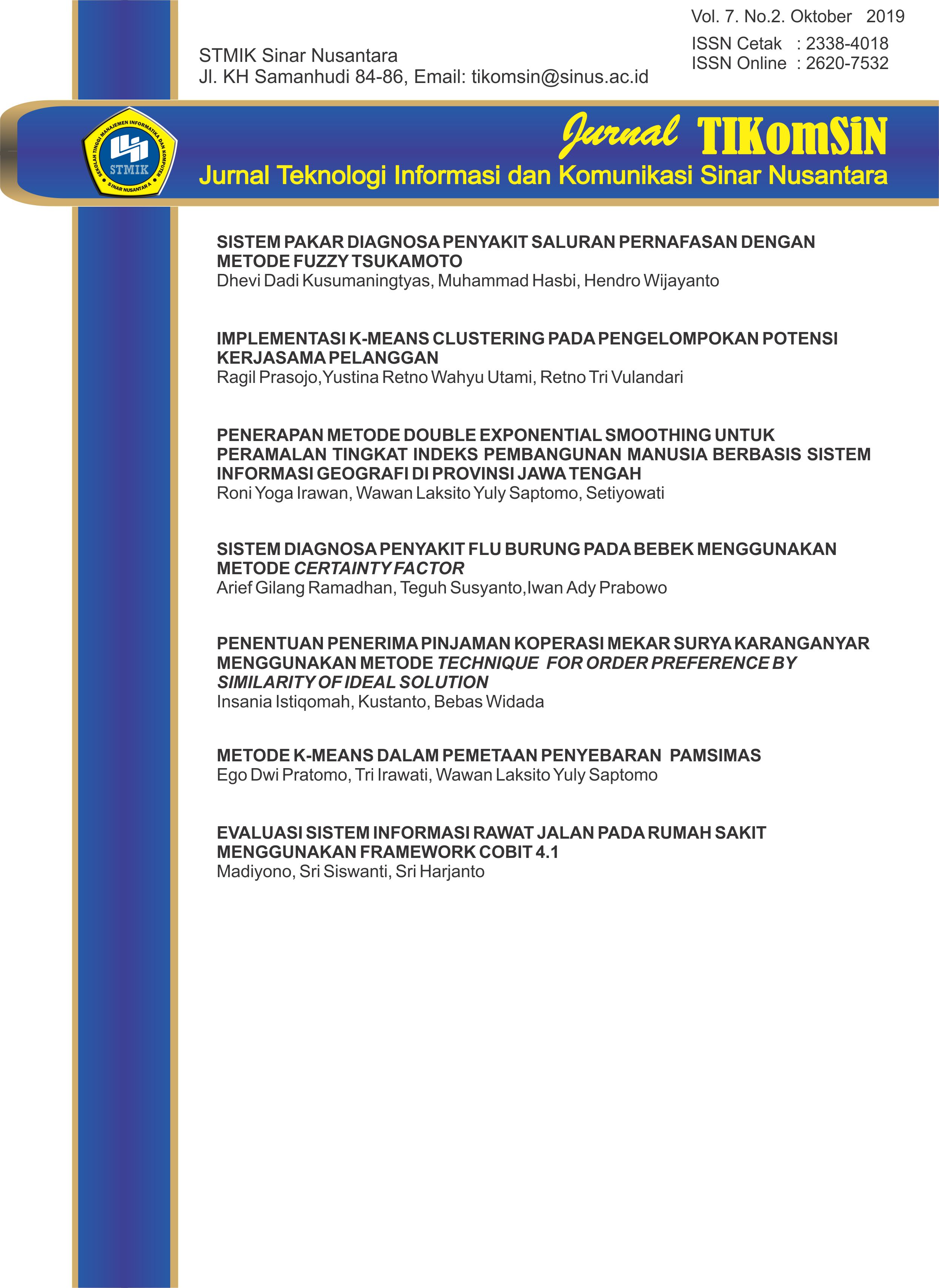
PENENTUAN PENERIMA PINJAMAN KOPERASI MEKAR SURYA KARANGANYAR MENGGUNAKAN METODE TECHNIQUE FOR ORDER PREFERENCE BY SIMILARITY OF IDEAL SOLUTION (TOPSIS)
DOI:
https://doi.org/10.30646/tikomsin.v7i2.444Abstract
ABSTRACT
The problems arise in the form of less objective decision-making and require a long time for selection and there is no computerized system that supports the prioritization of loan recipients. The purpose of this study was to overcome the problem determination of loan recipients by providing objective assessments to prospective loan recipients at the Cooperative Mekar Surya Karanganyar using the TOPSIS method. Loan determination applications use the Visual Basic programming language. Research methods include data collection and analysis and system design. The formulation of this research problem covers how the loan determination at the Cooperative Mekar Surya Karanganyar uses the TOPSIS method and how to build a loan determination application system using the TOPSIS method using the Visual Basic programming language. Based on the test results by comparing the determination of customer loan recipients in the Mekar Surya Cooperative with the calculation of the TOPSIS method proves the application of determining the loan recipient has good performance.
Keywords: TOPSIS, Determination of loan recipients, Cooperative
References
A. S. Wicaksono, S. H. Fitriasih, and Kustanto, “Sistem Pendukung Keputusan Penjuran Siswa SMA N 1 Kawedanan Dengan Metode TOPSIS,†J. Teknol. Inf. dan Komun. Sinar Nusant., vol. 5, no. 2, pp. 40–45, 2017.
A. Riyantomo, N. E. Budiyanto, and A. Laksitasari, “Sistem Pendukung Keputusan Penilaian Kelayakan Kredit dengan Menggunakan Metode Simple Additive Weighting di Koperasi Roda Sejahtera Semarang,†Momentum, vol. 14, no. 1, pp. 62–68, 2012.
A. Triayudi and F. S. Hidayat, “Sistem Pendukung Keputusan Penentuan Penerima Pinjaman Modal Dana Bergulir Koperasi Simpan Pinjam Pada Diskoperindag Kabupaten Serang Menggunakan Metode TOPSIS,†J. ProTekInfo, vol. 3, no. 1, pp. 49–54, 2016.
Y. B. Utomo and J. Ipmawati, “Sistem Pendukung Keputusan Penentuan Penerima Kredit Usaha ( Studi Kasus : Adira Finance Kediri ),†Citec J., vol. 3, no. 4, pp. 295–306, 2016.
Jasri, D. Siregar, and R. Rahim, “Decision Support System Best Employee Assessments with Technique for Order of Preference by Similarity to Ideal Solution,†Int. J. Recent Trends Eng. Res., vol. 03, no. 03, pp. 6–17, 2017.
A. Aziz, “Decission Support System Menentukan Kualitas Rumah Susun Pada Pemda Pringsewu Menggunakan Metode Topsis,†Konf. Mhs. Sist. Inf., vol. 6, no. 1, pp. 1–6, 2018.
C. S. Aulia Putra Faza, “Implementasi Metode AHP-Topsis untuk Menentukan Kelayakan Pinjaman Modal (Studi Kasus Pada Koperasi Simpan Pinjam Jasa Pekalongan),†J. Inf. Syst., vol. 1, no. 1, 2016.
A. Syafrianto, “Sistem Pendukung Keputusan Penentuan Kelayakan Kredit Pinjaman UKM di Koperasi Sejahtera,†J. Ilm. DASI Vol., vol. 16, no. 4, pp. 11–16, 2015.
P. Mauliana, N. Hunaifi, and F. Wahyudi, “Sistem Pendukung Keputusan Penerimaan Debitur Menggunakan Metode TOPSIS (Studi Kasus: Swamitra KSP Intranz),†J. Infotronik, vol. 3, no. 1, pp. 15–20, 2018.
R. Tamtoro and H. Heribertus, “Sistem Pendukung Keputusan Kelayakan Pemberian Kredit Pada Koperasi Simpan Pinjam Sekawan Dengan Menggunakan Metode Weighted Product,†J. Inf. Syst., vol. 14, no. 1, pp. 1–11, 2015.
Downloads
Additional Files
Published
How to Cite
Issue
Section
Citation Check
License
Authors who publish with this journal agree to the following terms:
- Authors retain copyright and grant the journal right of first publication with the work simultaneously licensed under a Creative Commons Attribution License that allows others to share the work with an acknowledgement of the work's authorship and initial publication in this journal.
- Authors are able to enter into separate, additional contractual arrangements for the non-exclusive distribution of the journal's published version of the work (e.g., post it to an institutional repository or publish it in a book), with an acknowledgement of its initial publication in this journal.
- Authors are permitted and encouraged to post their work online (e.g., in institutional repositories or on their website) prior to and during the submission process, as it can lead to productive exchanges, as well as earlier and greater citation of published work (See The Effect of Open Access).
Â

This work is licensed under a Creative Commons Attribution-NonCommercial-ShareAlike 4.0 International License.