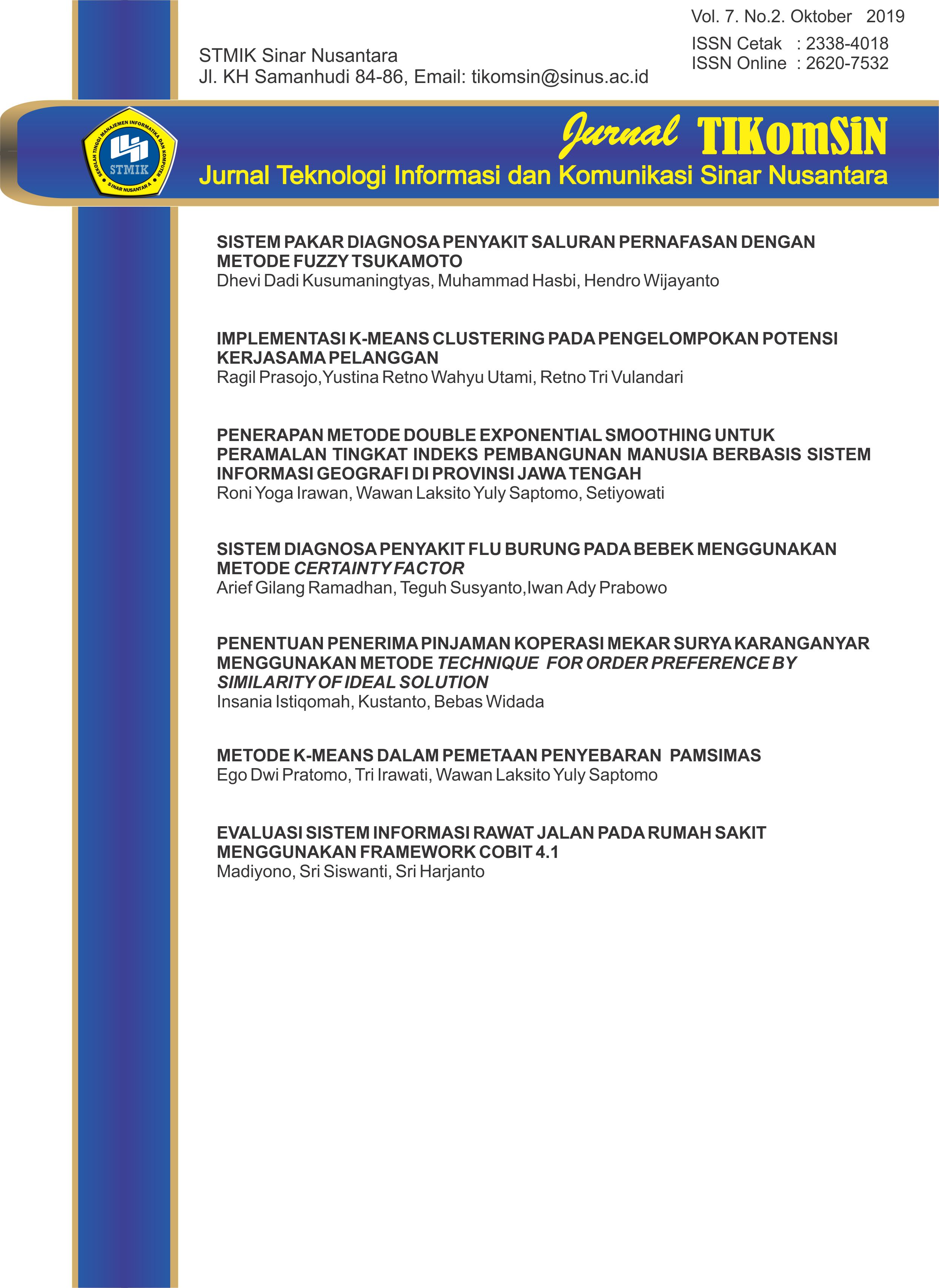
METODE K-MEANS DALAM PEMETAAN PENYEBARAN PAMSIMAS
DOI:
https://doi.org/10.30646/tikomsin.v7i2.449Abstract
Program water supply and sanitation water the community (Pamsimas) is one of the government's mainstay programs in the provision of clean water and sanitation for rural and suburban communities through a community-based approach. With the effort to determine which villages are categorized as potential to receive financial assistance and no potential to receive APBN assistance for the installation of the project pamsimas. The aim is to establish a standard system for selecting Pamsimas villages to help government programs channel them to the right target. With the K-Means Clustering clustering method, this method is very suitable to be used in predicting and classifying which villages are categorized as potentials and does not have the potential to detect the state budget for the Pamsimas project installation. The data is taken interview and direct observation to the Pamsimas office which is the primary data and the criteria data in the form of village data and village connections are secondary data. The results obtained are the K-Means method can be applied clustering of Pamsimas Karanganyar village clustering which is useful to assist the selection of villages on target. By testing the functionality using a black box and testing the validity using the Rapidminer Software. In the mapping study, it was stated that 2 clusters were categorized as potential and not potential. For the results of a valid percentage of the Pamsimas application is 100%.
Keywords: Mapping, Pamsimas, Clustering K-Means.
Â
References
I. S. Ernawi, Pedoman Umum Pengelolaan Pamsimas. Jakarta Pusat: Sekretariat CPMU Pamsimas, 2013.
R. T. Vulandari, Data Mining Teori dan Aplikasi Rapidminer. Surakarta: Penerbit Gava Media, 2017.
E. Prasetyo, Data Mining - Konsep dan Aplikasi Menggunakan Matlab. Yogyakarta: ANDI OFFSET, 2012.
I. W. S. Wicaksana, Belajar Data Mining dengan Rapidminer. Jakarta: Remi Sanjaya.
T. M. Andriyani, L. Linawati, and A. Setiawan, Penerapan Algoritma Fuzzy C-means (FCM) pada Penentuan Lokasi Pendirian Loket Pembayaran Air PDAM Salatiga. Salatiga: UKSW Salatiga, 2013.
M. S. Fajar, Analisis Kecelakaan Lalu Lintas Jalan Raya di Kota Semarang Menggunakan Metode K-Means. Semarang: UNNES Semarang, 2015.
L. Iswari and U. I. Indonesia, Pemanfaatan Algoritma K-Means Untuk Pemetaan Hasil Klasterisasi Data Kecelakaan Lalu Lintas. Bandung: Universitas Islam Indonesia, 2016.
A. Zaqi and A. Kahfi, “Sistem Pengolah Data Mining Industri Sepatu Menggunakan Metode K-Means Clustering di Jawa Tengah,†no. Universitas Dian Nuswantoro, 2013.
T. Suprawoto, Klasifikasi Data Mahasiswa Menggunakan Metode K-Means Untuk Menunjang Pemilihan Strategi Pemasaran, vol. 1, no. 1. Semarang: Universitas Dian Nuswantoro, 2016.
Bayu Hendrayana, “Konsep Dasar Teknik Pengujian Perangkat Lunak,†Bandung: ITB Press, 2017
Downloads
Published
How to Cite
Issue
Section
Citation Check
License
Authors who publish with this journal agree to the following terms:
- Authors retain copyright and grant the journal right of first publication with the work simultaneously licensed under a Creative Commons Attribution License that allows others to share the work with an acknowledgement of the work's authorship and initial publication in this journal.
- Authors are able to enter into separate, additional contractual arrangements for the non-exclusive distribution of the journal's published version of the work (e.g., post it to an institutional repository or publish it in a book), with an acknowledgement of its initial publication in this journal.
- Authors are permitted and encouraged to post their work online (e.g., in institutional repositories or on their website) prior to and during the submission process, as it can lead to productive exchanges, as well as earlier and greater citation of published work (See The Effect of Open Access).
Â

This work is licensed under a Creative Commons Attribution-NonCommercial-ShareAlike 4.0 International License.