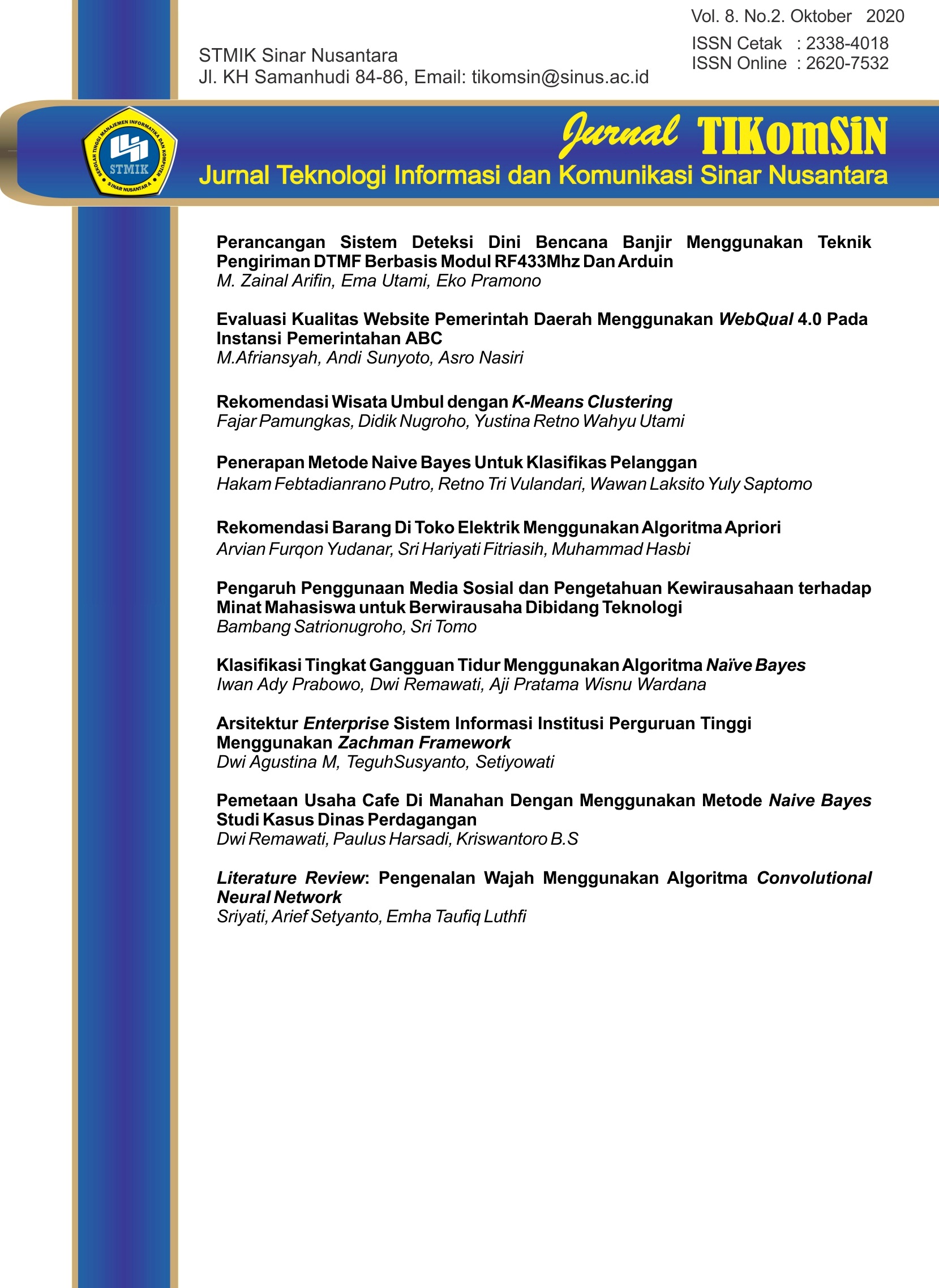
Perancangan Sistem Deteksi Dini Bencana Banjir Menggunakan Teknik Pengiriman DTMF Berbasis Modul RF 433 Mhz Dan Arduino
DOI:
https://doi.org/10.30646/tikomsin.v8i2.465Abstract
Flood is one of the unpredictable natural disasters, especially in the rainy season. There are many effects for many people, such as they lose their property and sometimes have many victims due to floods. So that, estimation of water level is important to detect the basic risk of flooding. In this study used the Water Level (TMA) in form of a short message technique which is can be sent from radio waves and river water level sensors. The value of the sensors to know the highest river water level itself, so it does not need signals, internet networks and also pulse for it. The final result of this study is the water level information which is normal status, standby I, standby II, standby III or standby IV.
Keywords: RF 433MHz, Flood, Arduino, Early Detection
References
Arief Andy Soebroto, Imam Cholissodin, Randy Cahya Wihandika, Maria Tenika Frestantiya, Ziya El Arief, “Prediksi Tinggi Muka Air (TMA) Untuk Mendeteksi Dini Bencana Banjir Menggunakan SVR-TVWPSO,†Jurnal Teknologi Informasi dan Ilmu Komputer (JTIIK), 2015.
Muzakky, A., Nurhasi, A., Nurdiansyah, A., Wicaksana, G., Istiadi. (2018). Perancangan Sistem Deteksi Banjir Berbasis IoT. Conference on Innovation and Application of Science and Technology (CIASTECH 2018).
Satria, D., Yana, S., Munadi, R., Syahreza, S. (2017). Sistem Peringatan Dini Banjir Berbasis Sms Gateway Dan Mikrokontroler Arduino Uno. Seminar Nasional II USM. Vol. 1, Oktober 2017, 78-82
IK Khisan, “Konsep Rancangan Pendeteksi Banjir Jarak Jauh Memanfaatkan Fasilitas Pesan Singkat (SMS),†Jurnal Teknik Elektro Undip, 2011.
A Sumarudin, M. Yani, WP. Putra, F. Amri, P. Paskal “Sistem Pemantauan dan Peringatan Dini Potensi Banjir Sungai Cimanuk Berbasis Internet of Things (IoT)†Prosiding Industrial Research Workshop and National Seminar, 2017.
Slameto, A.A., Pramono, E., Arifin, Z., (2019). Sistem Pendeteksi Dini Bencana Banjir Menggunakan Teknik DTMF (Dual Tone Multiple Frequency). Jurnal Teknologi Informasi Vol. XIV Nomor 2 Juni 2019.
Windarto dan R Ristianti, “Aplikasi Kontrol Jarak Jauh Lampu dan Pagar Rumah dengan Teknologi Dual Tone Multi Frequency (DTMF)†Seminar Nasional Informatika (SNIf), 2017.
Apri Junaidi, “Internet of Things, Sejarah, Teknologi dan Penerapannya: Review,†Jurnal Ilmiah Teknologi Informasi Terapan, vol.1(3) hal. 62-66, 2015.
Siswo Wardoyo, “Pengantar Mikrokontroler & Aplikasi Pada Arduino,†Graha Ilmu, 2015.
Downloads
Published
How to Cite
Issue
Section
Citation Check
License
Authors who publish with this journal agree to the following terms:
- Authors retain copyright and grant the journal right of first publication with the work simultaneously licensed under a Creative Commons Attribution License that allows others to share the work with an acknowledgement of the work's authorship and initial publication in this journal.
- Authors are able to enter into separate, additional contractual arrangements for the non-exclusive distribution of the journal's published version of the work (e.g., post it to an institutional repository or publish it in a book), with an acknowledgement of its initial publication in this journal.
- Authors are permitted and encouraged to post their work online (e.g., in institutional repositories or on their website) prior to and during the submission process, as it can lead to productive exchanges, as well as earlier and greater citation of published work (See The Effect of Open Access).
Â

This work is licensed under a Creative Commons Attribution-NonCommercial-ShareAlike 4.0 International License.