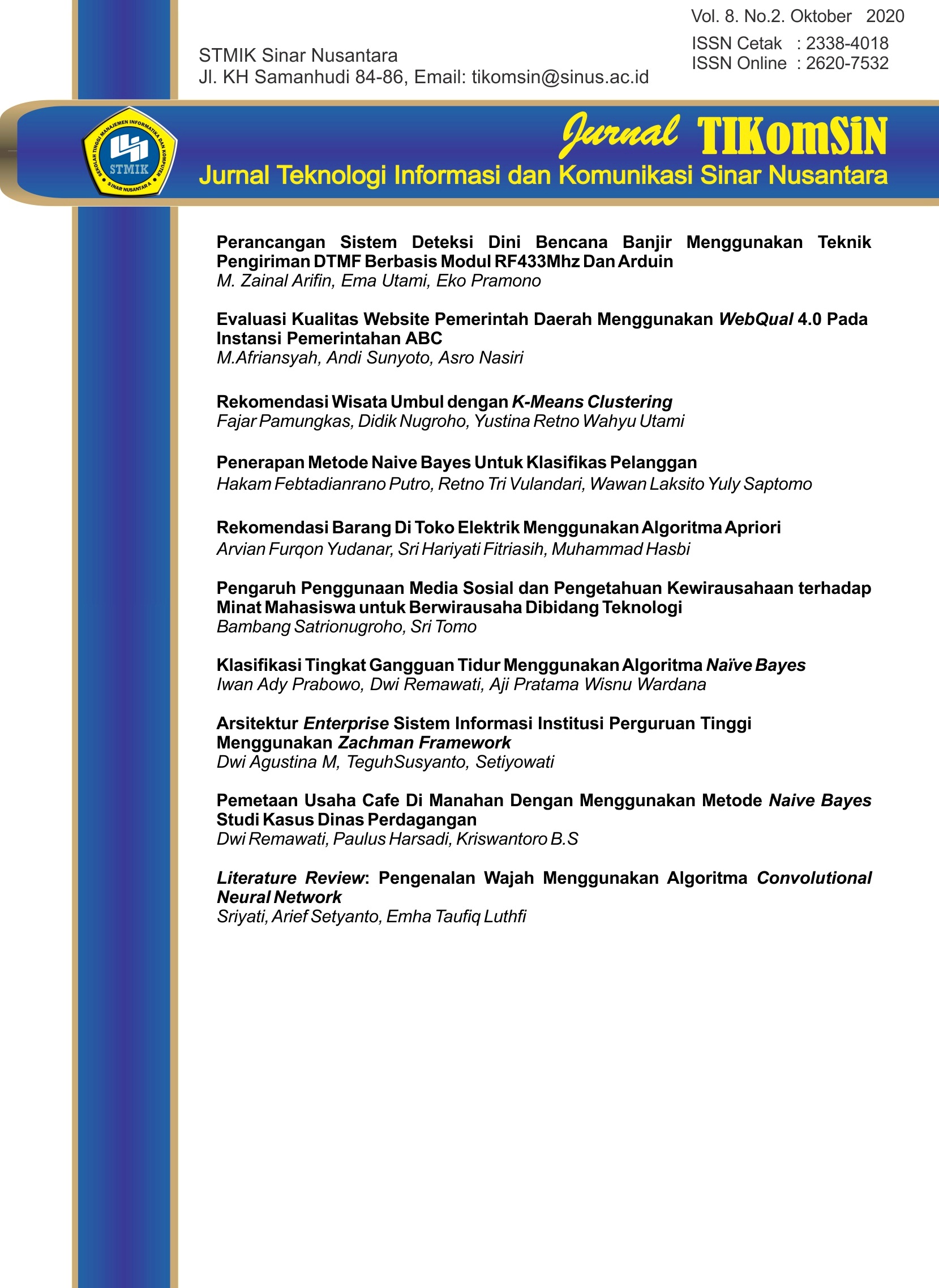
Rekomendasi Barang Di Toko Elektrik Menggunakan Algoritma Apriori
DOI:
https://doi.org/10.30646/tikomsin.v8i2.499Abstract
Each company or organization which wants to survive needs to determine the right business strategies. Sales data for products made by the company will get a lot of data. So it is very unfortunate if there is not repetition analyzing. Its offered variety products with a wide range of products, and sometimes the brand influence people to buy the product, to know the highest sales products, it needs to know the relationship between one product to others, one of them is existing algorithms in mining data algorithms. They are algorithms apriori to be informed, and it can help of this program, products which appear simultaneously knowable. The purpose of the research is to determine the recommendation of goods so that purchases of goods stock are efficient. Apriori algorithms including the type of association rules in mining data. The one-step analysis association phase which is gotten the attention of many researchers to produce efficient algorithms is the analysis of patterns of high frequency (frequent pattern mining). Important or not an association can be identified by the two benchmarks, namely: support and confidence. Support (support value) is the percentage of the combination of these items in the database, while confidence (value certainty) is a strong relationship between the items in the rules of the association. Apriori algorithm can be helpful for the development of marketing strategies. From the validity testing result, the data is efficient if the minimum support more than 10% and the minimum confidence of more than 50%. The calculation needs two different minimum support and minimum confidence to know the best result. The problem is how to increase sales, and find out the interest of buyers in the product. And the results are obtained to decide the layout of the products in the shop window as an effort to increase sales in the store.
Keywords:Â Mining Data, Good Recommendations, Apriori, AlgorithmReferences
P. H. Simbolon, “Implementasi Data Mining Pada Sistem Persediaan Barang Menggunakan Algoritma Apriori ( Studi Kasus : Srikandi Cash Credit Elektronic dan Furniture ),†vol. 6, no. 4, pp. 401–406, 2019.
A. -, F. Marisa, and D. Purnomo, “Penerapan Algoritma Apriori Terhadap Data Penjualan di Toko Gudang BM,†JOINTECS (Journal Inf. Technol. Comput. Sci., vol. 1, no. 1, pp. 1–5, 2016.
L. Kurniawati, A. E. Kusuma, and B. Dewansyah, “Implementasi Algoritma Apriori Untuk Menentukan Persediaan Spare Part Compressor,†Comput. Eng. Sci. Syst. J., vol. 4, no. 1, p. 6, 2019.
R. Vulandari, “Data Mining : Teori dan Aplikasi Rapidminer. Surakarta,†Data Min. Teor. dan Apl. Rapidminer. Surakarta, 2017.
Kusrini and E. T. Luthfi, Algoritma Data Minning, 1st ed. Yogyakarta: ANDI, 2009.
H. Dewantara, P. B. Santosa, and N. W. Setyanto, “Perancangan Aplikasi Data Mining Dengan Algoritma Apriori Untuk Frekuensi Analisis Keranjang Belanja Pada Data Transaksi Penjualan,†Tek. Ind., pp. 415–426, 2013.
A. Solichin S.Kom, “Pemrograman Web dengan PHP dan MySQL - Achmad Solichin - Google Buku,†Univ. Budi Luhur, no. January, p. 215, 2016.
N. M. I. M. M. I Dewa Gede Wahya Dhiyatmika, I Ketut Gede Darma Putra, “Aplikasi Augmented Reality Magic Book Pengenalan Binatang untuk Siswa TK,†Lontar Komput., vol. 6, no. 2, pp. 589–596, 2015.
R. Yanto, Manajemen Basis Data Menggunakan MySQL. 2016.
Canggih Ajika Pamungkas, Pengantar dan Implementasi Basis Data. 2017.
S. Indrajani, Sistem Informasi. Jakarta: PT Elex Media Komputindo, 2011.
S. Indrajani, “MM. Database Design,†vol. 42, 2015.
J. H. Mustakini, Analisis & Desain, Ed ke-III. Andi Offset, 2005.
Rezkiani, “Implementasi Data Minning dengan Algoritma Apriori,†2016.
M. Afdal and M. Rosadi, “Penerapan Association Rule Mining Untuk Analisis,†vol. 5, no. 1, pp. 99–108, 2019.
I. Kurnawan, F. Marisa, and P. Purnomo, “Implementasi Data Mining Dengan Algoritma Apriori Untuk Memprediksi Tingkat Kelulusan Mahasiswa,†J. Teknol. dan Manaj. Inform., vol. 4, no. 1, 2018.
N. Fitrina, Kustanto, and R. T. Vulandari, “Penerapan Algoritma Apriori Pada Sistem Rekomendasi Barang Di Minimarket Batox,†J. Teknol. Inf. dan Komun., vol. 6, no. 2, pp. 21–27, 2018.
Downloads
Additional Files
Published
How to Cite
Issue
Section
Citation Check
License
Authors who publish with this journal agree to the following terms:
- Authors retain copyright and grant the journal right of first publication with the work simultaneously licensed under a Creative Commons Attribution License that allows others to share the work with an acknowledgement of the work's authorship and initial publication in this journal.
- Authors are able to enter into separate, additional contractual arrangements for the non-exclusive distribution of the journal's published version of the work (e.g., post it to an institutional repository or publish it in a book), with an acknowledgement of its initial publication in this journal.
- Authors are permitted and encouraged to post their work online (e.g., in institutional repositories or on their website) prior to and during the submission process, as it can lead to productive exchanges, as well as earlier and greater citation of published work (See The Effect of Open Access).
Â

This work is licensed under a Creative Commons Attribution-NonCommercial-ShareAlike 4.0 International License.