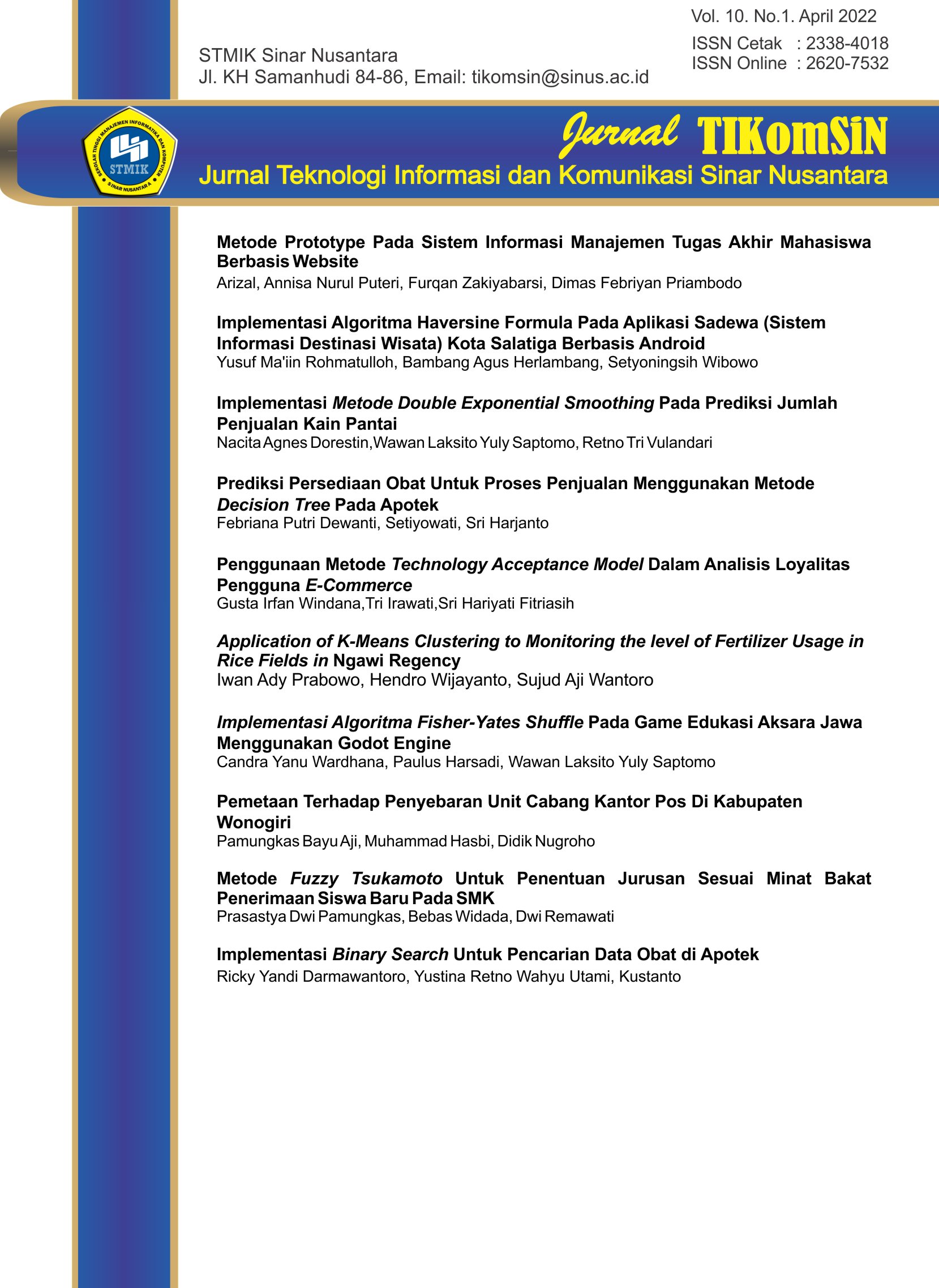
IMPLEMENTASI METODE DOUBLE EXPONENTIAL SMOOTHING PADA PREDIKSI JUMLAH PENJUALAN KAIN PANTAI
DOI:
https://doi.org/10.30646/tikomsin.v10i1.596Keywords:
Double Exponential Smoothing, Forecasting, Beach WearAbstract
Y2K Batik is an SME (Small and Medium Enterprise) engaged in batik. Y2K Batik produces and sells beach wear with various motifs. One of the important things in business is inventory of merchandise, inventory of merchandise is a factor in determining the success of a trading company to achieve its goals, because the goods sold affect the level of income to increase company profits. With these considerations, it is necessary to analyze the production of beach wear for the availability of merchandise in fulfilling customer orders. Based on the above background, the scope of the problem in this study is master data collection obtained from records of selling beach batik cloth periodically from time to time. By utilizing the existing data and applying certain methods, a sales forecasting prediction can be made using the Double exponential Smoothing method. From the results of calculations and testing of forecasting data on the Mandala Motif Beach Fabric variable with the most optimal value using = 0.9 of 2127 with an error value of 19.46% and an accuracy rate of 80.54% (Good). The Canting Motif Beach Wear variable with the most optimal value using = 0.9 of 3174 with an error value of 3.61% and an accuracy rate of 96.39% (Very Good). Double Exponential Smoothing is the most widely used method to determine the trend equation of the second smoothing data through a smoothing process. The programming language uses Microsoft Visual Studio 2013 and the DBMS uses Microsoft SQL Server 2012. The purpose of this research is to create a system that can simplify the process of analyzing the production of beach wear in order to meet the availability of goods ordered by customers.
References
D. Desmonda, T. Tursina, and M. A. Irwansyah, “Prediksi Besaran Curah Hujan Menggunakan Metode Fuzzy Time Series,†J. Sist. dan Teknol. Inf., vol. 6, no. 4, p. 141, 2018, doi: 10.26418/justin.v6i4.27036.
M. N. Fawaiq, A. Jazuli, and M. M. Hakim, “Prediksi Hasil Pertanian Padi Di Kabupaten Kudus Dengan Metode Brown’S Double Exponential Smoothing,†JIPI (Jurnal Ilm. Penelit. dan Pembelajaran Inform., vol. 4, no. 2, p. 78, 2019, doi: 10.29100/jipi.v4i2.1421.
R. Imbar and Y. Andreas, “Aplikasi Peramalan Stok Barang Menggunakan Metode Double Exponential Smoothing,†J. Tek. Inform. dan Sist. Inf., vol. 7, no. 2, pp. 123–141, 2012.
S. Makridakis, S. C. Wheelwright, and V. E. McGee, Metode dan Aplikasi Peramalan Jilid 1. Ciputat: Binarupa Aksara, 1999.
E. D. S. Mulyani, “Aplikasi Peramalan Pengadaan Barang Dengan Metode Trend Projection Dan Metode Single Exponential Smoothing (Studi Kasus Di Toko Pionir Jaya),†Semin. Nas. Inform., pp. 260–266, 2014.
E. W. ST. M.Eng, A. Zaki, and S. Community, Pemrograman Visual Basic.net Untuk AplikasM.Eng, E. W. ST., Zaki, A., & Community, S. (2015). Pemrograman Visual Basic.net Untuk Aplikasi Office. PT Elex Media Komputindo.i Office. Jakarta: PT Elex Media Komputindo, 201
J. Enterprise, Trik Cepat Menguasai MS SQL Server. Jakarta: PT Elex Media Komputindo, 2014.
H. Hasanah, “TEKNIK-TEKNIK OBSERVASI (Sebuah Alternatif Metode Pengumpulan Data Kualitatif Ilmu-ilmu Sosial),†At-Taqaddum, vol. 8, no. 1, p. 21, 2017, doi: 10.21580/at.v8i1.1163.
A. T. Mirzaqon and B. Purwoko, “Studi Kepustakaan Mengenai Landasan Teori Dan Praktik Konseling Expressive Writing Library,†J. BK UNESA, vol. 4, no. 1, pp. 1–8, 2017.
F. C. Ningrum, D. Suherman, A. Sita, P. H. Angga, and S. Aries, “Pengujian Black Box pada Aplikasi Perpustakaan Menggunakan Teknik Equivalence Partitions,†J. Teknol. Sist. Inf. dan Apl., vol. 3, no. 3, p. 150, 2020, doi: 10.32493/jtsi.v3i3.5343.
Downloads
Published
How to Cite
Issue
Section
Citation Check
License
Authors who publish with this journal agree to the following terms:
- Authors retain copyright and grant the journal right of first publication with the work simultaneously licensed under a Creative Commons Attribution License that allows others to share the work with an acknowledgement of the work's authorship and initial publication in this journal.
- Authors are able to enter into separate, additional contractual arrangements for the non-exclusive distribution of the journal's published version of the work (e.g., post it to an institutional repository or publish it in a book), with an acknowledgement of its initial publication in this journal.
- Authors are permitted and encouraged to post their work online (e.g., in institutional repositories or on their website) prior to and during the submission process, as it can lead to productive exchanges, as well as earlier and greater citation of published work (See The Effect of Open Access).
Â

This work is licensed under a Creative Commons Attribution-NonCommercial-ShareAlike 4.0 International License.