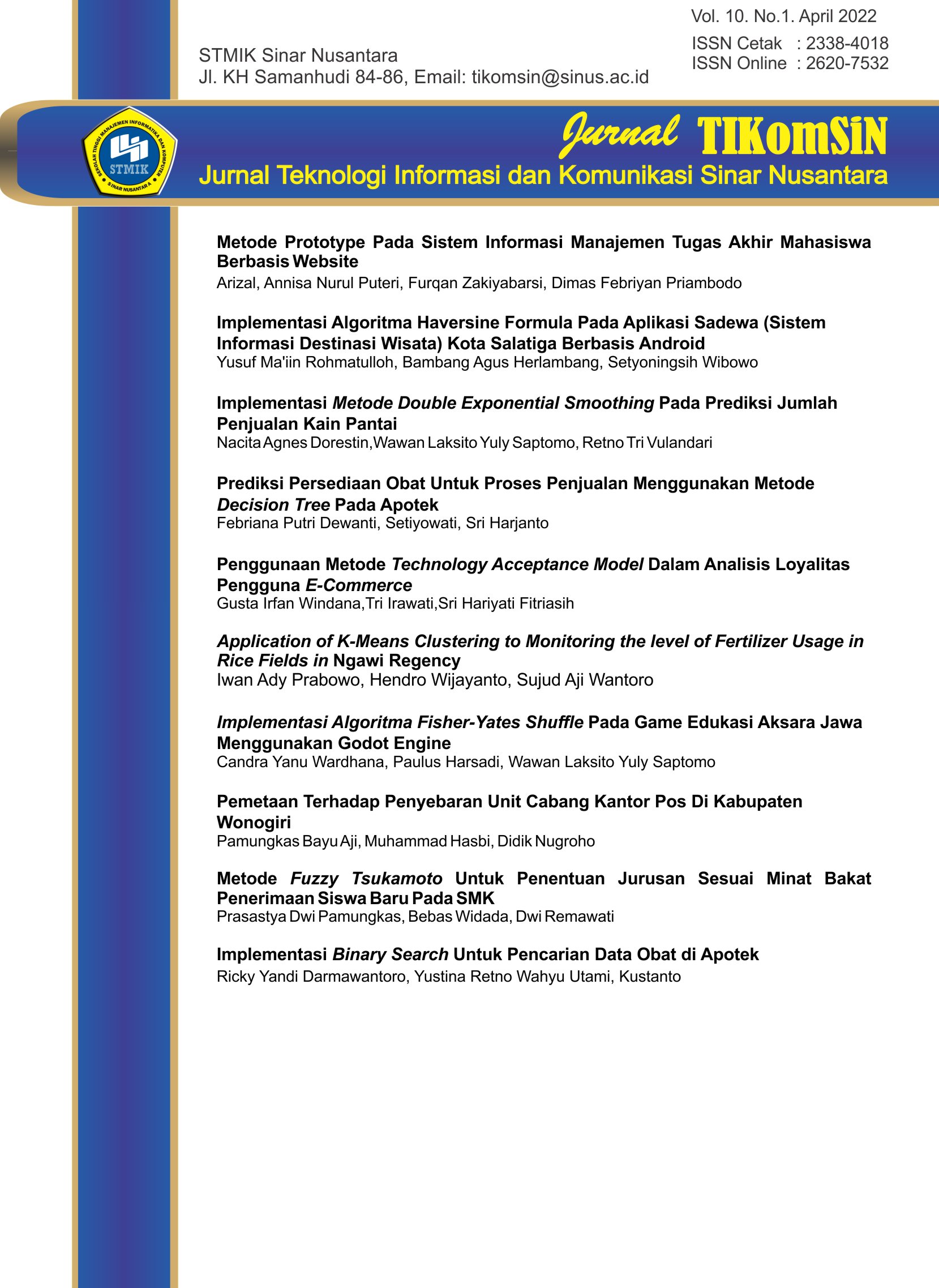
Implementasi Algoritma Fisher-Yates Shuffle Pada Game Edukasi Aksara Jawa Menggunakan Godot Engine
DOI:
https://doi.org/10.30646/tikomsin.v10i1.603Keywords:
Educational Game, Algorithm Shuffle Random, , Aksara JawaAbstract
Game is one of the implementations of the computer science field which has developed very rapidly. Game is also a form of educational application, meaning that it can be used as a learning media where the process can be carried out with the 'learning while playing' concept for children.The utilization and use of 'Aksara Jawa' educational game can support the learning process of the children when they want to learn while playing to recognize 'Aksara Jawa'. This 'Aksara Jawa' educational game is a game that is designed to improve children's ability to memorize and understand 'Aksara Jawa'. This game contain questions that need to be answered by players by arranging the scrambled 'Aksara Jawa' to form the correct words or sentences. The used algorithm is Shuffle Random which players can't memorize the position of 'Aksara Jawa' and make the game not boring, and also able to apply 'learning and playing' system and become a good learning method among the children. In this study, Shuffle Random Algorithm was used to randomize the 'Aksara Jawa' contained in every questions which were packaged in the form of a game. The making of this 'Aksara Jawa' educational game was using Godot engine software and GDscript programming language. The final result of this research is that this game can help to learn to memorize, so that it can train reasoning and memory power, and also can be used as a means of entertainment.
References
Z. Lubis, S. Aryza, Dan S. Annisa, “Perancangan Terbaru Model Pembuatan Game Shopping Habit Society Sebagai Media Edukasi Melestarikan Pasar Tradisional Menggunakan Algoritma Shuffle Random,†J. Electr. Technol., vol. 4, no. 2, hal. 59–66, 2019.
K. Adha, Mesran, dan Murdani, “Penerapan Linear Congruent Method Pada Game Edukasi Tebak Huruf Hiragana Dan Katakana Berbasis Android Penerapan Linear Congruent Method Pada Game Edukasi Tebak Huruf Hiragana Dan Katakana Berbasis Android,†J. Times, vol. VI, no. 1, hal. 6–11, 2017.
I. S. Boham, S. Sentinuwo, dan A. Sambul, “Rancang Bangun Aplikasi Game Pengenalan Sejarah Perang Tondano,†J. Tek. Inform., vol. 11, no. 1, 2017.
Z. Azmi, F. Taufik, dan B. Susilo, “Implementasi Jaringan Kohonen Dalam Pengenalan Citra Huruf Aksara Jawa,†vol. 17, no. 2, hal. 214–217, 2018.
Chris Bradfield, Godot Engine Game Development Projects. Milwaukee, 2018.
A. Yusnita dan T. Rija’i, “Implementasi Algoritma Shuffle Random pada Pembelajaran Panca Indra Berbasis Android,†JUITA J. Inform., vol. 7, no. 1, hal. 19, 2019.
D. Nurdiana dan A. Suryadi, “Perancangan Game Budayaku Indonesiaku Menggunakan Metode Mdlc,†J. Petik, vol. 3, no. 2, hal. 39, 2018.
Andriyat Rio, “GDD (Game Design Document),†2019. [Daring]. Tersedia pada: https://staff.uniku.ac.id/rioandriyat/gdd-game-design-document/.
A. Yusnita, A. Y. Rangan, dan F. Setiawan, “Membangun Game Fun Animal Puzzle Menggunakan Algoritma Shuffle Random,†Sebatik, vol. 15, no. 1, hal. 1–6, 2016.
S. Wijayanti, A. Nurhuda, dan R. Andrea, “Edugame ‘Etam-Tainment’ Pembelajaran Bahasa Kutai dengan Shuffle Random dan Agen Cerdas,†J. Nas. Tek. Elektro dan Teknol. Inf., vol. 7, no. 3, hal. 302–307, 2018.
A. Syukur dan A. Fitra, “Game Interaksi Pengenalan Huruf dan Perangkaian Kata,†Semin. Nas. Teknol. dan Multimed. 2017, no. 2017, hal. 7–12, 2017.
S. Koriaty dan M. D. Agustani, “PENGEMBANGAN MODEL PEMBELAJARAN GAME EDUKASI UNTUK MENINGKATKAN MINAT SISWA KELAS X TKJ SMK NEGERI 7 PONTIANAK,†vol. 14, no. 2, hal. 277–288, 2016.
Downloads
Published
How to Cite
Issue
Section
Citation Check
License
Authors who publish with this journal agree to the following terms:
- Authors retain copyright and grant the journal right of first publication with the work simultaneously licensed under a Creative Commons Attribution License that allows others to share the work with an acknowledgement of the work's authorship and initial publication in this journal.
- Authors are able to enter into separate, additional contractual arrangements for the non-exclusive distribution of the journal's published version of the work (e.g., post it to an institutional repository or publish it in a book), with an acknowledgement of its initial publication in this journal.
- Authors are permitted and encouraged to post their work online (e.g., in institutional repositories or on their website) prior to and during the submission process, as it can lead to productive exchanges, as well as earlier and greater citation of published work (See The Effect of Open Access).
Â

This work is licensed under a Creative Commons Attribution-NonCommercial-ShareAlike 4.0 International License.