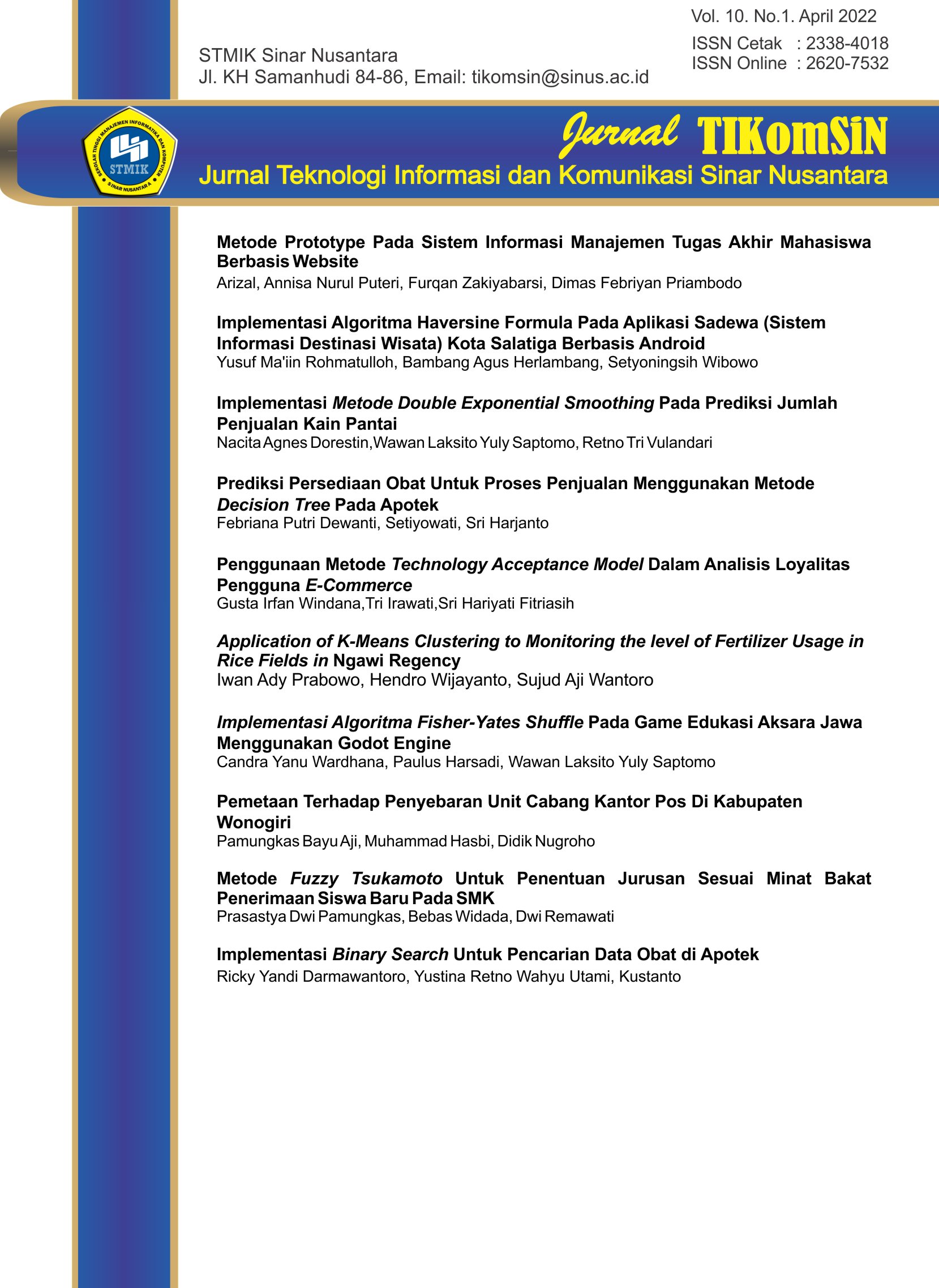
Metode Prototype pada Sistem Informasi Manajemen Tugas Akhir Mahasiswa Berbasis Website
DOI:
https://doi.org/10.30646/tikomsin.v10i1.606Keywords:
Information Management System, Final Project, Prototype Method, Website, Use Case Diagram, Entity Relation Diagram,Abstract
Final Project as a Research is one of the main requirements for the graduation of undergraduate students from universities. Supervisory guidance is one way to find solution for student research problems. The final project guidance process involves multiple parts: campus administration, supervisors, and students. However, this process is often difficult to carry out properly because of the busyness of each individual, both lecturers and students. As a result, the process for carrying out the final project was hindered. Another thing that makes the completion of the thesis slow is the administrative service procedure to complete the final project which is too time consuming. This research aims to simplify and speed up the process of completing the student's final project. The prototype method is used to develop the final project management information system. This information system is designed using use case diagrams, rich picture diagrams, and entity relation diagrams. Tests were carried out using the black box method. The result of the research is a final project management information system which makes the student's final project completion process more efficient and effective. This information system facilitates administrative services and monitoring of the final project because it is performed systematically and can be controlled in real time.
Â
References
A. Kasim, L. Hadjaratie, and R. H. Dai, “Rancang Bangun Sistem Informasi Skripsi dan Kerja Praktik Berbasis Web,†Jambura J. Informatics, vol. 2, no. 2, pp. 95–107, 2020, doi: 10.37905/jji.v2i2.5331.
N. M. Sari, L. M. Tua, and E. Krisnanik, “Sistem Informasi Monitoring Pembimbingan Skripsi / Tugas Akhir (SIMP-S / TA) Berbasis Android,†Semin. Nas. Inform. Sist. Inf. dan Keamanan Siber, pp. 9–10, 2019.
M. A. Mohamed et al., “An Implementation of Final Year Project Management System: A Case Study at Universiti Sultan Zainal Abidin,†World Appl. Sci. J., vol. 35, no. 8, pp. 1246–1251, 2017, doi: 10.5829/idosi.wasj.2017.1246.1251.
F. G. J. Rupilele et al., “Management information system for monitoring and inspection of the implementation of Universities,†Int. J. Eng. Technol., vol. 7, no. 2.13 Special Issue 13, pp. 451–456, 2018, doi: 10.14419/ijet.v7i2.13.18138.
Arizal and Annisa Nurul Puteri, “Sistem Informasi Manajemen Wisuda Berbasis Website Menggunakan Metode Waterfall,†J. Sist. dan Inform., vol. 14, no. 2, pp. 125–134, 2020, doi: 10.30864/jsi.v14i2.309.
H. Priyanto and H. Muhardi, “Sistem Informasi dan Monitoring Tugas Akhir Mahasiswa di Program Studi Teknik Sipil Fakultas Teknik Universitas Tanjungpura Students Final Project Information and Monitoring System in Civil Engineering Faculty of Engineering University of Tanjungpura,†vol. 09, no. 3, pp. 381–391, 2021, doi: 10.26418/justin.v9i3.44040.
R. Susanto and A. D. Andriana, “Perbandingan Model Waterfall dan Prototyping untuk Pengembangan Sistem Informasi,†Maj. Ilm. UNIKOM, vol. 14, no. 1, 2016.
P. Sharma and D. Singh, “Comparative Study of Various SDLC Models on Different Parameters,†Int. J. Eng. Res., vol. 4, no. 4, pp. 188–191, 2015, doi: 10.17950/ijer/v4s4/405.
T. Pricillia and Zulfachmi, “Perbandingan Metode Pengembangan Perangkat Lunak,†Surv. Pap., vol. X, no. 01, pp. 6–12, 2021.
A. Srivastava, “A Comparative Analysis of Software Development Models Based On Various Parameters,†Int. J. Comput. Sci. Eng., vol. 7, no. 9, pp. 17–21, 2019, doi: 10.26438/ijcse/v7i9.1721.
A. Dennis, B. H. Wixom, and R. M. Roth, System Analysis and Design by Alan Dennis 5th edition, 5th ed. Don Fowley, 2012.
M. V. Al Hasri and E. Sudarmilah, “Sistem Informasi Pelayanan Administrasi Kependudukan Berbasis Website Kelurahan Banaran,†MATRIK J. Manajemen, Tek. Inform. dan Rekayasa Komput., vol. 20, no. 2, pp. 249–260, 2021, doi: 10.30812/matrik.v20i2.1056.
V. H. Kristanto, Metodologi Penelitian Pedoman Penulisan Karya Tulis Ilmiah (KTI). Yogyakarta: Deepublish, 2018.
P. D. Kusuma, Algoritma dan Pemrograman. Yogyakarta: Deepublish, 2020.
K. M. Reid, AS Level for OCR Applied ICT. Oxford: Heinemann Educational, 2005.
S. Adi and D. M. Kristin, “Strukturisasi Entity Relationship Diagram dan Data Flow Diagram Berbasis Business Event-Driven,†ComTech Comput. Math. Eng. Appl., vol. 5, no. 1, p. 26, 2014, doi: 10.21512/comtech.v5i1.2577.
M. Larrea, “Black-Box Testing Technique for Information Visualization. Sequencing Constraints with Low-Level Interactions,†J. Comput. Sci. Technol. (La Plata), vol. 17, no. 1, pp. 37–48, 2017.
Downloads
Published
How to Cite
Issue
Section
Citation Check
License
Authors who publish with this journal agree to the following terms:
- Authors retain copyright and grant the journal right of first publication with the work simultaneously licensed under a Creative Commons Attribution License that allows others to share the work with an acknowledgement of the work's authorship and initial publication in this journal.
- Authors are able to enter into separate, additional contractual arrangements for the non-exclusive distribution of the journal's published version of the work (e.g., post it to an institutional repository or publish it in a book), with an acknowledgement of its initial publication in this journal.
- Authors are permitted and encouraged to post their work online (e.g., in institutional repositories or on their website) prior to and during the submission process, as it can lead to productive exchanges, as well as earlier and greater citation of published work (See The Effect of Open Access).
Â

This work is licensed under a Creative Commons Attribution-NonCommercial-ShareAlike 4.0 International License.