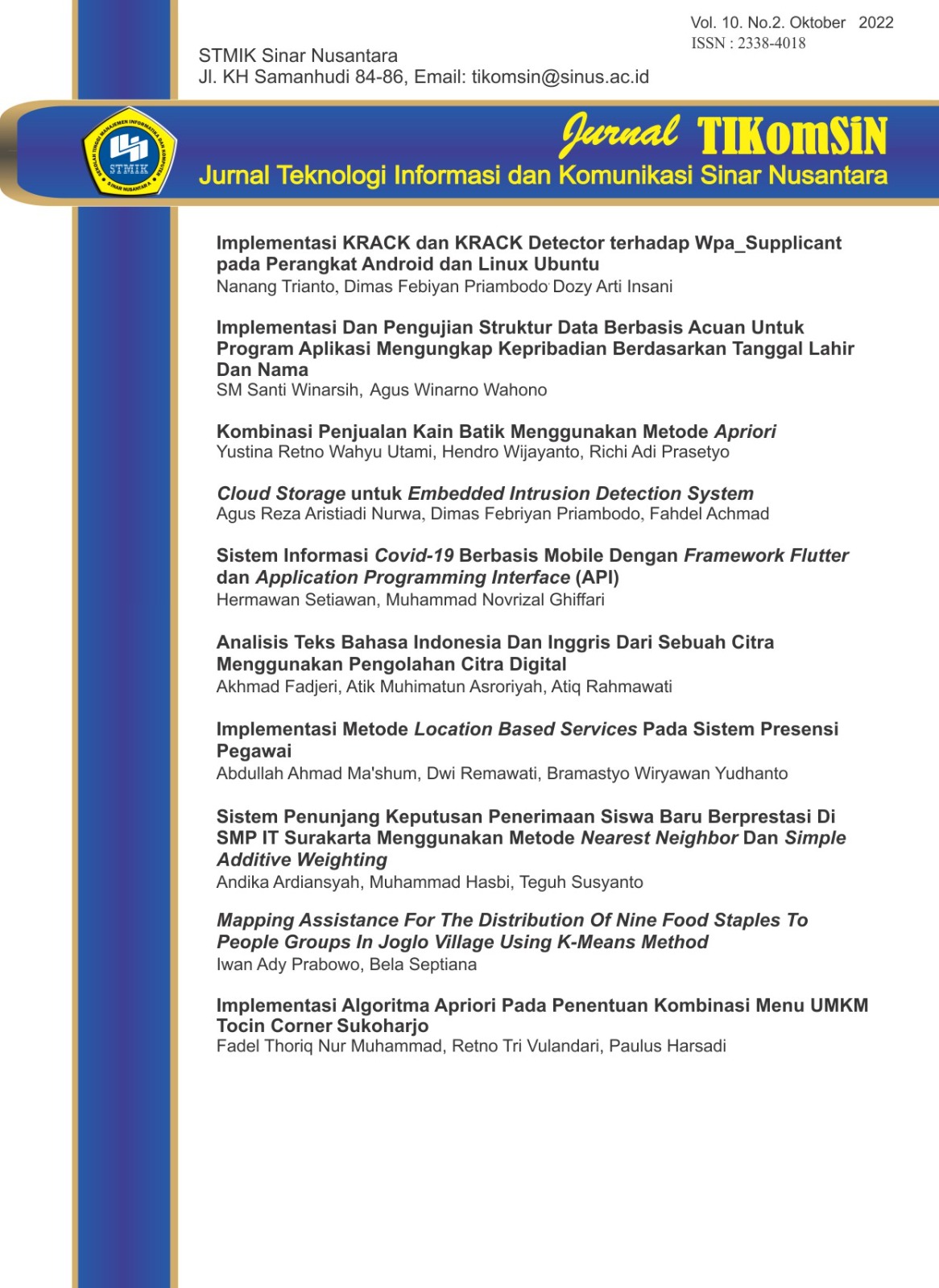
IMPLEMENTASI KRACK DAN KRACK DETECTOR TERHADAP WPA_SUPPLICANT PADA PERANGKAT ANDROID DAN LINUX UBUNTU
DOI:
https://doi.org/10.30646/tikomsin.v10i2.639Keywords:
4-way handshake, KRACK Detector, WiFi, WPA2Abstract
Nowadays WiFi services is available in many public places to accesses the information. Most of WiFi services use the Wifi Protected Access 2 (WPA2) security. This protocol uses a 4-way handshake mechanism for authentication process, but there is a weakness by using the 4-way handshake mechanism that possible to re-install the key (KRACK). This weakness can be used by attackers to hold up communications so that attackers can enter the network. This study, KRACK analysis was carried out on wpa_supplicant Android and Linux Ubuntu which connected to WiFi and the WPA2 security protocol to know the weaknesses. The analysis is doing on the user's device by connecting to the Rogue AP generated by the Vanhoef script. This dangerous line is compared to normal line. Analyzing attacks on 4-way handshakes, this research create implementation of KRACK Detector and the result of detection will be used to get the KRACK characteristics. The information getting from the result can prevent the disadvantages which coming by attacks. The validation of the research was carried out by using Wireshark to make sure that the third massage sends which show threat of attack.
References
B. Kurniawan, “Sistem Pakar Diagnosa Penyakit Paru Pada Anak,†J. TIKomSiN, vol. 5, no. 2, pp. 53–60, 2017.
A. N. Puteri, F. Zakiyabarsi, and D. F. Priambodo, “Metode Prototype Pada Sistem Informasi Manajemen Tugas Akhir Mahasiswa Berbasis Website,†J. Teknol. Inf. dan Komun. Sinar Nusant., vol. 10, no. 1, pp. 1–8, 2022, doi: http://dx.doi.org/10.30646/tikomsin.v10i1.606.
R. Setiawan, “Penggunaan Internet sebagai Teknologi Informasi di Kalangan Mahasiswa Ekonomi Akuntansi Universitas Muhammadiyah Surakarta,†2009.
M. R. Arief, “Teknologi Jaringan Tanpa Kabel (Wireless),†vol. 2007, no. November, pp. 1–8, 2007.
F. Mustika, “Implementasi Purwarupa Intrusion Detection System untuk Mendeteksi Evil Twin Attack pada Jaringan Nirkabel Menggunakan Skema Agarwal et al.,†2019.
M. Vanhoef and F. Piessens, “Key reinstallation attacks: Forcing nonce Reuse in WPA2,†Proc. ACM Conf. Comput. Commun. Secur., pp. 1313–1328, 2017, doi: 10.1145/3133956.3134027.
M. Vanhoef, F. Piessens, and K. U. Leuven, “Key Reinstallation Attacks : Forcing Nonce Reuse in WPA2,†2017.
J. Ernekerov, “Analysis and Detection of KRACK Attack against WiFi Infrastructure,†2019.
L. K. Mæhlum, “KrackPlus Sammendrag av Bacheloroppgaven,†2018.
J. Malinen, “Linux WPA/WPA2/IEEE 802.1X Supplicant,†2013. .
O. Mallis, “securingsam/krackdetector,†github.com, 2017. .
N. S.T, R. Lobo, P. S. Vernekar, and V. G. Shetty, “Mitigation of Key Reinstallation Attack in WPA2 Wi-Fi networks by detection of Nonce Reuse,†Int. Res. J. Eng. Technol., vol. 05, no. 05, 2018.
Y. Li, M. Serrano, T. Chin, K. Xiong, and J. Lin, “A software-defined networking-based detection and mitigation approach against KRACK,†ICETE 2019 - Proc. 16th Int. Jt. Conf. E-bus. Telecommun., vol. 2, pp. 244–251, 2019, doi: 10.5220/0007926202440251.
Downloads
Published
How to Cite
Issue
Section
Citation Check
License
Authors who publish with this journal agree to the following terms:
- Authors retain copyright and grant the journal right of first publication with the work simultaneously licensed under a Creative Commons Attribution License that allows others to share the work with an acknowledgement of the work's authorship and initial publication in this journal.
- Authors are able to enter into separate, additional contractual arrangements for the non-exclusive distribution of the journal's published version of the work (e.g., post it to an institutional repository or publish it in a book), with an acknowledgement of its initial publication in this journal.
- Authors are permitted and encouraged to post their work online (e.g., in institutional repositories or on their website) prior to and during the submission process, as it can lead to productive exchanges, as well as earlier and greater citation of published work (See The Effect of Open Access).
Â

This work is licensed under a Creative Commons Attribution-NonCommercial-ShareAlike 4.0 International License.