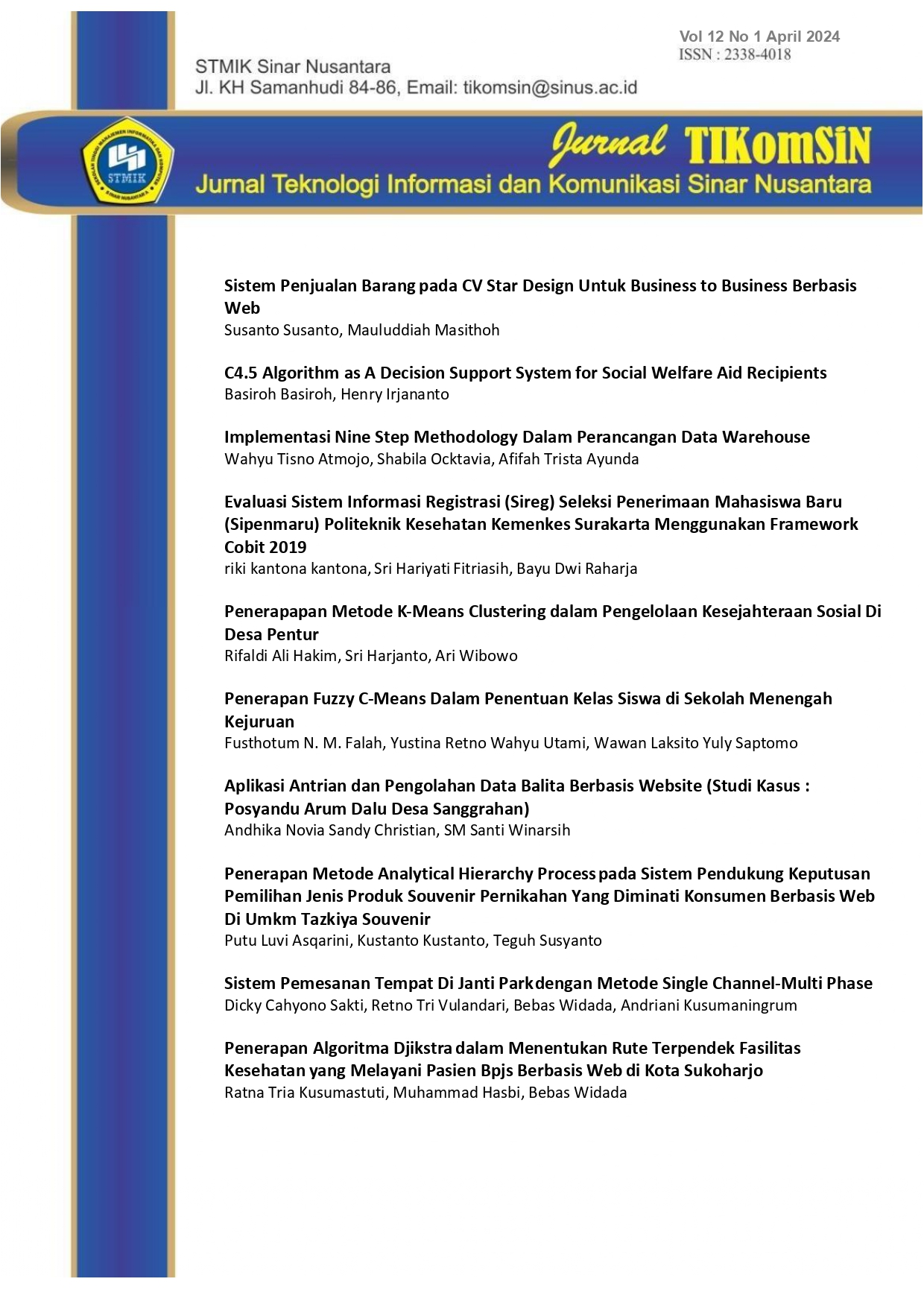
SISTEM PEMESANAN TEMPAT DI JANTI PARK DENGAN METODE SINGLE CHANNEL-MULTI PHASE
DOI:
https://doi.org/10.30646/tikomsin.v12i1.823Keywords:
Reservation, Single Channel-Multi Phase, web programmingAbstract
Janti Park is a new water attraction that was released at the year 2020. The place is suitable for family gatherings, often many visitors book places for social gatherings, birthdays and meetings. But in the process there are often obstacles in recapping reservations or ordering a place because the system is only via WA and comes directly to Janti Park. To be able to improve service to visitors in booking place, one solution that can be done is to Design a System Web-Based Place Reservation which has the aim of being able to makes it easier for visitors to book a place and no longer need to come to janti park and makes it easier to record reservations for places that have been booked by visitors. In designing this place ordering system using the Single method Channel – Multi Phase with analysis and implementation stages. At the coding stage using web programming languages (HTML, CSS, PHP and). The final results of this research were carried out using black box testing and user acceptance test.
References
P. Prasetyo, “Strategi Dinas Kebudayaan Pariwisata,†eJournal Ilmu Pemerintah., vol. 1, no. 1, pp. 151–164, 2013.
A. A. Poipessy and M. Umasangadji, “Pembuatan Aplikasi Jadwal Kerja Karyawan Berbasis Web Pada Stasiun Pengisian Bahan Bakar Umum (Spbu) Kalumata Ternate,†IJIS - Indones. J. Inf. Syst., vol. 3, no. 1, pp. 37–45, 2018, doi: 10.36549/ijis.v3i1.40.
I. S. Fitri and N. Koesdiningsih, “Analisis Sistem Antrian dengan Menggunakan Metode Single Channel - Multi Phase untuk Meminimumkan Waktu Tunggu pada Grapari Digilife Dago Bandung,†Pros. Manaj., pp. 861–865, 2016.
Y. G. Nengsih, “Optimalisasi Antrian Menggunakan Metode Single Channel Single Phase ( Studi Kasus DR . Reksodiwiryo Padang ) Struktur Antrian 1 . Single channel - single phase pelayanan . Sedangkan single phase adalah hanya memiliki satu stasiun pelayanan antrian yang ha,†J. Ilm. Perekam Dan Inf. Kesehat. Imelda, vol. 5, no. 1, pp. 30–39, 2020.
A. Josi, “Penerapan Metode Prototyping Dalam Membangun Website Desa (Studi Kasus Desa Sugihan Kecamatan Rambang),†Jti, vol. 9, no. 1, pp. 50–57, 2017.
A. H. Nugroho and T. Rohimi, “Perancangan Aplikasi Sistem Pengolahan DataPenduduk Dikelurahan Desa Kaduronyok Kecamatan Cisata, Kabupaten Pandeglang Berbasis Web,†Jutis, vol. 8, no. 1, pp. 17749231–5527063, 2020.
E. Usada, Y. Yuniarsyah, and N. Rifani, “Rancang Bangun Sistem Informasi Jadwal Perkuliahan Berbasis Jquery Mobile Dengan Menggunakan PHP Dan MySQL,†J. INFOTEL - Inform. Telekomun. Elektron., vol. 4, no. 2, p. 40, 2012, doi: 10.20895/infotel.v4i2.107.
P. Astuti, “Penggunaan Metode Black Box Testing (Boundary Value Analysis) Pada Sistem Akademik (Sma/Smk),†Fakt. Exacta, vol. 11, no. 2, p. 186, 2018, doi: 10.30998/faktorexacta.v11i2.2510.
I. Aini, N., Wicaksono, S. A., & Arwani, “Pembangunan Sistem Informasi Perpustakaan Berbasis Web menggunakan Metode Rapid Application Development (RAD)(Studi pada: SMK Negeri 11 Malang),†J. Pengemb. Teknol. Inf. dan Ilmu Komput., vol. 3, no. 9, pp. 8647–8655, 2019.
Downloads
Published
How to Cite
Issue
Section
Citation Check
License
Authors who publish with this journal agree to the following terms:
- Authors retain copyright and grant the journal right of first publication with the work simultaneously licensed under a Creative Commons Attribution License that allows others to share the work with an acknowledgement of the work's authorship and initial publication in this journal.
- Authors are able to enter into separate, additional contractual arrangements for the non-exclusive distribution of the journal's published version of the work (e.g., post it to an institutional repository or publish it in a book), with an acknowledgement of its initial publication in this journal.
- Authors are permitted and encouraged to post their work online (e.g., in institutional repositories or on their website) prior to and during the submission process, as it can lead to productive exchanges, as well as earlier and greater citation of published work (See The Effect of Open Access).
Â

This work is licensed under a Creative Commons Attribution-NonCommercial-ShareAlike 4.0 International License.