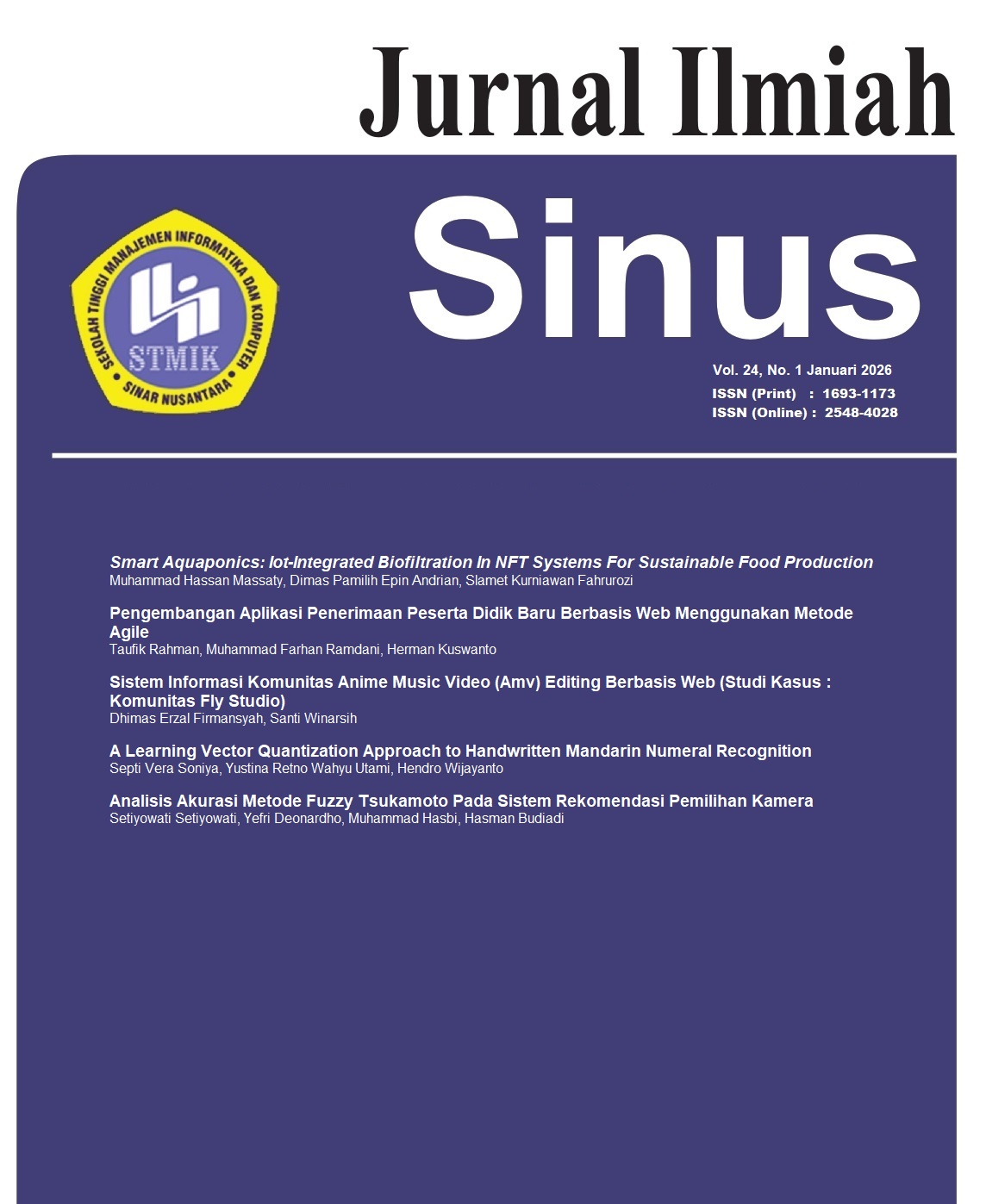
ANALISIS AKURASI METODE FUZZY TSUKAMOTO PADA SISTEM REKOMENDASI PEMILIHAN KAMERA
DOI:
https://doi.org/10.30646/sinus.v24i1.1072Keywords:
Photography, Fuzzy Tsukamoto, Recommendation SystemsAbstract
Photography is one of the fields of visual communication that has many enthusiasts in Indonesia. The development of cameras has undergone many changes over time, making a variety of camera options and components available, which creates confusion for consumers who are buying the camera that best suits their needs. Tsukamoto’s fuzzy method is a component of soft computing. In the Tsukamoto method, each consequence of an IF-THEN rule must be represented by a fuzzy set with a monotonous membership function. The purpose of making the application “Camera Selection Recommendation System with Tsukamoto Fuzzy Method at Photography Shop†is to explain the tsukamoto fuzzy method as one of the methods of selection techniques with criteria and also provide recommendations for camera buyers according to the desired criteria in the hope that people who are unfamiliar with cameras do not make the wrong choice when they want to buy a camera according to their functions and needs. The 'wrong choice' in this context refers to a functional mismatch where a consumer acquires a device that lacks essential technical specifications for their specific use case such as low battery endurance for outdoor shoots or insufficient video resolution for professional content or conversely, investing in high-end features that remain underutilized, leading to inefficient resource allocation.
References
A.S., R., & Shalahuddin, M. (2018). Rekayasa perangkat lunak terstruktur dan berorientasi objek edisi revisi. cite: 244.
Andrari, F. R., & Q., M. N. D. (2021). Penerapan Metode Fuzzy Mamdani Dalam Menentukan Harga Jual Ponsel Pintar Bekas (Studi Kasus Pada Kayyis Cellular Depok). Jurnal Ilmiah Komputer Grafis, 14.
Ardhandy, F. F., & Suryanto. (2025). Transformasi Estetika Fotografi dari Era Analog ke Era Digital pada Komunitas Fotogafer Semarang. Jurnal Ilmiah Ilmu Pendidikan & Sosial Humaniora, 2021, 103–114.
Gloria, P., & Sediyono, E. (2022). Perancangan Sistem Rekomendasi Pemberian Beasiswa dengan Metode Fuzzy Tsukamoto. Journal of Information Technology Ampera, 3(2), 124–147.
Kamisutara, M., & Purworusmiardi, T. (2016). PERANCANGAN APLIKASI SISTEM PENDUKUNG KEPUTUSAN UNTUK PEMILIHAN KAMERA DENGAN ADAPTIVE SOFTWARE DEVELOPMENT DAN WEIGHTIED. E-Jurnal NARODROID, 2(1).
Logo, J. F. B., W., A., & S., E. R. (2020). Model Berbasis Fuzzy Dengan Fis Tsukamoto Untuk Penentuan Besaran Gaji Karyawan Pada Perusahaan Swasta. Jurnal Teknoinfo, 14.
Mahrozi, N., & Yaqin, M. A. (2024). PENGUJIAN APLIKASI DENGAN METODE BLACKBOX TESTING: ANALISIS BOUNDARY VALUE DAN EQUIVALENCE PARTITIONING PADA APLIKASI SISTEM PAKAR KUCING. Jurnal Ilmiah Sain Dan Teknologi, 2(2), 257–265.
Mirawan, M. S. E. (2020). Analisis Penilaian Kinerja Dosen Mengajar Menggunakan Logika Fuzzy. Jurnal Unitek, 13.
Ompusunggu, A. N., & S., L. (2018). Sistem Pendukung Keputusan Seleksi Penerimaan Asisten Praktikum menggunakan Metode Fuzzy Tsukamoto. Jurnal MEANS, 3.
Sari, N. K., & Palumpun, Y. (2021). SISTEM PENDUKUNG KEPUTUSAN PEMILIHAN KAMERA MENGGUNAKAN METODE SIMPLE MULTI ATTRIBUTE RATING TECHNIQUE (SMART) BERBASIS WEB. Jurnal Teknologi Informasi, 9(1).
Sulastri, H. A., & T., F. R. (2021). SISTEM PENUNJANG KEPUTUSAN (SPK) SELEKSI PENERIMAAN DAN PENJURUSAN SISWA BARU MENGGUNAKAN SIMPLE ADDITIVE WEIGTHING (SAW) dan FUZZY TSUKOMOTO DI SMA NEGERI 1 KALIREJO. Journal of Informatics and Electrical Engineering, 3(1).
Wemaf, F. X. C., & T., S. A. (2021). STUDI NARATIF DALAM FOTOGRAFI CERITA KEHIDUPAN JOHN KEI. Jurnal Dimensi DKV Seni Rupa Dan Desain.
Zadeh, L. A. (1965). Fuzzy sets. In Information and Control (Vol. 8, Issue 3).
Downloads
Additional Files
Published
How to Cite
Issue
Section
Citation Check
License
Authors who publish with this journal agree to the following terms:
- Authors retain copyright and grant the journal right of first publication with the work simultaneously licensed under a Creative Commons Attribution License that allows others to share the work with an acknowledgement of the work's authorship and initial publication in this journal.
- Authors are able to enter into separate, additional contractual arrangements for the non-exclusive distribution of the journal's published version of the work (e.g., post it to an institutional repository or publish it in a book), with an acknowledgement of its initial publication in this journal.
- Authors are permitted and encouraged to post their work online (e.g., in institutional repositories or on their website) prior to and during the submission process, as it can lead to productive exchanges, as well as earlier and greater citation of published work (See The Effect of Open Access).
Â

This work is licensed under a Creative Commons Attribution-NonCommercial-ShareAlike 4.0 International License.