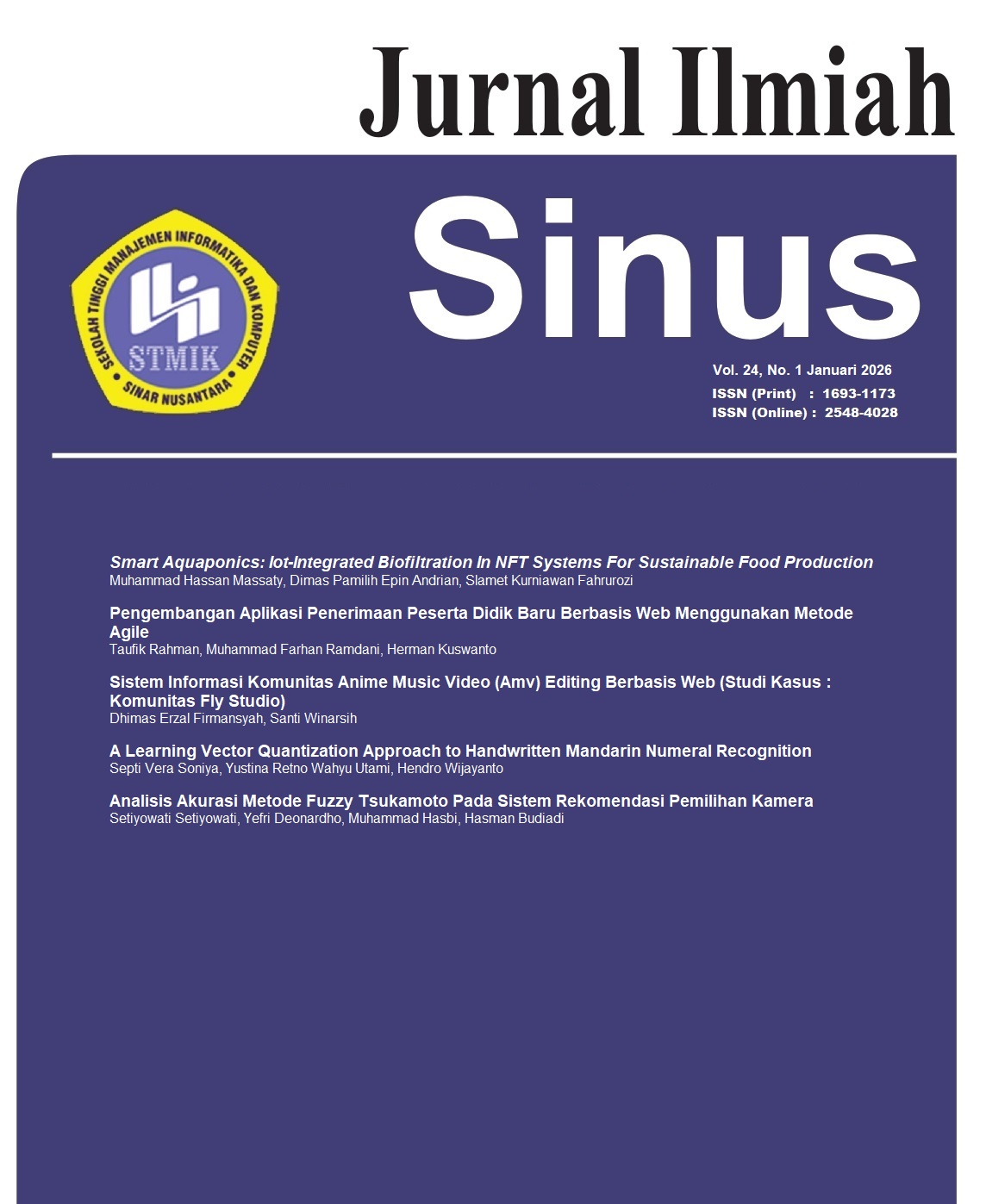
A Learning Vector Quantization Approach to Handwritten Mandarin Numeral Recognition
DOI:
https://doi.org/10.30646/sinus.v24i1.1073Keywords:
Learning Vector Quantization, Pattern Recognition, Mandarin NumbersAbstract
Numbers 1 to 10 in Mandarin are also studied in the Mandarin language learning process as basic numbers. Mandarin numbers have a different shape from Arabic numbers and Roman numerals. So it is necessary to recognize the pattern of mandarin numbers to help the learning process of mandarin. Therefore, the purpose of this research is to build an application that applies the Learning Vector Quantization method for handwriting pattern recognition of Mandarin numbers. System testing methods used are Black Box and Confusion Matrix for accuracy testing methods. The application that has been made produces an accuracy of 92.80% with a total of 250 test data. Keyword: Learning Vector Quantization, Pattern Recognition, Mandarin Numbers.
References
Angga Kurniawan, A., Dian Syah, R., & Ariyani, R. (2022). Klasifikasi Citra Digital Tulisan Tangan Angka Menggunakan Metode Convolutional Neural Network. JUIT, 1(1), 36–41. https://cezannec.github.io/
Daood, A., Al-Saegh, A., & Fadhil Mahmood, A. (2023). Handwriting Detection And Recognition Of Arabic Numbers And Characters Using Deep Learning Methods. In Journal of Engineering Science and Technology (Vol. 18, Number 3).
Fergina, A., Badrujaman, A., & Yustiana, I. (2022). Development of Android-Based Speech Recognition Application Using Learning Vector Quantization Method in Optimizing Deaf Communication. International Journal of Electrical Engineering and Information Technology, 05.
Handoko, A. A., Rosid, M. A., & Indahyanti, U. (2024). Implementasi Convolutional Neural Network (CNN) Untuk Pengenalan Tulisan Tangan Aksara Bima. SMATIKA JURNAL, 14(1), 96–110. https://doi.org/10.32664/smatika.v14i01.1196
Semuel, N., & Pekuwali, A. A. (2022). Pattern Recognition of Doctor’s Prescription Handwriting Using the Naïve Bayes Classifier Method at Puskesmas Kambaniru Pengenalan Pola Tulisan Tangan Resep Dokter Menggunakan Metode Naïve Bayes Classifier pada Puskesmas Kambaniru. MALCOM: Indonesian Journal of Machine Learning and Computer Science, 2(1), 55–61.
Kaparang, G. N. (2024). Bahasa Mandarin untuk Pemula. Deepublish Digital.
Sah, A., Korespondensi, P., Desi Alexander, A., & Tanniewa, A. M. (2025). Pengembangan Model Klasifikasi Citra Penyakit Daun Lada Menggunakan Jaringan Syaraf Tiruan Learning Vector Quantization (LVQ). JURNAL ILMIAH INFORMATIKA DAN ILMU KOMPUTER (JIMA-ILKOM), 4(1), 34–44. https://doi.org/10.58602/jima-ilkom.v4i1.53
Salsabila Citra Putri Winanto, C., Intan Nuraini, A., & Ibnu Adam Informatika, R. (2025). Pengenalan Angka Pada Citra Tulisan Tangan Menggunakan Algoritma Convolutional Neural Network (CNN). In Jurnal Mahasiswa Teknik Informatika) (Vol. 9, Number 4).
Semita, M. J. (2018). Bahasa Mandarin Untuk Pemula. Pusat Kajian Bahasa.
Subagyo, I. R., & Akbar, M. (2025). Hybrid Matrik Co-Occurence Dan Learning Vector Quantization Pada Klasifikasi Citra Gelombang Suara Perut. Jurnal Mahasiswa Teknik Informatika), 9(1), 850–857.
Wicaksana, C., & Lufianawati, D. (2021). Pengenalan Pola Vektor Tanda Tangan Citra Digital Menggunakan Metode Pembagian Wilayah dan Learning Vector Quantization (LVQ). Setrum : Sistem Kendali-Tenaga-Elektronika-Telekomunikasi-Komputer, 10. https://doi.org/10.36055/setrum.v10i2.13054
Downloads
Additional Files
Published
How to Cite
Issue
Section
Citation Check
License
Authors who publish with this journal agree to the following terms:
- Authors retain copyright and grant the journal right of first publication with the work simultaneously licensed under a Creative Commons Attribution License that allows others to share the work with an acknowledgement of the work's authorship and initial publication in this journal.
- Authors are able to enter into separate, additional contractual arrangements for the non-exclusive distribution of the journal's published version of the work (e.g., post it to an institutional repository or publish it in a book), with an acknowledgement of its initial publication in this journal.
- Authors are permitted and encouraged to post their work online (e.g., in institutional repositories or on their website) prior to and during the submission process, as it can lead to productive exchanges, as well as earlier and greater citation of published work (See The Effect of Open Access).
Â

This work is licensed under a Creative Commons Attribution-NonCommercial-ShareAlike 4.0 International License.