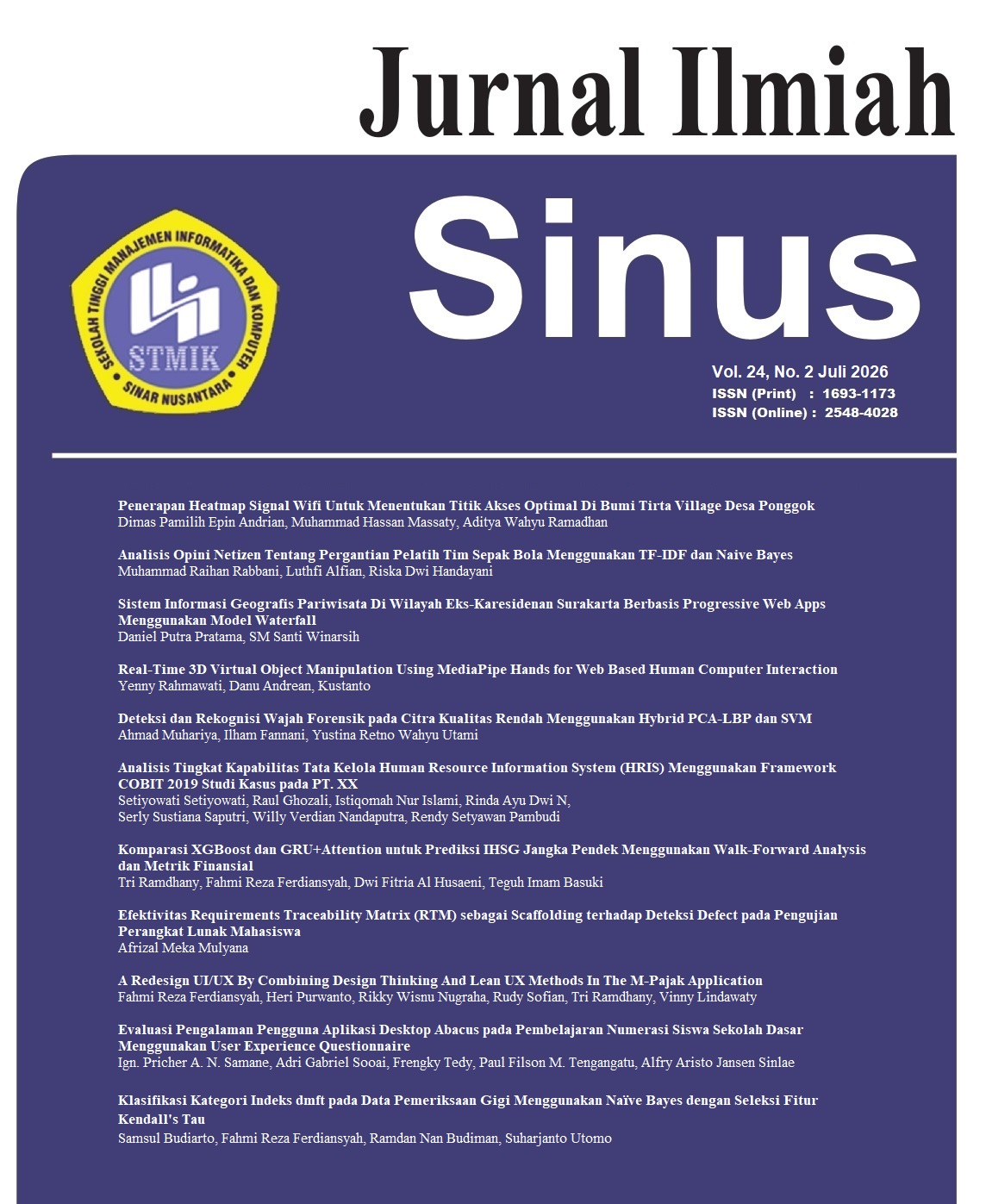
Deteksi dan Rekognisi Wajah Forensik pada Citra Kualitas Rendah Menggunakan Hybrid PCA-LBP dan SVM
DOI:
https://doi.org/10.30646/sinus.v24i2.1105Abstract
Face recognition and detection is a biometric technique widely used in digital forensics to identify perpetrators or victims from CCTV or mobile device image evidence, yet real-world evidence images are often low-quality due to blur, noise, small resolution, and poor lighting. The novelty of this study lies in a hybrid feature-extraction scheme combining Principal Component Analysis (PCA/Eigenface) and Local Binary Pattern (LBP), fused through a weighted sum rule whose weights are optimized per degradation type, coupled with three non-learning image enhancement techniques (Non-Local Means denoising, unsharp masking, and CLAHE), together with direct empirical evidence that naive feature fusion without weighting can degrade system performance. This study builds and directly tests the pipeline using 100 images from the official Labeled Faces in the Wild (LFW) subset bundled with the scikit-image library (50 face images and 50 non-face images, 25×25 pixels), evaluated using accuracy, precision, recall, F1-score, and ROC-AUC for the face-vs-non-face classification task, and rank-1 accuracy for the identification task on a gallery of 50 identities. The best results show a hybrid PCA+LBP-SVM classification accuracy of 95.0–97.5% depending on image quality conditions, while for the rank-1 identification task, the PCA feature excels under blur degradation (96%) but drops sharply under dark lighting (2%), the LBP feature shows the opposite pattern, and the weighted score fusion scheme succeeds in matching or exceeding the best single method under every condition. It should be noted that image enhancement does not always improve identification performance; under certain degradation conditions, enhancement actually sharply reduces rank-1 identification accuracy, indicating that the relationship between visual quality and recognition performance is not always linear. This study provides fully reproducible empirical evidence, based on a public dataset, on the contribution of each stage of the digital forensic pipeline to face recognition performance on low-quality image evidence.
Downloads
Published
How to Cite
Issue
Section
Citation Check
License
Authors who publish with this journal agree to the following terms:
- Authors retain copyright and grant the journal right of first publication with the work simultaneously licensed under a Creative Commons Attribution License that allows others to share the work with an acknowledgement of the work's authorship and initial publication in this journal.
- Authors are able to enter into separate, additional contractual arrangements for the non-exclusive distribution of the journal's published version of the work (e.g., post it to an institutional repository or publish it in a book), with an acknowledgement of its initial publication in this journal.
- Authors are permitted and encouraged to post their work online (e.g., in institutional repositories or on their website) prior to and during the submission process, as it can lead to productive exchanges, as well as earlier and greater citation of published work (See The Effect of Open Access).
Â

This work is licensed under a Creative Commons Attribution-NonCommercial-ShareAlike 4.0 International License.