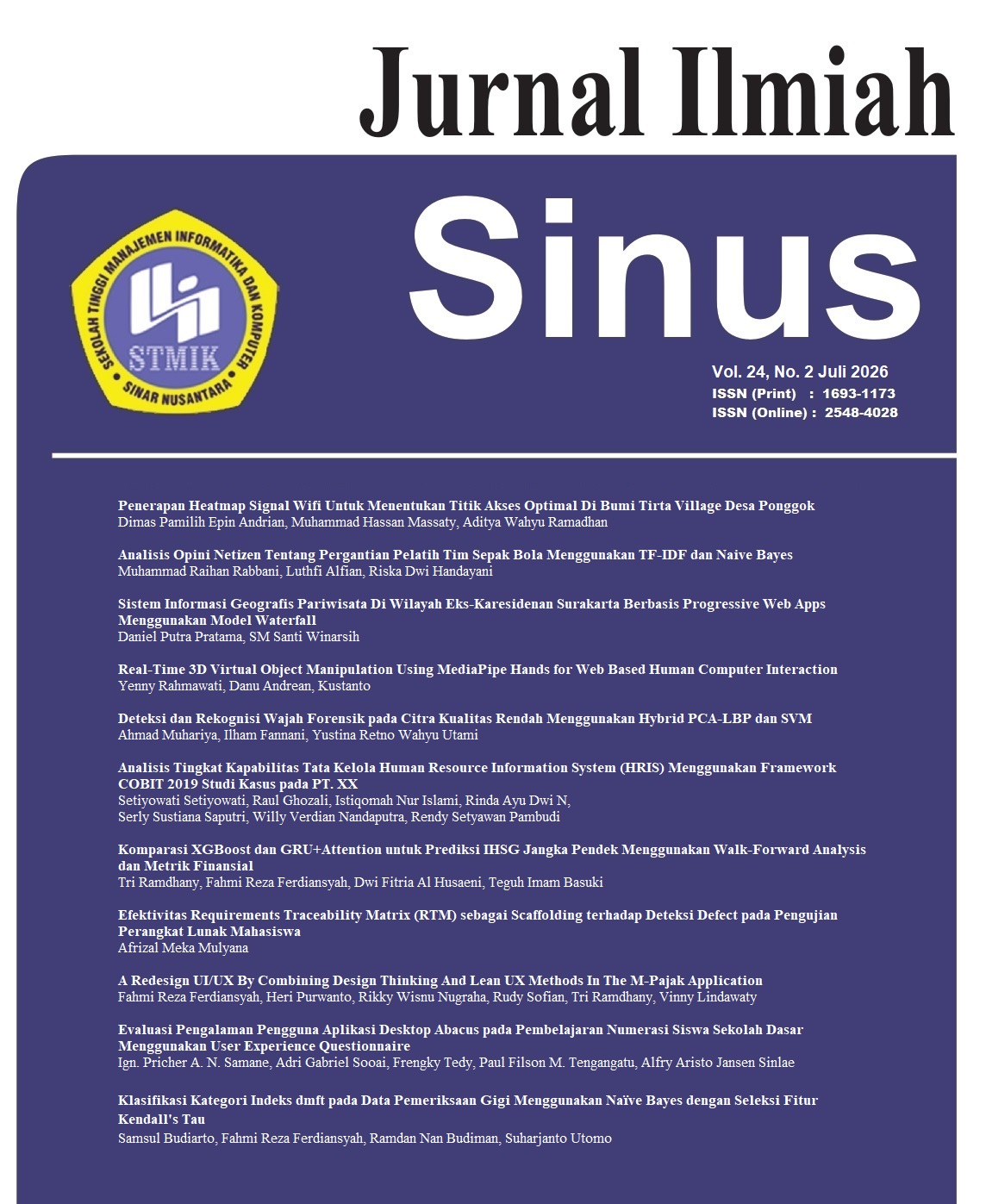
Evaluasi Pengalaman Pengguna Aplikasi Desktop Abacus pada Pembelajaran Numerasi Siswa Sekolah Dasar Menggunakan User Experience Questionnaire
DOI:
https://doi.org/10.30646/sinus.v24i2.1117Abstract
Despite the growing use of digital tools in elementary mathematics education, empirical evaluation of user experience for child-oriented numeracy applications remains limited, particularly for desktop-based tools such as Abacus. This gap matters because application development without direct evaluation by child users may not reflect their actual needs. Previous Abacus-related studies have mainly focused on learning outcomes, while users' perceptions of pragmatic and hedonic quality remain underexplored. This study evaluates the user experience of the Abacus desktop application using the User Experience Questionnaire (UEQ), complemented by semi-structured interviews with selected students and teachers to support interpretation of the findings. A descriptive quantitative design with qualitative supporting data was adopted, involving 200 elementary school students in grades IV–VI, aged 9–12 years, from three elementary schools in Kupang Regency, selected through purposive sampling. The UEQ assessed six dimensions: Attractiveness, Perspicuity, Efficiency, Dependability, Stimulation, and Novelty, analyzed using mean, variance, standard deviation, and 95% confidence intervals. All six dimensions achieved positive mean scores. The highest ratings were found for Attractiveness (2.464), Stimulation (2.463), and Perspicuity (2.461), reflecting favorable perceptions of the application's appeal, motivating quality, and ease of use. The Novelty dimension recorded the lowest mean score (1.935), though still positive, suggesting room for further innovation. Interview findings supported these patterns, with students and teachers reporting positive impressions of the application's appeal and engagement. Overall, the Abacus desktop application provides a positive user experience for elementary school students, with future development recommended to prioritize novelty and interactive features.
Downloads
Published
How to Cite
Issue
Section
Citation Check
License
Authors who publish with this journal agree to the following terms:
- Authors retain copyright and grant the journal right of first publication with the work simultaneously licensed under a Creative Commons Attribution License that allows others to share the work with an acknowledgement of the work's authorship and initial publication in this journal.
- Authors are able to enter into separate, additional contractual arrangements for the non-exclusive distribution of the journal's published version of the work (e.g., post it to an institutional repository or publish it in a book), with an acknowledgement of its initial publication in this journal.
- Authors are permitted and encouraged to post their work online (e.g., in institutional repositories or on their website) prior to and during the submission process, as it can lead to productive exchanges, as well as earlier and greater citation of published work (See The Effect of Open Access).
Â

This work is licensed under a Creative Commons Attribution-NonCommercial-ShareAlike 4.0 International License.