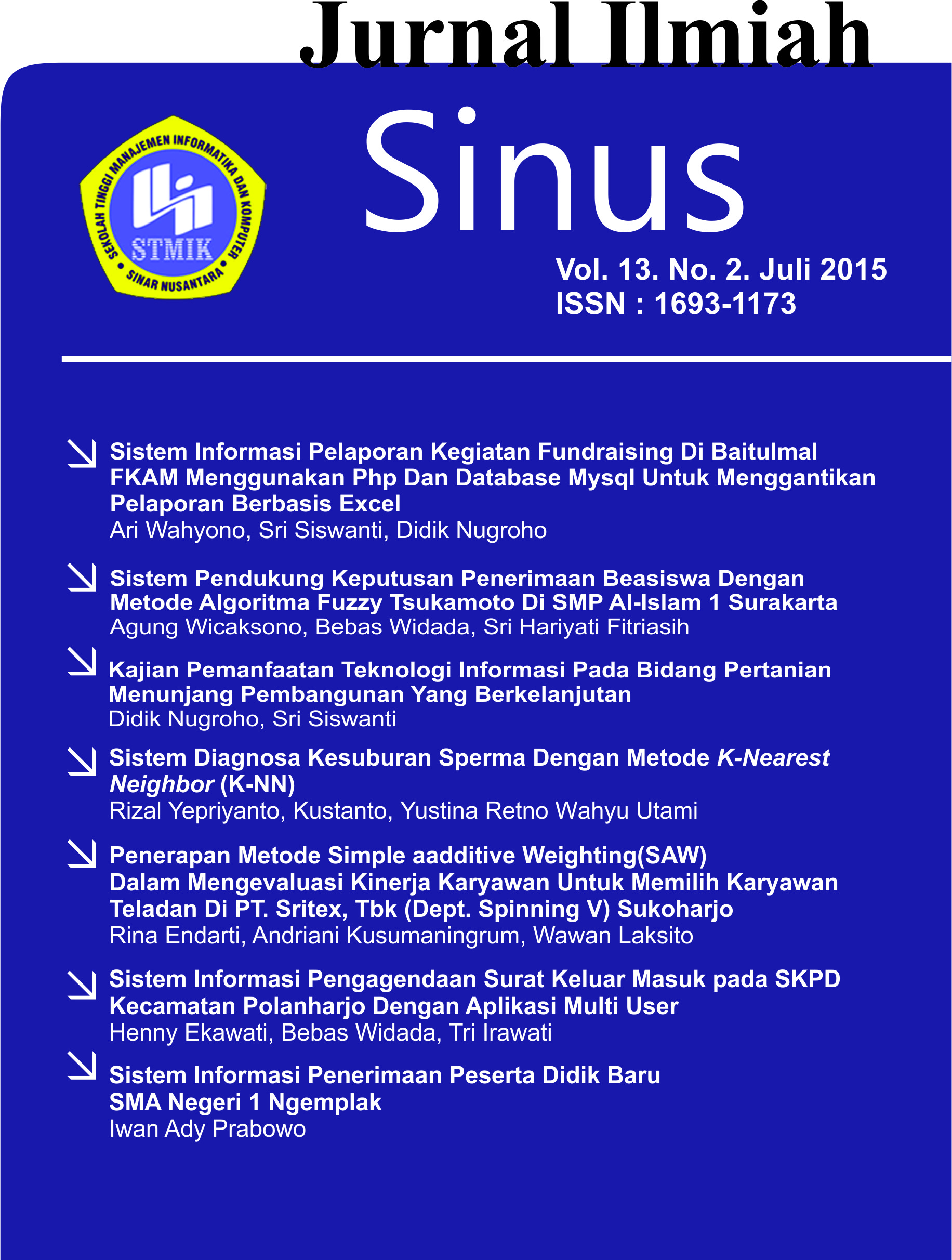
SISTEM PENDUKUNG KEPUTUSAN PENERIMAAN BEASISWA DENGAN METODE ALGORITMA FUZZY TSUKAMOTO DI SMP AL-ISLAM 1 SURAKARTA
DOI:
https://doi.org/10.30646/sinus.v13i2.214Abstract
Scholarships interpreted as a form of an award given to individuals in order to continue their education to a higher level. the provision of such financial assistance granted to individuals, college students or students who are used for the continuation of education reached by the scholarship program is expected to ease the burden of students in studying in particular the issue of costs.
Tsukamoto fuzzy logic reasoning is one method that can be applied to construct a system as problem solving how to determine which eligible students in obtaining scholarships on the basis of interviews conducted by the authors to the organizing committee are as follows scholarship amount of income parents, the value of the interview conditions Economic family residence criteria, and the value - average semester. Based on the results of testing this application is very helpful team selectors scholarship reception in SMP Al-Islam 1 Surakarta because the calculation result of this application form and then through a total score ranking system will be known to the students who deserve a scholarship.
Â
Keywords: Scholarship, Fuzzy Tsukamoto, SMP Al-Islam 1 Surakarta.
Downloads
Published
How to Cite
Issue
Section
Citation Check
License
Authors who publish with this journal agree to the following terms:
- Authors retain copyright and grant the journal right of first publication with the work simultaneously licensed under a Creative Commons Attribution License that allows others to share the work with an acknowledgement of the work's authorship and initial publication in this journal.
- Authors are able to enter into separate, additional contractual arrangements for the non-exclusive distribution of the journal's published version of the work (e.g., post it to an institutional repository or publish it in a book), with an acknowledgement of its initial publication in this journal.
- Authors are permitted and encouraged to post their work online (e.g., in institutional repositories or on their website) prior to and during the submission process, as it can lead to productive exchanges, as well as earlier and greater citation of published work (See The Effect of Open Access).
Â

This work is licensed under a Creative Commons Attribution-NonCommercial-ShareAlike 4.0 International License.