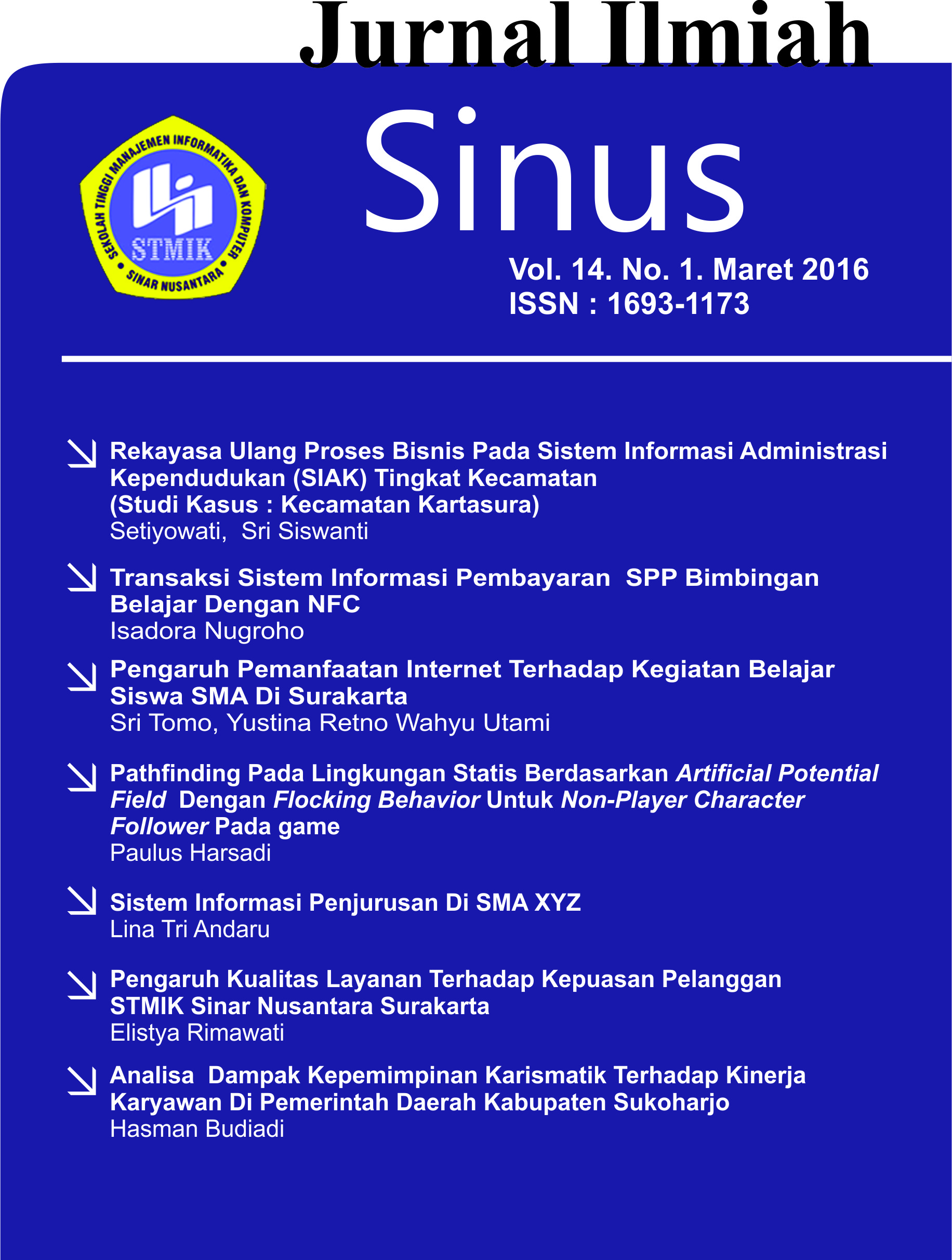
PATHFINDING PADA LINGKUNGAN STATIS BERDASARKAN ARTIFICIAL POTENTIAL FIELD DENGAN FLOCKING BEHAVIOR UNTUK NON-PLAYER CHARACTER FOLLOWER PADA GAME
DOI:
https://doi.org/10.30646/sinus.v14i1.233Abstract
Artificial Intelligence in video games are an essential to provide a challenge to the players. One of them makes the character or Follower NPC (non-player character Follower) in video games such as human or animal behavior indeed. Among the many techniques in Artificial Intelligence, pathfinding is one of the popular techniques studied than the other. In own pathfinding is to avoid obstacles that is one of the main problem. Algorithm which solves this problem is Astarpathfinding, but it has a disadvantage in determining way in the large area. AstarPathfinding requires high computing time. In this research, the proposed algorithm which is able to handle the pathfinding process by using the function attractive potential field of Artificial Potential Field to perform pathfinding to the purpose and the flocking behavior techniques to avoid the obstacle. Based on the test results through environments static simulation, it can be gotten that the proposed algorithm has a faster computation time than the comparison algorithm, Astarpathfinding algorithm.
Â
Kata Kunci : Artificial Intelligence, Game, pathfinding, Artificial Potential Field, Flocking behavior
Downloads
Published
How to Cite
Issue
Section
Citation Check
License
Authors who publish with this journal agree to the following terms:
- Authors retain copyright and grant the journal right of first publication with the work simultaneously licensed under a Creative Commons Attribution License that allows others to share the work with an acknowledgement of the work's authorship and initial publication in this journal.
- Authors are able to enter into separate, additional contractual arrangements for the non-exclusive distribution of the journal's published version of the work (e.g., post it to an institutional repository or publish it in a book), with an acknowledgement of its initial publication in this journal.
- Authors are permitted and encouraged to post their work online (e.g., in institutional repositories or on their website) prior to and during the submission process, as it can lead to productive exchanges, as well as earlier and greater citation of published work (See The Effect of Open Access).
Â

This work is licensed under a Creative Commons Attribution-NonCommercial-ShareAlike 4.0 International License.