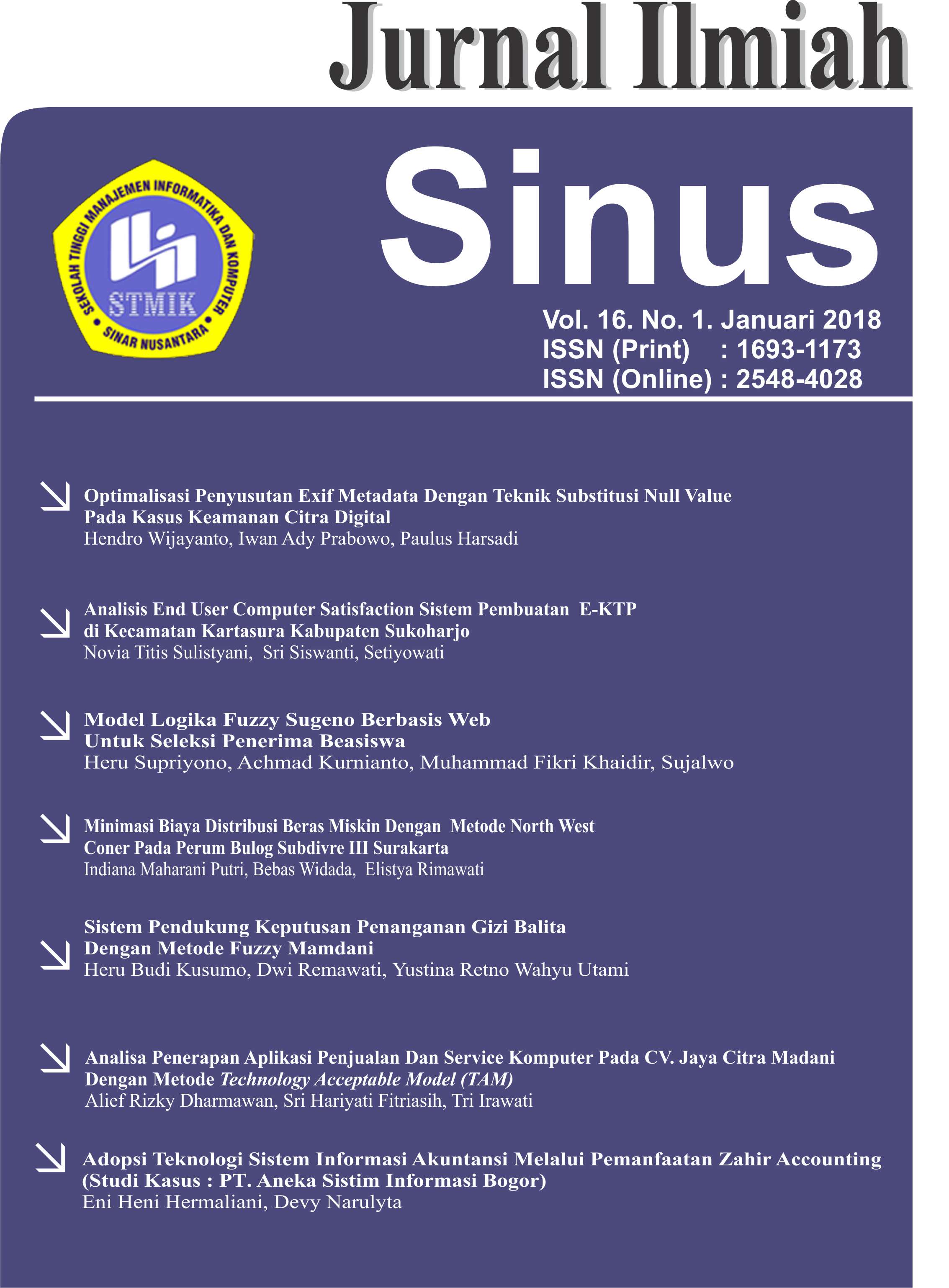
OPTIMALISASI PENYUSUTAN EXIF METADATA DENGAN TEKNIK SUBSTITUSI NULL VALUE PADA KASUS KEAMANAN CITRA DIGITAL
DOI:
https://doi.org/10.30646/sinus.v16i1.327Keywords:
substitution, EXIF, optimization, metadata, security, image forensicAbstract
Data and information security technique is a way to keep an object confidential. eXchangable Image File Format (EXIF) Metadata is data information about digital image. In the digital forensic investigation, this is very useful for copyright security or safeguarding digital evidence. Steganography and cryptography techniques have been widely used to overcome these problem. However, from the research that has been done in terms of security EXIF of metadata digital image photography, there are still some weaknesses. Among them is the depreciation of the digital image size after decryption. Since the standard EXIF metadata treatmens released by JEIDA and CIPA have different characteristic with JFIF metadata. A null value will be deemed to be the content with a value of 1 in EXIF standard. While in JFIF metadata model, the value of null is considered to be worth 0 (zero). This is make the EXIF metadata security process is shrinking of -25,15% from the original size. With the optimizing null value before encryption, the same metadata will be obtained between original image and after decryption. The null value will be replaced with an empty string (it’s worth 1) before encryption. Results from the model obtained an average of -1,51% depreciation of the original digital image size.Therefore, this technique can optimize the digital image copyright protection.
References
Casey, E. (2011). Digital Evidance And Computer Crime. Computer.
CIPA (Camera & Imaging Product Association). (2012). CIPA DC- 008 - Translation - 2012.
Huang, H. C., & Fang, W. C. (2010). Metadata-based image watermarking for copyright protection. Simulation Modelling Practice and Theory, 18(4), 436–445. https://doi.org/10.1016/j.simpat.2009.09.004
JEIDA (Japan Electronic Industries Development Association). (2012). Metadata reference tables Standard Exif Tags.
Ltd, N. 2000. (2000). Data Masking : What You Need to Know. A Net 2000 Ltd. White Paper, 25.
McMicken, B. (2014). Using EXIF Metadata. International Crime Scene Investigators Association, 1–20.
Raghavan, S., & Raghavan, S. V. (2014). Eliciting file relationships using metadata based associations for digital forensics. CSI Transactions on ICT, 2(1), 49–64. https://doi.org/10.1007/s40012-014-0046-4
Sencar, H. T., & Memon, N. (2009). Identification and recovery of JPEG files with missing fragments. Digital Investigation, 6(SUPPL.), 88–98. https://doi.org/10.1016/j.diin.2009.06.007
Wijayanto, H., Riadi, I., & Prayudi, Y. (2016). Encryption EXIF Metadata for Protection Photographic Image of Copyright Piracy. International Journal of Research in Computer and Communication Technology, 5(5), 237–242.
Zhou, H., Shen, Y., Zhu, X., Liu, B., Fu, Z., & Fan, N. (2016). Digital image modification detection using color information and its histograms. Forensic Science International, 266, 379–388. https://doi.org/10.1016/j.forsciint.2016.06.005
Downloads
Published
How to Cite
Issue
Section
Citation Check
License
Authors who publish with this journal agree to the following terms:
- Authors retain copyright and grant the journal right of first publication with the work simultaneously licensed under a Creative Commons Attribution License that allows others to share the work with an acknowledgement of the work's authorship and initial publication in this journal.
- Authors are able to enter into separate, additional contractual arrangements for the non-exclusive distribution of the journal's published version of the work (e.g., post it to an institutional repository or publish it in a book), with an acknowledgement of its initial publication in this journal.
- Authors are permitted and encouraged to post their work online (e.g., in institutional repositories or on their website) prior to and during the submission process, as it can lead to productive exchanges, as well as earlier and greater citation of published work (See The Effect of Open Access).
Â

This work is licensed under a Creative Commons Attribution-NonCommercial-ShareAlike 4.0 International License.