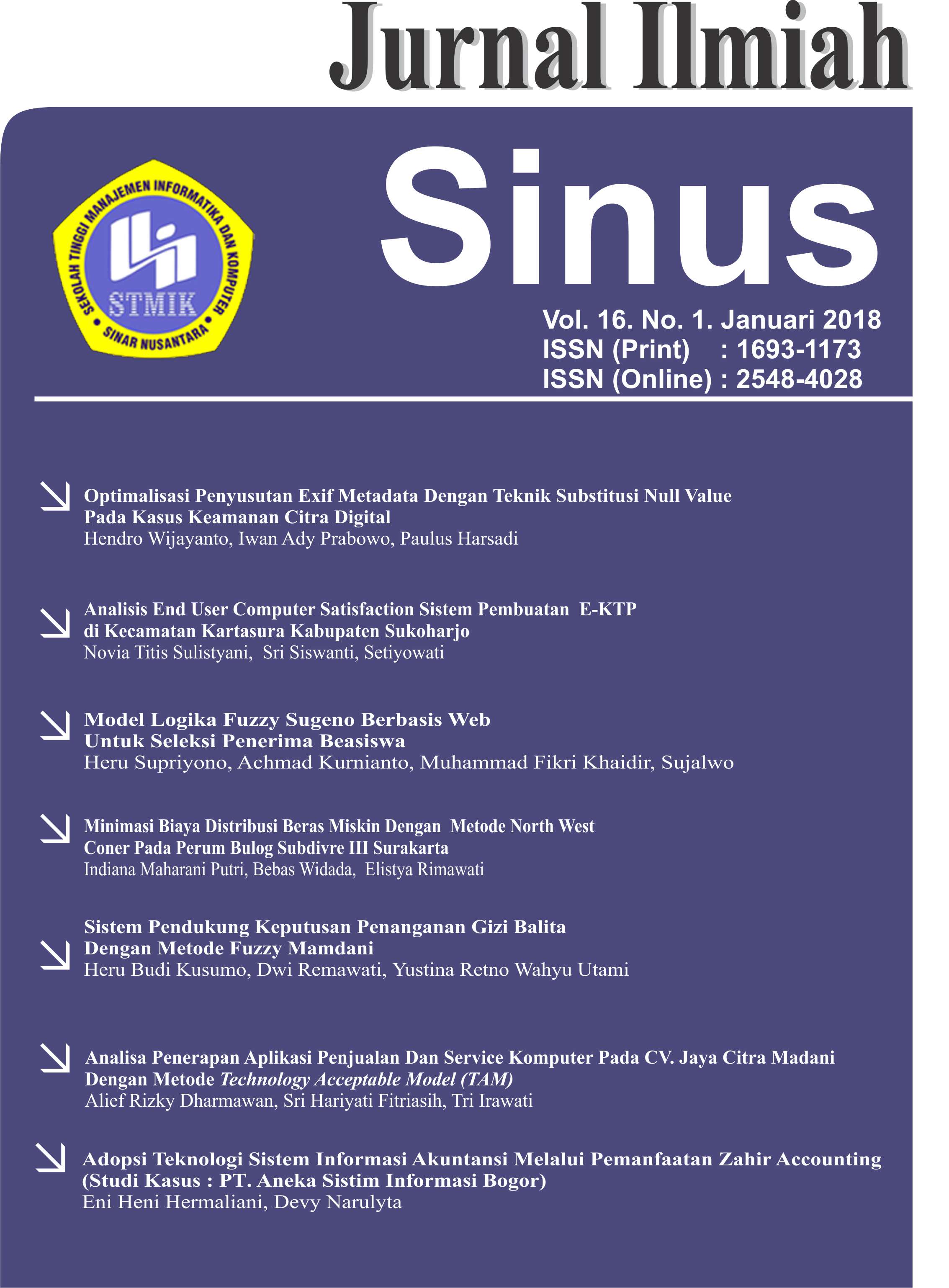
MODEL LOGIKA FUZZY SUGENO BERBASIS WEB UNTUK SELEKSI PENERIMA BEASISWA
DOI:
https://doi.org/10.30646/sinus.v16i1.329Keywords:
scholarship selection, fuzzy logic Sugeno, decision support systems, expert systems, web-based systemsAbstract
One of the main problems emerging in the decision making process by human is the possibilities of bias decision caused by personal factors. This paper discusses the development of a Fuzzy Sugeno based decision support systems for selecting scholarship recipients which is implemented in a web based systems. The main objectives of the research are to result a Fuzzy Sugeno model which mimic human reasoning in the scholarship selection and to calculate recommendation value of every applicant. There are five factors used in the computation involving grade point average (GPA), parent’s income, number of sibling, organization activities, and achievement. Traditional system development life cycle or waterfall method was used in the system development process. Fuzzy Sugeno model is implemented mainly using Django framework with Python programming language. The result of the research is the web based decision support systems for selecting scholarship recipient. The blackbox testing of the decision support systems showed that all functions of the systems are functioning well as expected and the validation testing result using real data showed that the validity level I equals to 92.3 %.
References
Badiru, A., & Cheung, J. Y. (2002). Fuzzy Engineering Expert Systems With Neural Network. New York: John Wiley and Sons.
Daws, K. M., Al-Dawood, Z. I., & Al-Kabi, S. H. (2009). Fuzzy Logic Approach for Metal Casting Selection Process. Jordan Journal of Mechanical Engineering, Vol. 3, No. 3, 162-167.
Etikariena, A. (2014). Perbedaan Kelelahan Kerja Berdasarkan Makna Kerja Pada Karyawan. Psikogenesis, Vol. 2, No. 2, 169-179.
Fonseca, J., Afonso, L.J., Martins, J. S., & Couto, C. (1999). Fuzzy Logic Speed Control of an Induction Motor. Microprocessors and Microsystems, Vol. 22, No. 1999, 523-534.
Pressman, R. S. (2001). Software Engineering A Practitioner’s Approach, 5th ed. Boston: McGraw-Hill.
Sajfert, Z., Atanaskovic, P., Pamucar, D., & Nikolic, M. (2012). Application of Fuzzy Logic Into Process of Decision Making Regarding Selection of Managers. African Journal of Business Management, Vol 6, No. 9, 3221-3233.
Sommerville, I. (2011). Software Engineering, Ninth Edition. Boston: Addison-Wesley.
Supriyono, H., Saputro, N. A. & Pradessya, R. A. (2016). Rancang Bangun Sistem Informasi Manajemen Presensi Berbasis SMS Gateway (Studi Kasus : SMP Muhammadiyah 1 Kartasura). Prosiding The 3rdUniversty Research Coloquium 2016. 13 Februari 2016. ISSN 2407-9189, 1-15
Supriyono, H., Khaidir, M.F., Kurnianto, A., & Sujalwo. (2017). Implementasi Logika Kabur Untuik Seleksi Calon Penerima Beasiswa Dalam Sistem Berbasis Web. Prosiding The 5th Urecol 2017, Yogyakarta , 18 Februari 2017, 1171-1178.
Supriyono, H. & Sari, C.P. (2015). Pemilihan Rumah Tinggal Menggunakan Metode Weighted Product. Khazanah Informatika, Vol. I No. 1, 23-28.
Turban, E., Aronson, J. E., & Liang, J. P. (2007). Decision Support Systems and Intelligent Systems 7th Edition. New Delhi: Prentice Hall.
Wibowo, H., Amalia, R., Fadlun, A., & Arivanty, K. (2009). Sistem Pendukung Keputusan Untuk Menentukan Penerima Beasiswa Bank BRI Menggunakan FMADM (Studi Kasus: Mahasiswa Fakultas Teknologi Industri Universitas Islam Indonesia). Prosiding Seminar Nasional Aplikasi Teknologi Informasi (SNATI) 2009, Yogyakarta, 20 Juni 2009, B-62-B-67 .
Wikipedia, Beasiswa, https://id.wikipedia.org/wiki/Beasiswa (diakses 19 September 2017)
Downloads
Published
How to Cite
Issue
Section
Citation Check
License
Authors who publish with this journal agree to the following terms:
- Authors retain copyright and grant the journal right of first publication with the work simultaneously licensed under a Creative Commons Attribution License that allows others to share the work with an acknowledgement of the work's authorship and initial publication in this journal.
- Authors are able to enter into separate, additional contractual arrangements for the non-exclusive distribution of the journal's published version of the work (e.g., post it to an institutional repository or publish it in a book), with an acknowledgement of its initial publication in this journal.
- Authors are permitted and encouraged to post their work online (e.g., in institutional repositories or on their website) prior to and during the submission process, as it can lead to productive exchanges, as well as earlier and greater citation of published work (See The Effect of Open Access).
Â

This work is licensed under a Creative Commons Attribution-NonCommercial-ShareAlike 4.0 International License.