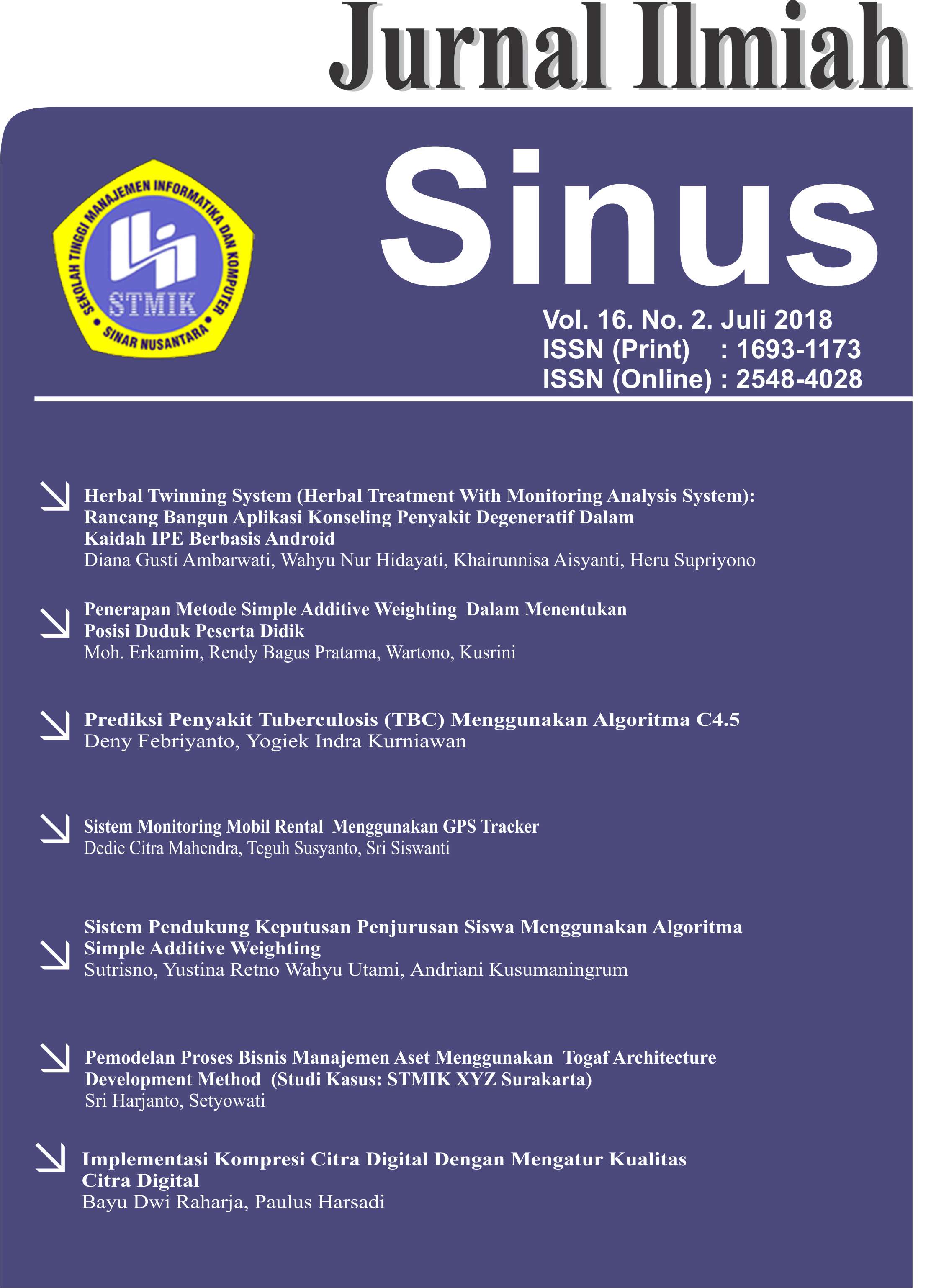
SISTEM PENDUKUNG KEPUTUSAN PENJURUSAN SISWA MENGGUNAKAN ALGORITMA SIMPLE ADDITIVE WEIGHTING
DOI:
https://doi.org/10.30646/sinus.v16i2.356Keywords:
Decision Support System, High School Majors, Simple Additive WeightingAbstract
Inappropriately high school majors can be detrimental to students in the future. With the right majors are expected to maximize the potential, talent and ability of individual students, so that will maximize the academic value of these students. The method of majors conducted in a school is basically still using conventional methods so there are some weaknesses of the method and in the determination of its course only based on ranking, without specifying the weight of each criteria, with the method based on the analysis and experience that happened there are still some students can not compete with his classmates in developing his academic potential and ultimately to solve the problem in one school to re-clarify at the beginning of the even semester which aims to map the ability of each student and the necessity to build a student majors application based on the academic potential that is able to generate maximum decisions from each student, by looking at the existing problems it is needed an alternative solution that is by designing and building Supporting System Decision in Simple Additive Weighting (SAW) method, supported by Unified Modeling Language (UML) as application design, PHP as programming language and MySQL as its database. In the test of the built application, using the Blackbox method, and the system feasibility test results using 25 test attributes, 21 valid attributes and 4 invalid attributes and a feasibility value generated from the system of 84%, thus the application is eligible to use despite the repair and development still needs to be improved.
References
Jaberidoost, M., Olfat, L., Hosseini, A., Kebriaeezadeh, A., Abdollahi, M., Alaeddini, M., & Dinarvand, R. (2015). Pharmaceutical Supply Chain Risk Assessment In Iran Using Analytic Hierarchy Process (Ahp) And Simple Additive Weighting (Saw) Methods. Journal Of Pharmaceutical Policy And Practice, 8(1), 1–10. Https://Doi.Org/10.1186/S40545-015-0029-3
Kusrini. (2010). Konsep Dan Aplikasi Sistem Pendukung Keputusan. Yogyakarta.
Kustiyahningsih, Y., & Rahmanita, E. (2016). Aplikasi Sistem Pendukung Keputusan Menggunakan Algoritma C4.5. Untuk Penjurusan SMA. Jurnal Semantec, 5(2), 101–108.
Nugroho, Y. S., & Haryati, S. N. (2015). Klasifikasi Dan Klastering Penjurusan Siswa Sma Negeri 3 Boyolali. Khazanah Informatika, 1(1), 1–6.
Sasongko, N. T., Tomo, S., & Fitriasih, S. H. (2018). Sistem Penunjang Keputusan Calon Desa Penerima Air Bersih Di Kecamatan Sumberlawang Sragen Menggunakan. Jurnal TIKomSiN, 6(1), 37–44.
Shakouri G., H., Nabaee, M., & Aliakbarisani, S. (2014). A quantitative discussion on the assessment of power supply technologies: DEA (data envelopment analysis) and SAW (simple additive weighting) as complementary methods for the “Grammar.†Energy, 64, 640–647. https://doi.org/10.1016/J.ENERGY.2013.10.022
Tamošaitienė, J., Zavadskas, E. K., & Turskis, Z. (2013). Multi-criteria Risk Assessment of a Construction Project. Procedia Computer Science, 17, 129–133. https://doi.org/10.1016/J.PROCS.2013.05.018
Yu, J. W. (2015). A fuzzy multi-criteria decision-making model based on simple additive weighting method and relative preference relation. Appl. Soft Comput., 30, 412–420.
Downloads
Published
How to Cite
Issue
Section
Citation Check
License
Authors who publish with this journal agree to the following terms:
- Authors retain copyright and grant the journal right of first publication with the work simultaneously licensed under a Creative Commons Attribution License that allows others to share the work with an acknowledgement of the work's authorship and initial publication in this journal.
- Authors are able to enter into separate, additional contractual arrangements for the non-exclusive distribution of the journal's published version of the work (e.g., post it to an institutional repository or publish it in a book), with an acknowledgement of its initial publication in this journal.
- Authors are permitted and encouraged to post their work online (e.g., in institutional repositories or on their website) prior to and during the submission process, as it can lead to productive exchanges, as well as earlier and greater citation of published work (See The Effect of Open Access).
Â

This work is licensed under a Creative Commons Attribution-NonCommercial-ShareAlike 4.0 International License.