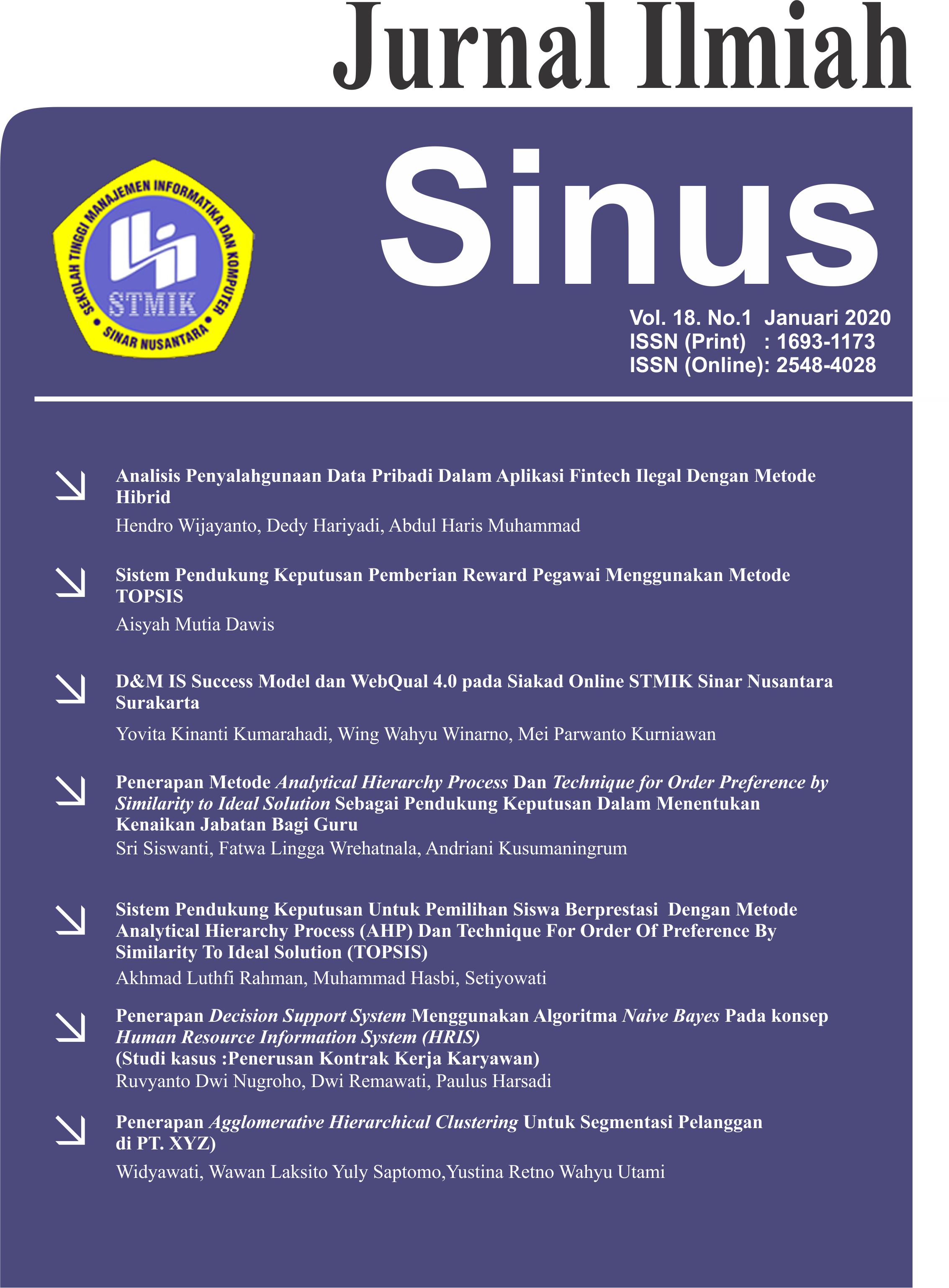
Analisis Penyalahgunaan Data Pribadi Dalam Aplikasi Fintech Ilegal Dengan Metode Hibrid
DOI:
https://doi.org/10.30646/sinus.v18i1.433Keywords:
Digital Forensic Analysis, Hybrid Analysis, Fintech, Personal Data, Data BreachAbstract
Penetration of internet usage in Indonesia has increased by 10.12% from 2017 to 2018. This has led to very rapid technological growth, such as the growth of online loan services or Financial Technology (Fintech). This condition makes the emergence of illegal fintech services built by certain groups to reap profits. Illegal fintech service providers stand building applications with a lot of personal data requested at registration. Starting from personal data, family, work up to banking are accompanied by photo evidence and contact numbers. Hybrid analysis is needed to see the extent in which the fintech application treats customer data. In this technique, there are static analysis and dynamic analysis. Static analysis is used to see the extent in which the fintech application runs on Smartphone devices with required data and other policies. Dynamic analysis is used to view the activity of tiles and permissions of fintech applications from source code, malware analysis, and permission analysis. Hybrid analysis results show that all fintech applications have a huge potential for misuse of customer's personal data. This is indicated by the existence of a data collection URL that can be accessed by the public, there are malware activities, READ_PHONE_STATE and READ_CONTACS permissions so that fintech application providers freely monitor all contact activities, locations on the customer's Smartphone. The results of the analysis can be used to recommend fintech service users to be careful of fintech applications. Moreover, it can be used as a reference for making illegal fintech detection frameworks.
References
Asosiasi Penyelenggara Jasa Internet Indonesia (APJII). (2018). Infografis Penetrasi & Perilaku Pengguna Internet Indonesia. Indonesia.
Baryamureeba, V., & Tushabe, F. (2004). The Enhanced Digital Investigation Process Model. Proceedings of the Digital Forensic Research Conference, DFRWS 2004 USA, 1–9.
Dewi Rosadi, S., & Gumelar Pratama, G. (2018). Urgensi Perlindungandata Privasidalam Era Ekonomi Digital Di Indonesia. Veritas et Justitia, 4(1), 88–110. https://doi.org/10.25123/vej.2916
Lin, X., Chen, T., Zhu, T., Yang, K., & Wei, F. (2018). Automated forensic analysis of mobile applications on Android devices. Digital Investigation, 26, S59–S66. https://doi.org/10.1016/j.diin.2018.04.012
Mark, R.-O. (2013). Information Security The Complete Reference, Second Edition. 896. Retrieved from www.it-ebooks.info/book/3340
Palmer, G. L. (2001). A Road Map for Digital Forensic Research.
Rahmadani, V. S., Raharjana, I. K., & Taufik, T. (2015). Penerapan Reverse Engineering Dalam Penentuan Pola Interaksi Sequence Diagram Pada Sampel Aplikasi Android. Journal of Information Systems Engineering and Business Intelligence, 1(1), 25. https://doi.org/10.20473/jisebi.1.1.25-32
Rosadi, S. D. (2017). Prinsip-Prinsip Perlindungan Data Pribadi Nasabah Kartu Kredit Menurut Ketentuan Nasional dan Implementasinya. Sosiohumaniora, 19(3), 206–212.
Sautunnida, L. (2018). Urgensi Undang-undang Perlindungan Data Pribadi di Indonesia. Kanun Jurnal Ilmu Hukum, 20(2), 369–384.
Downloads
Published
How to Cite
Issue
Section
Citation Check
License
Authors who publish with this journal agree to the following terms:
- Authors retain copyright and grant the journal right of first publication with the work simultaneously licensed under a Creative Commons Attribution License that allows others to share the work with an acknowledgement of the work's authorship and initial publication in this journal.
- Authors are able to enter into separate, additional contractual arrangements for the non-exclusive distribution of the journal's published version of the work (e.g., post it to an institutional repository or publish it in a book), with an acknowledgement of its initial publication in this journal.
- Authors are permitted and encouraged to post their work online (e.g., in institutional repositories or on their website) prior to and during the submission process, as it can lead to productive exchanges, as well as earlier and greater citation of published work (See The Effect of Open Access).
Â

This work is licensed under a Creative Commons Attribution-NonCommercial-ShareAlike 4.0 International License.