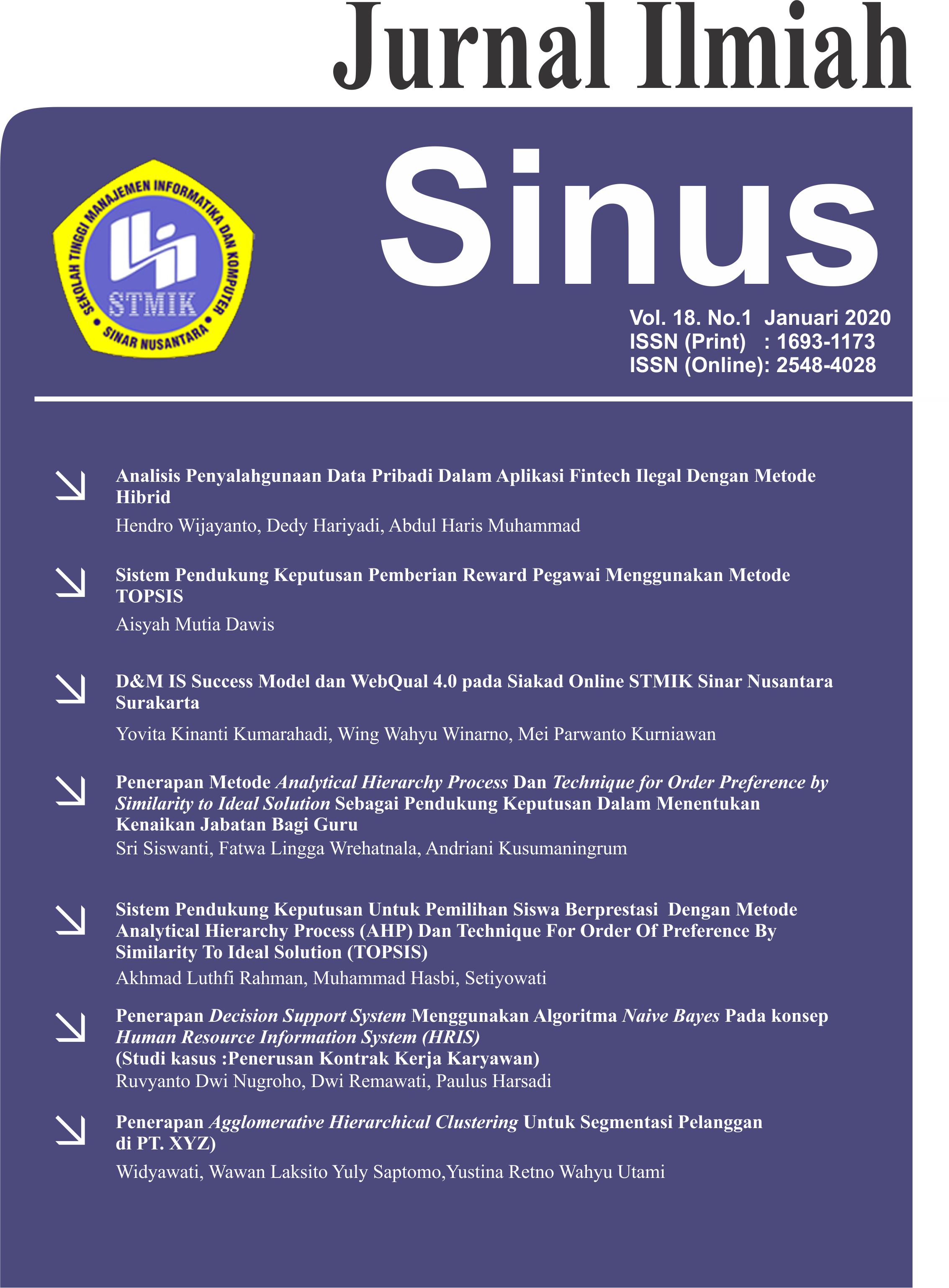
Penerapan Sistem Penunjang Keputusan Menggunakan Algoritma Naive Bayes Pada konsep Human Resource Information System (HRIS) (Studi kasus :Penerusan Kontrak Kerja Karyawan di PT. XYZ)
DOI:
https://doi.org/10.30646/sinus.v18i1.440Keywords:
Naïve Bayes, Contract Employees, Decision Support Systems, Human Resource Information SystemAbstract
One of the valuable assets in a company is human resources (HR). Human Resource Information System (HRIS) has emerged as one of the drivers of competitiveadvantage and strategic decision making tool. One of the HRIS task is employee recruitment. Employees become an important role. Therefore, this research is conducted forclassification of employee status determination using the Naïve Bayes methods. One of the duties of employees is to provide service to customer in the process of purchasing goods until the payment transaction process directly. Because of the large number of contract employees at the time of certain events, it requires companies to select every three months for the continuation of the work contract period for employees according to store needs so that the company's employee payroll expenses do not exceed the budget. One of the criteria is for being able to work in flexible groups between the ages of 17 and 25 for contract employees with a minimum of high school or vocational education. The purposes of this study are to design and build a Decision Support System application for the Continuation of Employee Employment Contracts Using the Naïve Bayes Method at PT. XYZ Retail. The result of the research is the application using the naïve bayes method with an accuracy rate of 90%.
Â
References
Ablhamid, R. K., Santoso, B., & Muslim, M. A. (2013). Decision Making and Evaluation System for Employee Recruitment Using Fuzzy Analytic Hierarchy Process. International Refereed Journal of Engineering and Science, 2(7), 24–31.
Aksoy, A., & Sallam, S. (2018). Factors Affecting Human Resources Information Systems in Developing Countries. Electronic Business Journal, 17(10), 33–40.
Cestnik, B. (1990). Estimating probabilities: a crucial task in machine learning. In ECAI, 90, 147–149.
Chen, P. (2009). A Fuzzy Multiple Criteria Decision Making Model in Employee Recruitment. International Journal of Computer Science and Network Security, 9(7), 113–117. Retrieved from http://paper.ijcsns.org/07_book/200907/20090716.pdf
Dai, W., Xue, G. R., Yang, Q., & Yu, Y. (2007). Transferring Naive Bayes classifiers for text classification. Proceedings of the National Conference on Artificial Intelligence, 1, 540–545.
Dong-Chul Park. (2016). Image Classification Using Naïve Bayes Classifier. International Journal of Computer Science and Electronics Engineering (IJCSEE), 4(3), 135–139. Retrieved from http://www.vision.caltech.edu/html-files/archive.html
G Subbalakshmi M. (2011). Decision Support in Heart Disease Prediction System using Naive Bayes. Indian Journal of Computer Science and Engineering (IJCSE), 2(2), 170–176.
Granik, M., & Mesyura, V. (2017). Fake news detection using naive Bayes classifier. 2017 IEEE 1st Ukraine Conference on Electrical and Computer Engineering, UKRCON 2017 - Proceedings, 900–903. https://doi.org/10.1109/UKRCON.2017.8100379
Karandikar, J., McLeay, T., Turner, S., & Schmitz, T. (2015). Tool wear monitoring using naïve Bayes classifiers. International Journal of Advanced Manufacturing Technology, 77(9–12), 1613–1626. https://doi.org/10.1007/s00170-014-6560-6
Kevin P. Murphy. (2006). naive bayes classifiers. University of British Columbia, 18, 371–381.
Liu, X., Lu, R., Ma, J., Chen, L., & Qin, B. (2016). Privacy-Preserving Patient-Centric Clinical Decision Support System on Naïve Bayesian Classification. IEEE Journal of Biomedical and Health Informatics, 20(2), 655–668. https://doi.org/10.1109/JBHI.2015.2407157
Nagendra, A., & Deshpande, M. (2014). Human Resource Information Systems (HRIS) in HR Planning and Development in Mid to Large Sized Organizations. Procedia - Social and Behavioral Sciences, 133, 61–67. https://doi.org/10.1016/j.sbspro.2014.04.169
Nilsson, N. J. (1965). Learning machines.
Schroeder, H. (2012). The Importance of Human Resource Management in Strategic Sustainability: An Art and Science Perspective. Journal of Environmental Sustainability, 2(1), 1–9. https://doi.org/10.14448/jes.02.0004
Siregar, D., Rahim, R., Engineering, C., Islam, U., Singingi, K., Gatot, J., & Km, S. (2017). Decision Support System Best Employee Assessments with Technique for Order of Preference by Similarity to Ideal Solution. International Journal of Recent Trends in Engineering and Research, 3(3), 6–17. https://doi.org/10.23883/ijrter.2017.3037.fj7lk
Tang, B., Kay, S., & He, H. (2016). Toward Optimal Feature Selection in Naive Bayes for Text Categorization. IEEE Transactions on Knowledge and Data Engineering, 28(9), 2508–2521. https://doi.org/10.1109/TKDE.2016.2563436
Tomanna, T., Gerbi, D. Y., Hossin, M. A., & Zhang, S. (2018). Impact of Information System on Transformation of Human Resource Performance: An Exploratory Study in Oromia Radio and Television Organization. Journal of Human Resource and Sustainability Studies, 06(01), 37–52. https://doi.org/10.4236/jhrss.2018.61025
Vaghela, C., Bhatt, N., & Mistry, D. (2015). A Survey on Various Classification Techniques for Clinical Decision Support System. International Journal of Computer Applications, 116(23), 14–17. https://doi.org/10.5120/20498-2369
Downloads
Published
How to Cite
Issue
Section
Citation Check
License
Authors who publish with this journal agree to the following terms:
- Authors retain copyright and grant the journal right of first publication with the work simultaneously licensed under a Creative Commons Attribution License that allows others to share the work with an acknowledgement of the work's authorship and initial publication in this journal.
- Authors are able to enter into separate, additional contractual arrangements for the non-exclusive distribution of the journal's published version of the work (e.g., post it to an institutional repository or publish it in a book), with an acknowledgement of its initial publication in this journal.
- Authors are permitted and encouraged to post their work online (e.g., in institutional repositories or on their website) prior to and during the submission process, as it can lead to productive exchanges, as well as earlier and greater citation of published work (See The Effect of Open Access).
Â

This work is licensed under a Creative Commons Attribution-NonCommercial-ShareAlike 4.0 International License.