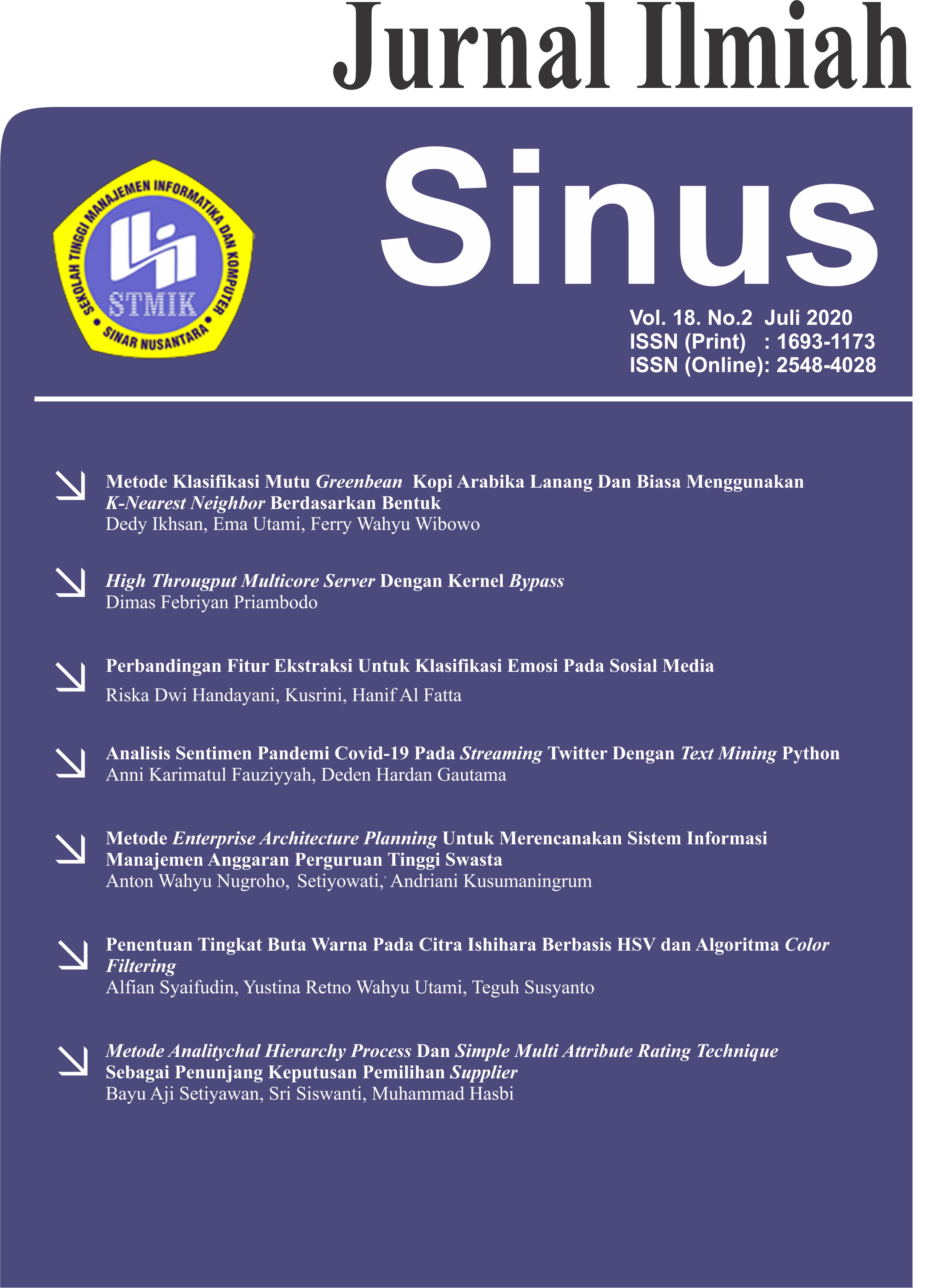
METODE KLASIFIKASI MUTU GREENBEAN KOPI ARABIKA LANANG DAN BIASA MENGGUNAKAN K-NEAREST NEIGHBOR BERDASARKAN BENTUK
DOI:
https://doi.org/10.30646/sinus.v18i2.456Keywords:
Digital image processing, k-nearest neighbor, classification of Greenbean ArabicaAbstract
During this time, the Greenbean coffee sorting process is still done manually which still has many shortcomings. Manually, this result is classified in inappropriate and inconsistent classification results due to human negligence. Grading in the processing and marketing sectors is important. Inappropriate grading opposes farmers simply because Lanang and ordinary Arabica coffee are the same. Hence, we need a consistent classification system. This research uses image processing to recognize Greenbean Arabica coffee. K-NN (K-Nearest Neighbor) method is used for a quality classification. This research will classify Arabica Greenbean coffee into 4 quality classes, namely intact Lanang Arabica, broken Lanang Arabica, intact ordinary Arabica, and ordinary broken Arabica. The search of trial process shows that K-NN classification feature is able to recognize Arabica coffee Greenbean into 4 classes with an accuracy value of 63.5%, very good at recognizing 90% of regular Arabica intact and 97% of whole Arabica intact. However, it is still weak in recognizing broken coffee Greenbean based on its type. The area feature is better in recognizing Arabica coffee Greenbean based on 4 classes with an accuracy of 69.8%. This research obtains 120 datasets from 80 tested data trains and 40 tested random data.
References
Badan Standarisasi Nasional (BSN) SNI 01-2907:2008 Tentang Biji kopi
Arboleda, E. R., Fajardo, A. C., & Medina, R. P. (2018). Classification of coffee bean species using image processing, artificial neural network and K nearest neighbors. 2018 IEEE International Conference on Innovative Research and Development, ICIRD 2018. https://doi.org/10.1109/ICIRD.2018.
Dahril, M. (2014). Aplikasi Prakiraan Cuaca Se-Riau Berbasis Android Menggunakan Metode Moving Average Dan K-Nearest Neighbor. Aksara Komputer Terapan. Pekanbaru, Politeknik Caltex Riau.
Duan, Z. (2018). Characters recognition of binary image using KNN, "In Proceedings of the 4th International Conference on Virtual Reality (ICVR), pp:116–118.
Fathoni, K., Zikky, M., Nurhayati, A. S., & Prasetyaningrum, I. (2018). Application of K-Nearest Neighbor Algorithm for Puzzle Game of Human Body’s System Learning on Virtual Mannequin. Proceedings - 2018 International Conference on Applied Science and Technology, ICAST 2018.
Kadir, A., & Susanto, A. (2013). Pengantar Pengolahan Citra. Teori Dan Aplikasi Pengolahan Citra.
Md Isa, N. E. Z., Amir, A., Ilyas, M. Z., & Razalli, M. S. (2017). The Performance Analysis of K-Nearest Neighbors (K-NN) Algorithm for Motor Imagery Classification Based on EEG Signal. MATEC Web of Conferences. https://doi.org/10.1051/matecconf/201714001024
Nasution, T. H., & Andayani, U. (2017). Recognition of roasted coffee bean levels using image processing and neural network. IOP Conference Series: Materials Science and Engineering. https://doi.org/10.1088/1757-899X/180/1/012059
Sari, N. (2004). Pendugaan Biji Kopi Utuh, Bjji Kopi Pecah, Biji Kopi Berlubang dan
Benda Asing Untuk Evaluasi Mutu Kopi Dencan Pengolahan Citra dan Metode Fuzzy. Skripsi Jurusan Teknik Pertanian Fakultas Pertanian IPB, Bogor.
Sutoyo, T, dkk. (2009). Teori Pengolahan Citra Digital. Andi, Yogyakarta hal 9 - 27.
Syahputra, H., Arnia, F., & Munadi, K. (2019). Karakterisasi Kematangan Buah Kopi
Berdasarkan Warna Kulit Kopi Menggunakan Histogram dan Momen Warna. Jurnal Nasional Teknik Elektro. Vol. 8, No. 1, Maret p-ISSN: 2302-2949, e-ISSN: 2407 – 7267
Ulum, Nasrul. Prismana,I Gusti Lanang Putra Eka. Firdaus, R. A. J. (2018). Identifikasi
Jenis Biji Kopi Menggunakan Citra Digital Dengan Metode Klasifikasi City Block Distance. Inovate. Volume 03 Nomor 01, 30-37
Downloads
Published
How to Cite
Issue
Section
Citation Check
License
Authors who publish with this journal agree to the following terms:
- Authors retain copyright and grant the journal right of first publication with the work simultaneously licensed under a Creative Commons Attribution License that allows others to share the work with an acknowledgement of the work's authorship and initial publication in this journal.
- Authors are able to enter into separate, additional contractual arrangements for the non-exclusive distribution of the journal's published version of the work (e.g., post it to an institutional repository or publish it in a book), with an acknowledgement of its initial publication in this journal.
- Authors are permitted and encouraged to post their work online (e.g., in institutional repositories or on their website) prior to and during the submission process, as it can lead to productive exchanges, as well as earlier and greater citation of published work (See The Effect of Open Access).
Â

This work is licensed under a Creative Commons Attribution-NonCommercial-ShareAlike 4.0 International License.