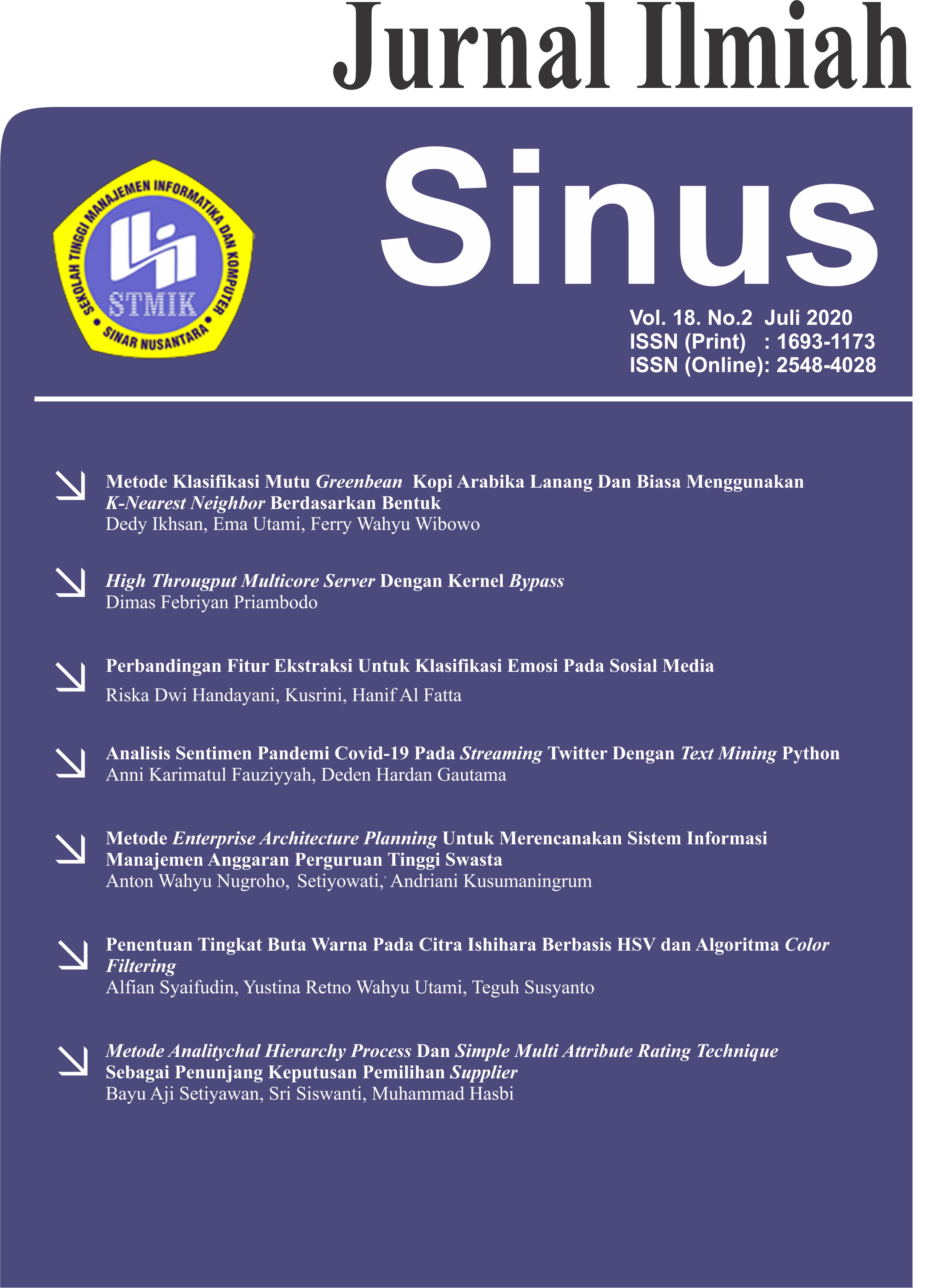
Metode Enterprise Architecture Planning Untuk Merencanakan Sistem Informasi Manajemen Anggaran Perguruan Tinggi Swasta
DOI:
https://doi.org/10.30646/sinus.v18i2.477Keywords:
Blueprint, Information Systems, Budgeting, EAPAbstract
The success of higher education can be seen from the performance of education, research and community service, and university governance. The use of information technology is very influential in organizational performance. Budget management and expenditure are some of the important business processes in a university involving several work units so that integration system is needed. The purpose of this study is to plan an Enterprise Architecture budget and information system of expenditure management that is integrated with systems in other work units. An Enterprise Architecture Planning (EAP) is a methodology for making enterprise architecture planningby focusing on data management architecture, application creation architecture, and technology architecture. Those will be used as well as the implementation of architecture to support the achievement of organizational goals, namely integration system. The results of this study are Blue Print of Architecture Enterprise budget and expenditure management information systems in Higher Education. This Blue Print of Enterprise Architecture information system includes several business processes, namely business processes, budget management, payroll, asset management, HR management, and attendance. This compiled architecture is still found gap. For example, there are still entities that must be added (add), retained (replaced), replaced (removed) and removed (remove), with details of 17 Added entities, 1 Retained entity, 14 Replaced entities, and 0 Removed entity. In conclusion, the total gap is 32 entities.
References
Ambarsari, N., & Setyoutami, N. (2014). Perancangan Blueprint Sistem Informasi Menggunakan Metodologi Enterprise Architecture Planning (Eap) Pada Sman 3 Surakarta. Jurnal Rekayasa Sistem Dan Industri, 1(01), 141–143.
Ayu, N., Dewi, N., Sinaga, B. L., & Rusdianto, E. (2013). ( Studi kasus : Rumah Sakit Umum Daerah ). 2013(semnasIF), 194–201.
Bernard, S. A. (2009). The Importance of Formal Documentation In Enterprise Architectures. Journal of Enterprise Architecture, August, 29–58.
Kurniawan, A. P., & Chazar, C. (2015). Perencanaan Cetak Biru Sistem Informasi Terintegrasi Berbasis E2AF dan Metodologi EAP. VII(1), 25–44.
Kurniawan, B. (2011). Enterprise architecture planning sistem informasi pada perguruan tinggi swasta dengan zachman framework. Majalah Ilmiah UNIKOM, 9(1), 21–32. http://jurnal.unikom.ac.id/jurnal/enterprise-architecture.x/volume-91-artikel-3.pdf
Miftahuddin, Y., Ichwan, M., & Musrini, M. (2013). Penerapan Metode EAP ( Enterprise Architecture. Jurnal Informatika, 4(1).
Surendro, K., Kajian, B., Informasi, S., Informatika, T., & Arsitektur, P.
(2007). Pemanfaatan Enterprise Architecture Planning Untuk Perencanaan Strategis Sistem Informasi. Jurnal Informatika, 8(1), 9–9. https://doi.org/10.9744/informatika.8.1.pp.1-9
Downloads
Additional Files
Published
How to Cite
Issue
Section
Citation Check
License
Authors who publish with this journal agree to the following terms:
- Authors retain copyright and grant the journal right of first publication with the work simultaneously licensed under a Creative Commons Attribution License that allows others to share the work with an acknowledgement of the work's authorship and initial publication in this journal.
- Authors are able to enter into separate, additional contractual arrangements for the non-exclusive distribution of the journal's published version of the work (e.g., post it to an institutional repository or publish it in a book), with an acknowledgement of its initial publication in this journal.
- Authors are permitted and encouraged to post their work online (e.g., in institutional repositories or on their website) prior to and during the submission process, as it can lead to productive exchanges, as well as earlier and greater citation of published work (See The Effect of Open Access).
Â

This work is licensed under a Creative Commons Attribution-NonCommercial-ShareAlike 4.0 International License.