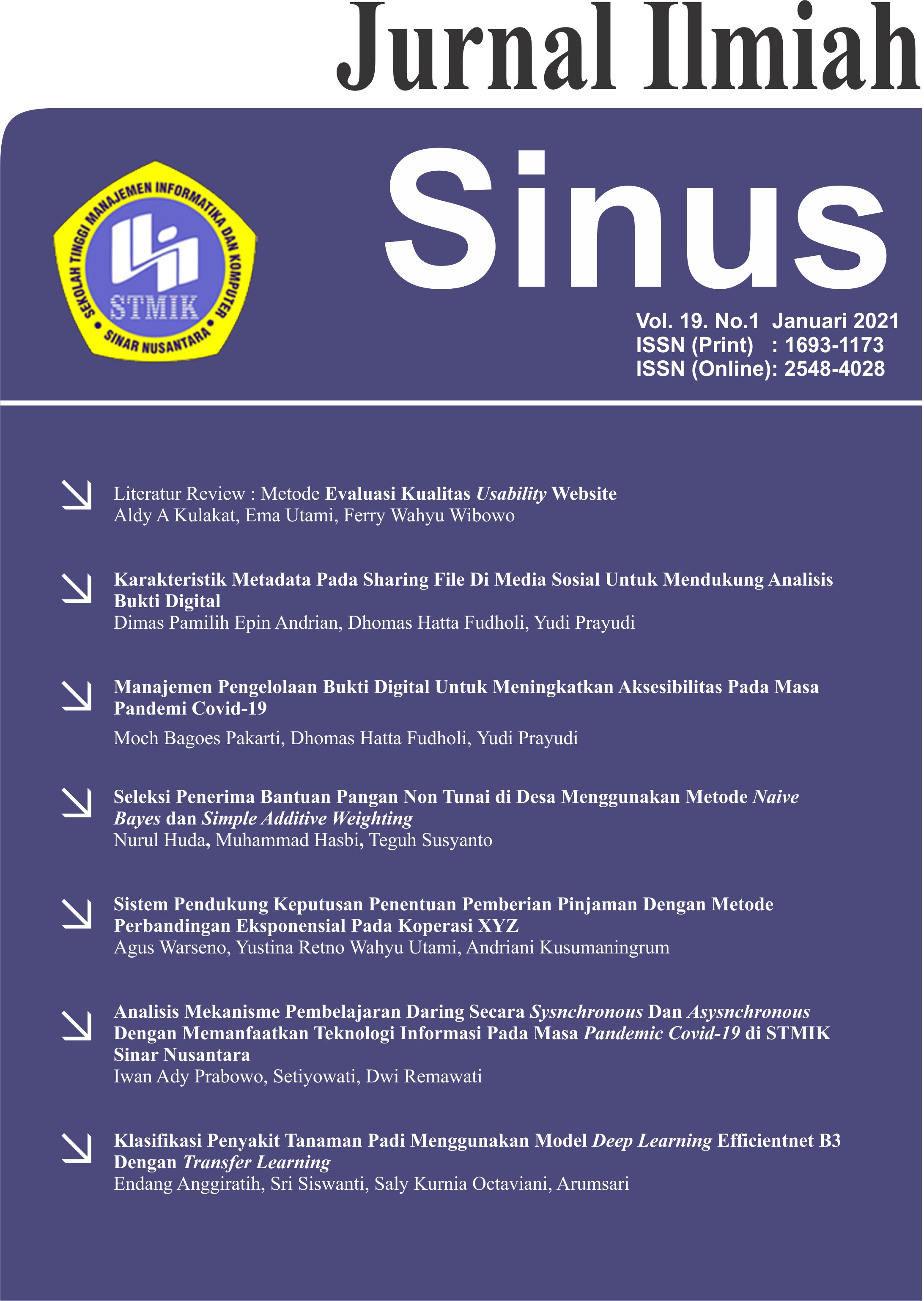
Manajemen Pengelolaan Bukti Digital Untuk Meningkatkan Aksesibilitas Pada Masa Pandemi Covid-19
DOI:
https://doi.org/10.30646/sinus.v19i1.502Keywords:
digital evidence, chain of custody, accessibilityAbstract
Covid-19 has a major impact on human life, including the process of managing digital evidence. Management of digital evidence requires special handling that can store and maintain the integrity of digital evidence. The current problem is there is no concept of storing digital evidence that can be accessed online in wider accessibility. Online digital evidence management is proposed as a solution to solve this problem. This concept is in the form of an online digital evidence management system that can be accessed anywhere and anytime using MD5 and SHA1 hash functions in order to maintain the properties of digital evidence so that it can be legally accepted. The problems with digital evidence management require a Management System for Digital Evidence that is suitable for application in Digital Forensics Laboratory. This research had successfully implemented the concept of online chain of custody. It is expected, with the concept of Online Digital Evidence Management, this digital evidence control and all activities related to it can be maintained and well documented. Moreover, it can reach a wider area accessed anywhere and any time and reduce the spread of Covid-19.
References
Cosic, J., & Baca, M. (2010). Do we have full control over integrity in digital evidence life cycle? Proceedings of the International Conference on Information Technology Interfaces, ITI, 429–434.
Dogan, S., & Akbal, E. (2017). Analysis of mobile phones in digital forensics. 2017 40th International Convention on Information and Communication Technology, Electronics and Microelectronics, MIPRO 2017 - Proceedings, 1241–1244. https://doi.org/10.23919/MIPRO.2017.7973613
Farmer, D., & Venema, W. (2005). Forensic Discovery. http://www.informit.com/store/forensic-discovery-paperback-9780321703255
Giova, G. (2011). Improving Chain of Custody in Forensic Investigation of Electronic Digital Systems. International Journal of Computer Science and Network Security, 11(1), 1–9. http://paper.ijcsns.org/07_book/201101/20110101.pdf
Prayudi, Y. (2014). Problema dan Solusi Digital Chain Of Custody. Seminar Nasional Aplikasi Teknologi Informasi (Senasti).
Prayudi, Y., Ashari, A., & K Priyambodo, T. (2014). Digital Evidence Cabinets: A Proposed Framework for Handling Digital Chain of Custody. International Journal of Computer Applications. https://doi.org/10.5120/18781-0106
Prayudi, Y., & SN, A. (2015). Digital Chain of Custody: State of The Art. International Journal of Computer Applications, 114(5), 1–9. https://doi.org/10.5120/19971-1856
Roscini, M. (2016). Digital evidence as a means of proof before the international court of justice. Journal of Conflict and Security Law, 21(3), 541–554. https://doi.org/10.1093/jcsl/krw016
Widatama, K., & Yudi Prayudi. (2017). Konsep Lemari Penyimpanan Bukti Digital Menggunakan Struktur Bahasa XML. Seminar Nasional Informatika Dan Aplikasinya Ke-3, September, 23.
Downloads
Published
How to Cite
Issue
Section
Citation Check
License
Authors who publish with this journal agree to the following terms:
- Authors retain copyright and grant the journal right of first publication with the work simultaneously licensed under a Creative Commons Attribution License that allows others to share the work with an acknowledgement of the work's authorship and initial publication in this journal.
- Authors are able to enter into separate, additional contractual arrangements for the non-exclusive distribution of the journal's published version of the work (e.g., post it to an institutional repository or publish it in a book), with an acknowledgement of its initial publication in this journal.
- Authors are permitted and encouraged to post their work online (e.g., in institutional repositories or on their website) prior to and during the submission process, as it can lead to productive exchanges, as well as earlier and greater citation of published work (See The Effect of Open Access).
Â

This work is licensed under a Creative Commons Attribution-NonCommercial-ShareAlike 4.0 International License.