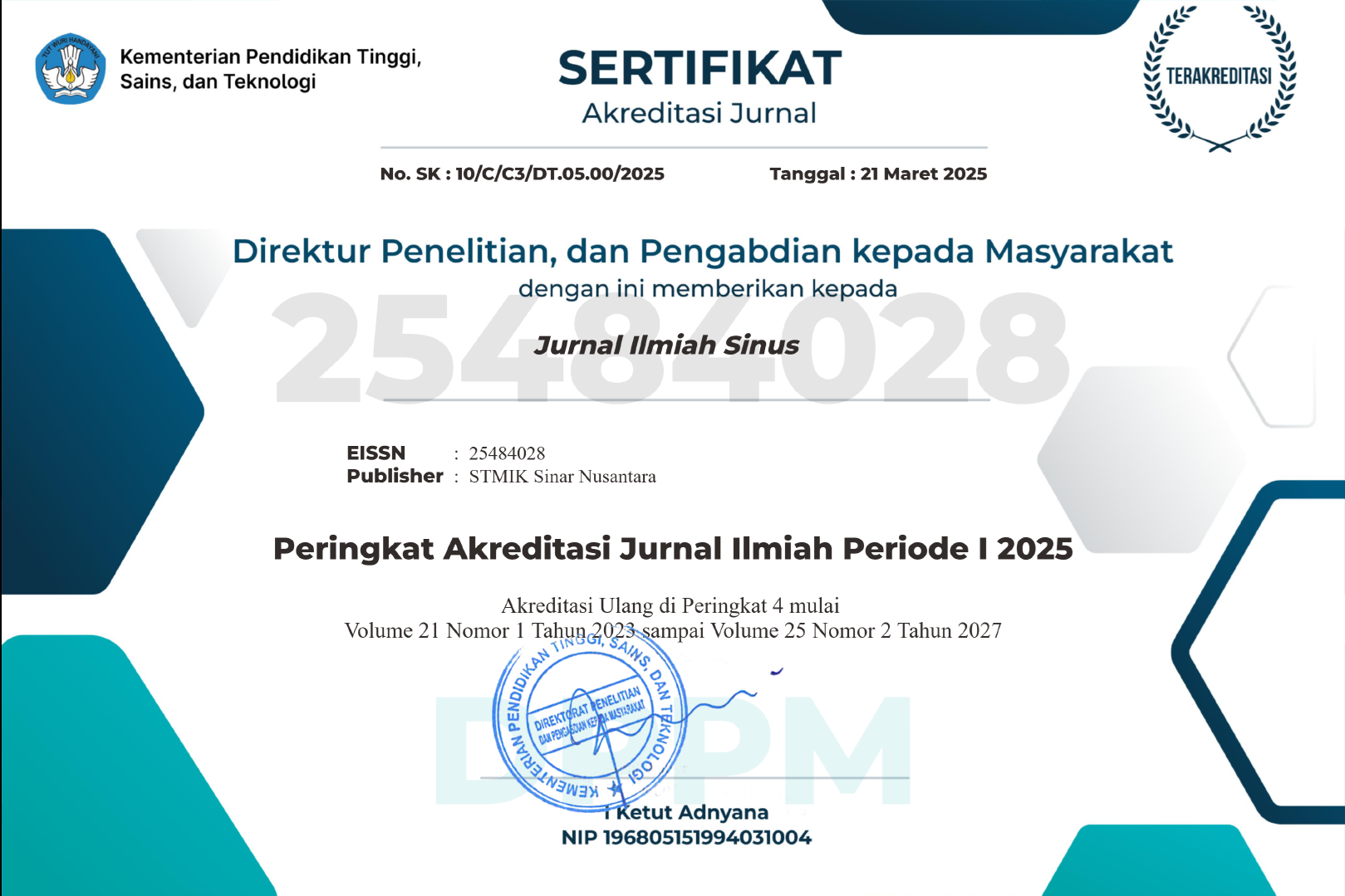
Klasifikasi Penyakit Tanaman Padi Menggunakan Model Deep Learning Efficientnet B3 dengan Transfer Learning
DOI:
https://doi.org/10.30646/sinus.v19i1.526Keywords:
Rice Plant Disease, Deep learning, EfficientNet B3Abstract
The level of rice productivity is influenced by several inhibiting factors, for example disease attack in rice plants. The slow and inappropriate treatment of rice plant can make the crop failure so that rice production and farmers' income decrease. The symptoms of rice disease are difficult to distinguish, especially in severe symptoms. Collaboration with other fields, especially computer science, is needed to classify diseases automatically so that the farmers can take action for plant treatment and the spread of disease can be controlled quickly. The classification of diseases based on images requires the best features/characteristics so that the disease can be classified. In this research, Deep Learning method, especially Convolutional Neural Network with EfficientNet B3 architecture, can extract features very well. In this research, the classification of brown spot and bacterial leaf disease by applying EfficientNet B3 with transfer learning reached 79.53% accuracy and 0.012 loss/error.
References
Duong, L. T., Nguyen, P. T., Sipio, C. Di, & Ruscio, D. Di. (2020). Automated fruit recognition using E ffi cientNet and MixNet. Computers and Electronics in Agriculture, 171(January), 105326. https://doi.org/10.1016/j.compag.2020.105326
Ghosal, S., & Sarkar, K. (2020). Rice Leaf Diseases Classification Using CNN with Transfer Learning. 2020 IEEE Calcutta Conference, CALCON 2020 - Proceedings, 230–236. https://doi.org/10.1109/CALCON49167.2020.9106423
Haris, N. A. (2020). Kombinasi Ciri Bentuk dan Ciri Tekstur Untuk Identifikasi Penyakit Pada Tanaman Padi. JATISI (Jurnal Teknik Informatika Dan Sistem Informasi), 7(2), 237–250. https://doi.org/10.35957/jatisi.v7i2.239
Howard, A., Sandler, M., Chen, B., Wang, W., Chen, L. C., Tan, M., Chu, G., Vasudevan, V., Zhu, Y., Pang, R., Le, Q., & Adam, H. (2019). Searching for mobileNetV3. Proceedings of the IEEE International Conference on Computer Vision, 2019-Octob, 1314–1324. https://doi.org/10.1109/ICCV.2019.00140
Lestari, T. A. (2019). PENGAMATAN PENYAKIT-PENYAKIT TANAMAN SISTEM JAJAR LEGOWO OBSERVATION OF PADDY DISEASES IN THE VILAGE OF SAKO RAMBUTAN SUB-DISTRICT BANYUASIN WITH THE JAJAR LEGOWO SYSTEM.
Lu, Y., Yi, S., Zeng, N., Liu, Y., & Zhang, Y. (2017). Identification of rice diseases using deep convolutional neural networks. Neurocomputing, 267, 378–384. https://doi.org/10.1016/j.neucom.2017.06.023
Murniyasih, E., Suryani, L., Sorong, S. P., & Sorong, S. P. (2020). Penerapan Metode Learning Vector Quantization. 6(1).
Prajapati, H. B., Shah, J., Technologies, D., & Dabhi, V. (2017). Publication Details : Detection and Classification of Rice Plant Diseases. August 2018. https://doi.org/10.3233/IDT-170301
Rahman, C. R., Arko, P. S., Ali, M. E., Iqbal Khan, M. A., Apon, S. H., Nowrin, F., & Wasif, A. (2020). Identification and recognition of rice diseases and pests using convolutional neural networks. Biosystems Engineering, 194, 112–120. https://doi.org/10.1016/j.biosystemseng.2020.03.020
Shrivastava, V. K., Pradhan, M. K., Minz, S., & Thakur, M. P. (2019). Rice plant disease classification using transfer learning of deep convolution neural network. International Archives of the Photogrammetry, Remote Sensing and Spatial Information Sciences - ISPRS Archives, 42(3/W6), 631–635. https://doi.org/10.5194/isprs-archives-XLII-3-W6-631-2019
Tan, M., & Le, Q. V. (2019). EfficientNet: Rethinking model scaling for convolutional neural networks. 36th International Conference on Machine Learning, ICML 2019, 2019-June, 10691–10700.
Downloads
Published
How to Cite
Issue
Section
Citation Check
License
Authors who publish with this journal agree to the following terms:
- Authors retain copyright and grant the journal right of first publication with the work simultaneously licensed under a Creative Commons Attribution License that allows others to share the work with an acknowledgement of the work's authorship and initial publication in this journal.
- Authors are able to enter into separate, additional contractual arrangements for the non-exclusive distribution of the journal's published version of the work (e.g., post it to an institutional repository or publish it in a book), with an acknowledgement of its initial publication in this journal.
- Authors are permitted and encouraged to post their work online (e.g., in institutional repositories or on their website) prior to and during the submission process, as it can lead to productive exchanges, as well as earlier and greater citation of published work (See The Effect of Open Access).
Â

This work is licensed under a Creative Commons Attribution-NonCommercial-ShareAlike 4.0 International License.