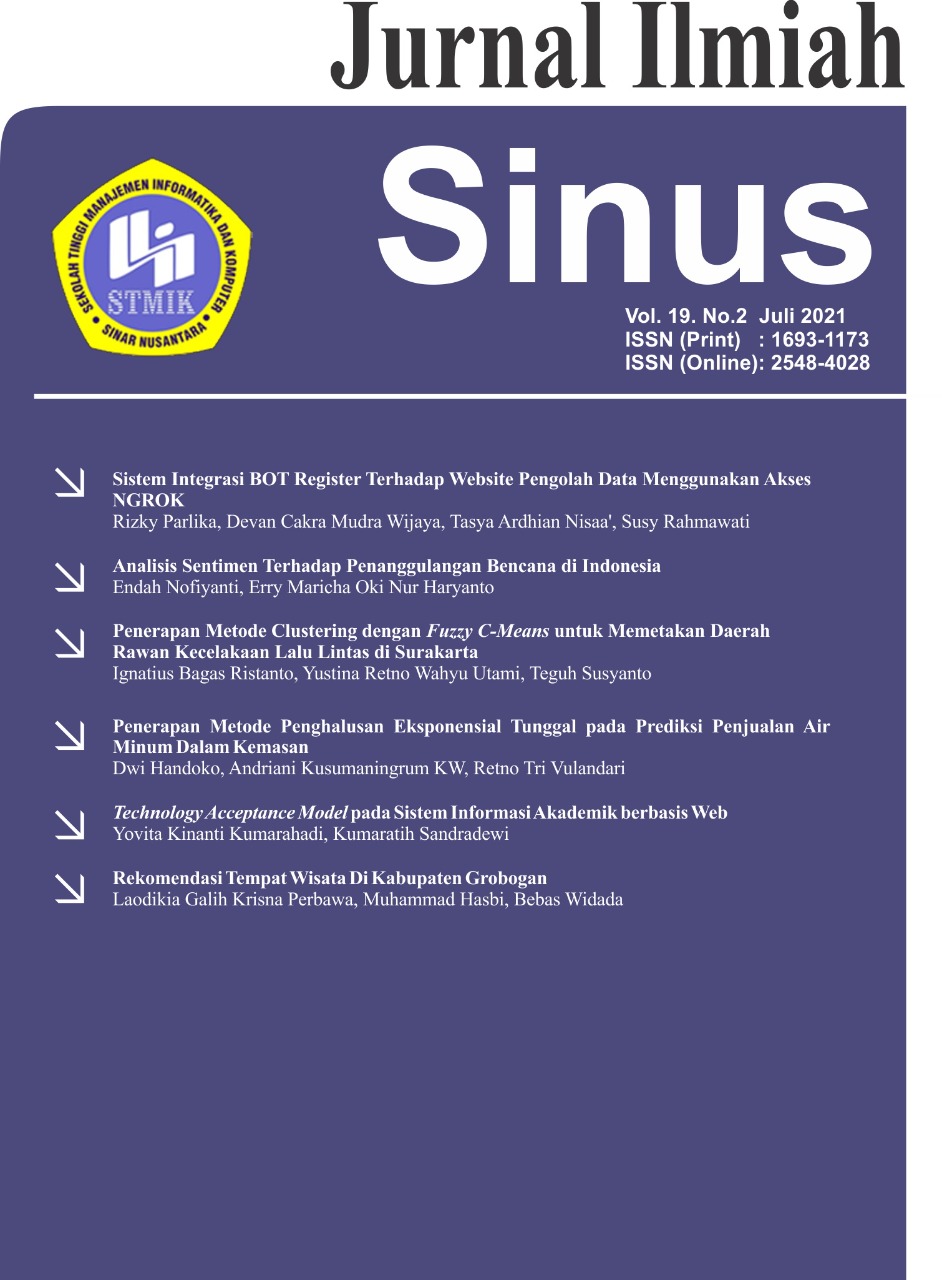
Technology Acceptance Model pada Sistem Informasi Akademik berbasis Web
DOI:
https://doi.org/10.30646/sinus.v19i2.534Keywords:
Technology Acceptance Model, academic information system, web-based systemAbstract
Academic information system is an important system in students learning’s activities because it’s used as connector between students and lecturers. In addition, academic information system also acts as a liaison between lecturers and other relevant external parties. Academic information system provides several services, both for students and lecturers. These facilities include the provision of information on study plans, grades, schedules, and courses. However, only a few facilities are frequently used so that the use of the academic information system is not optimal.
The problem in this study is the need for an evaluation to determine the acceptance of the academic information system by users, so that the system can be improved and developed. This study aims to determine the acceptance of web-based academic information system by users at STMIK Sinar Nusantara Surakarta with the Technology Acceptance Model or TAM.ÂReferences
Alharbi, Saleh, dan Steve Drew. 2014. “Using The Technology Acceptance Model In Understanding Academics’ Behavioural Intention To Use Learning Management Systems.†International Journal of Advanced Computer Science and Applications 5 (1): 143–55.
Davis, Fred D. 1989. “Perceived Usefulness, Perceived Ease Of Use, and User Acceptance Of Information Technology.†MIS Quarterly, 319–40.
Dharmawan, Alief Rizky, Sri Hariyati Fitriasih, dan Tri Irawati. 2018. “Analisa Penerapan Aplikasi Penjualan Dan Service Komputer Pada Cv Jaya Citra Madani Dengan Metode Technology Acceptable Model (TAM).†Jurnal Ilmiah SINUS 16 (1): 65–74.
Fathema, Nafsaniath, David Shannon, dan Margaret Ross. 2015. “Expanding The Technology Acceptance Model (TAM) to Examine Faculty Use of Learning Management Systems (LMSs) In Higher Education Institutions.†MERLOT Journal of Online Learning and Teaching 11 (2): 211–32.
Handayani, Trie. 2013. “Analisis Penerimaan Sistem Informasi Akademik Berbasis Web Mengunakan Technology Acceptance Model (TAM) dan Usability (Studi Kasus pada STTNAS Yogyakarta).†Prosiding Seminar Nasional Rekayasa Teknologi Industri dan Informasi, 101–7.
Imelda, dan Muhammad Erik. 2018. “Perancangan Sistem Informasi Akademik Pada Sekolah Dasar Negeri Sukajadi 9 Bandung.†Jurnal Teknologi dan Informasi 1 (3).
Librado, Dison. 2017. “Analisis Penerimaan Mahasiswa Terhadap Sistem Informasi Akademik (SIAKAD) Dengan Metode Technology Acceptance Model (TAM).†Jurnal SAINTEKOM 7 (2): 112–25.
Mulyani, Asri, dan Dede Kurniadi. 2015. “Analisis Penerimaan Teknologi Student Information Terminal (S-IT) Dengan Menggunakan Technology Acceptance Model (TAM).†Jurnal Wawasan Ilmiah 7 (12).
Sekaran, Uma., dan Roger. Bougie. 2013. Research Methods For Business : A Skill-Building Approach. Wiley.
Suryawan, Muhaji Bayu, dan Prihandoko Prihandoko. 2018. “Evaluasi Penerapan SIAKAD Politeknik Negeri Madiun Menggunakan Pendekatan TAM dan EUCS.†Creative Information Technology Journal 4 (3): 233–44.
Venkatesh, Viswanath, dan Fred D Davis. 1996. “A Model Of The Antecedents Of Perceived Ease Of Use: Development and Test.†Decision sciences 27 (3): 451–81.
Downloads
Published
How to Cite
Issue
Section
Citation Check
License
Authors who publish with this journal agree to the following terms:
- Authors retain copyright and grant the journal right of first publication with the work simultaneously licensed under a Creative Commons Attribution License that allows others to share the work with an acknowledgement of the work's authorship and initial publication in this journal.
- Authors are able to enter into separate, additional contractual arrangements for the non-exclusive distribution of the journal's published version of the work (e.g., post it to an institutional repository or publish it in a book), with an acknowledgement of its initial publication in this journal.
- Authors are permitted and encouraged to post their work online (e.g., in institutional repositories or on their website) prior to and during the submission process, as it can lead to productive exchanges, as well as earlier and greater citation of published work (See The Effect of Open Access).
Â

This work is licensed under a Creative Commons Attribution-NonCommercial-ShareAlike 4.0 International License.