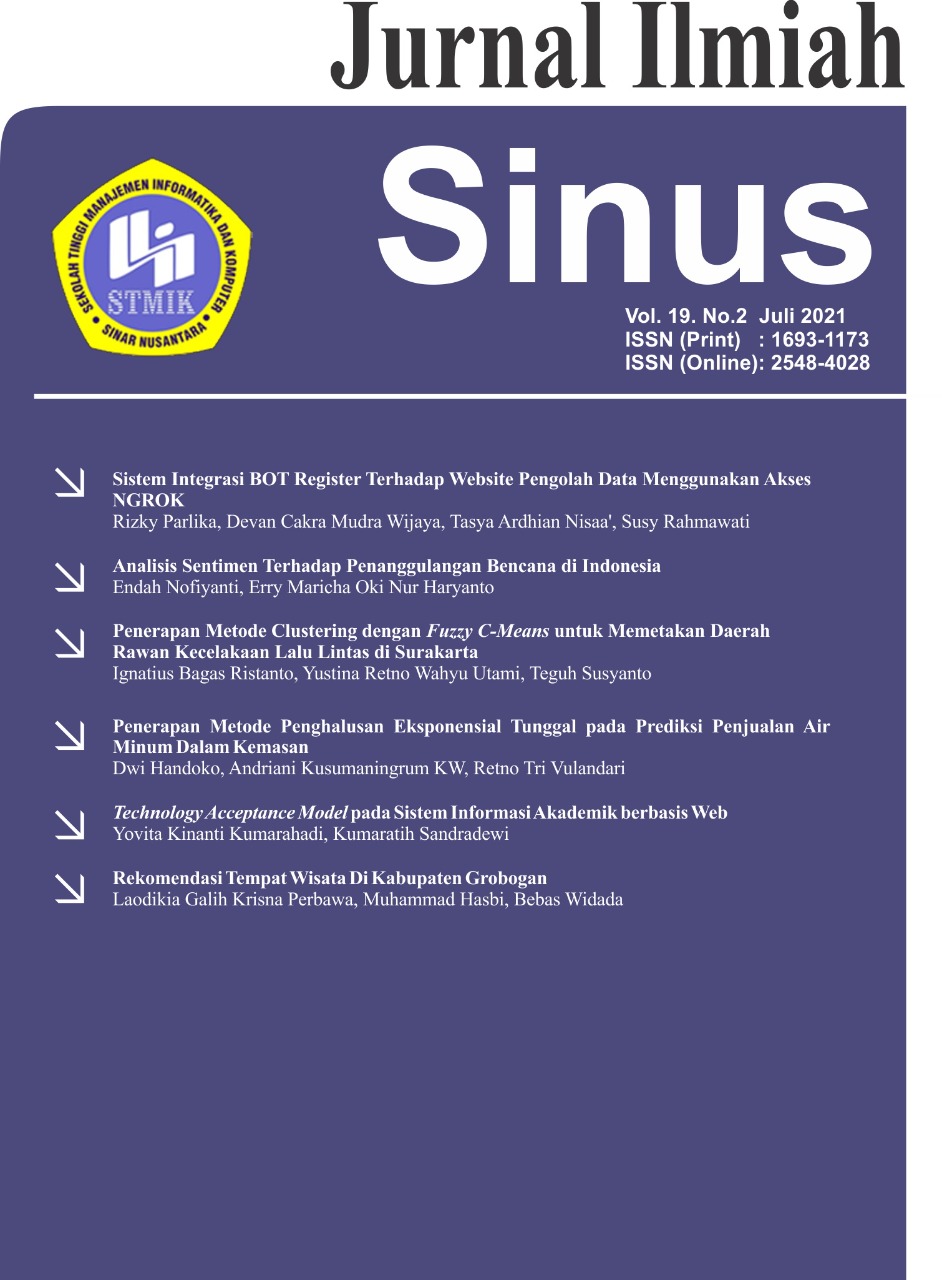
Rekomendasi Tempat Wisata Di Kabupaten Grobogan
DOI:
https://doi.org/10.30646/sinus.v19i2.560Keywords:
Search, PHP, Haversine Formula, mappingAbstract
Geografis Information System (SIG) is a computer system used to manipulate geographic data. The system is implemented with computer hardware and software that serves to init and verify data, data compilation, data storage, data changes and updates, data management and exchange, data manipulation, data calling and presentation and data analysis.In Grobogan Regency itself there are still many tourist locations that are not known to the public, especially tourists outside the area. The number of tourist attractions in Grobogan Regency itself is approximately 21 places, both natural tourism such as Waterfalls, Sendang, Goa.Religious tourism such as Tombs or artificial tourism such as swimming pools and reservoirs.Because of the time and information, people find it difficult to know the point of location and also information from the tours located in Grobogan Regency. In this Thesis Study use the Haversine Formula Method. With analysis, system design, coding/construction, testing, and implementation. At the analysis stage, the collection of data is observation and literature studies. While the data source obtained in the form of primary data and secondary data. At the design stage of the system using Unified Modelling Language (UML) include use case diagrams, activity diagrams, sequence diagrams, and class diagrams. At the construction stage use google maps API, PHP and MySQL programming languages. And at the testing stage using the Blackbox technique. While the implementation of this system can be used on desktop devices. By using the search for the nearest route and can recommend it from a radius of 20 km.The expected result of this study is that the app can recommend tourist attractions based on distance and also include tourist information located in Grobogan, so that tourists can easily access the tourist attractions they want to go to.
Â
References
A. Solichin, Pemprograman Web dengan PHP dan MySQL. Yogyakarta: Penerbit Budi Luhut, 2016.
Betha sidik, Pemprograman Web dengan PHP, Revisi Ked. Bandung: Informatika, 2014.
E. Petroutsos, Google Maps power tools for maximizing the API, 1st ed. McGraw-Hill Education, 2014.
E. Prahasta, Konsep-konsep dasar perspektif geodesi & geomatika. Bandung: Informatika Bandung, 2014.
Faya dan N. Fiftin, “Pemanfaatan Google Maps API Untuk Pembangunan Sistem Informasi Manajemen Bantuan Logistik Pasca Bencana Alam Berbasis Mobile Web,†J. Sarj. Tek. Inform, vol. 1, no. 1, pp. 162–171, 2013.
Gintoro, Iwan Wijaya Suharto,dan Febiyan Rachman, “Analisis Dan Perancangan Sistem Pencarian Taksi Terdekat Dengan Pelanggan Menggunakan Layanan Berbasis Lokasi,†(SNATI 2010), vol. 1, no. 1, pp. 1–5, 2010.
Nur Widyatmoko, Charitas Fibriani, “Pemanfaatan Geolocation dan Haversine Formulla dalam Perancangan Sistem Informasi Geografis ( GIS ) ( Studi Kasus : Pariwisata Kabupaten Semarang ),†Univ. Kristen Satya Wacana, vol. 1, no. 1, 2012.
Siswo Hadi Sumantri, dan Makmur Supriyatno, Sistem Informasis Geografis ( Geograpic Information System ) Kerentanan Bencana, EDISI 1. Jakarta: CV.Makmur Cahaya Ilmu, 2019.
Y. Widya, S. Suprihatini, dan F. Agus, “Sistem Pemilihan Tempat Kost Berbasis SIG Menggunakan Metode Electre dan GOOGLE Maps API,†J. Inform. Mulawarman, vol. 8, no. 3, pp. 65–71, 2013.
Downloads
Published
How to Cite
Issue
Section
Citation Check
License
Authors who publish with this journal agree to the following terms:
- Authors retain copyright and grant the journal right of first publication with the work simultaneously licensed under a Creative Commons Attribution License that allows others to share the work with an acknowledgement of the work's authorship and initial publication in this journal.
- Authors are able to enter into separate, additional contractual arrangements for the non-exclusive distribution of the journal's published version of the work (e.g., post it to an institutional repository or publish it in a book), with an acknowledgement of its initial publication in this journal.
- Authors are permitted and encouraged to post their work online (e.g., in institutional repositories or on their website) prior to and during the submission process, as it can lead to productive exchanges, as well as earlier and greater citation of published work (See The Effect of Open Access).
Â

This work is licensed under a Creative Commons Attribution-NonCommercial-ShareAlike 4.0 International License.