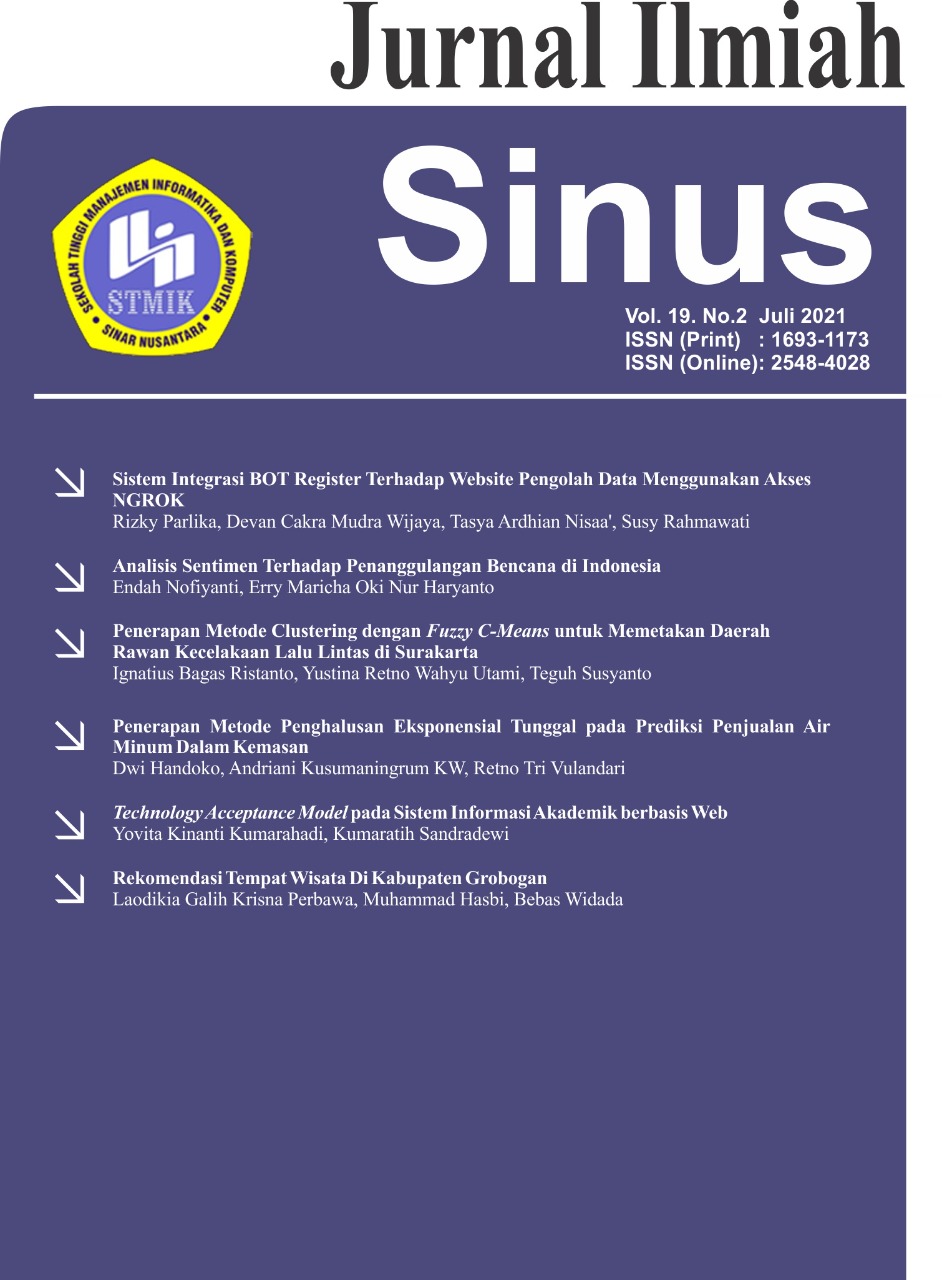
Penerapan Metode Clustering dengan Fuzzy C-Means untuk Memetakan Daerah Rawan Kecelakaan Lalu Lintas di Surakarta
DOI:
https://doi.org/10.30646/sinus.v19i2.562Keywords:
Mapping, Traffic Accident, Fuzzy C-Means, Clustering Data, Silhouette IndexAbstract
References
Arumsari, N. D., Arief Laila Nugraha, & Moehammad Awaluddin. (2016). Pemodelan Daerah Rawan Kecelakaan Dengan Menggunakan Cluster Analysis. Geodesi Undip, 5(Data Mining), 174–183.
Feryanti, I. K., & Mulyono, G. S. (2019). Analisis Kecelakaan Lalu Lintas di Kota Surakarta. Universitas Muhammadiyah Surakarta.
Kaufman, L., & Peter Rousseeuw. (1990). Finding Groups in Data: An Introduction to Cluster Analysis. John Wiley & Sons, Inc.
Maesaroh, S., Sunaryo, D. K., & Noraini, A. (2017). Analisis Daerah Rawan Kecelakaan Lalu Lintas Tahun 2017 Dengan Cluster Analysis (Studi Kasus: Kabupaten Pati). Institut Teknologi Nasional Malang.
Pradipta, A. D. R., Awaluddin, M., & Nugraha, A. L. (2018). Pemetaan Daerah Rawan Kecelakaan Di Kota Semarang Dengan Menggunakan Metode Cluster Analysis (Studi Kasus : Kecamatan Banyumanik Dan Tembalang). Jurnal Geodesi Undip, 7(4), 185–194.
Prahasta, E. (2009). Sistem Informasi Geografis Konsep - Konsep Dasar (Perpekstif Geodesi dan Geomatika). Informatika.
Prasetyo, E. (2014). Data Mining Mengolah Data Menjadi Informasi Menggunakan Matlab. Andi Offset.
Puspitasari, D., Syaifudin, Y. W., & Nofyandi, R. D. (2019). Pemetaan Daerah Rawan Kecelakaan Menggunakan Metode Fuzzy C-Means. Jurnal Informatika Polinema, 5(2), 90–95. https://doi.org/10.33795/jip.v5i2.260
Rozzaqiyah, R., Erlansari, A., & Anggriani, K. (2017). Web Gis Pemetaan Lokasi Kejadian Kecelakaan Di Kota Bengkulu. Jurnal Rekursif, 5(1), 55–66.
Sugiyono. (2014). Metode Penelitian Kuantitatif Kualitatif dan R&D. Alfabeta.
Undang-Undang No.22 tahun 2009, Tentang Lalu Lintas dan Angkutan Jalan. (2009).
Downloads
Published
How to Cite
Issue
Section
Citation Check
License
Authors who publish with this journal agree to the following terms:
- Authors retain copyright and grant the journal right of first publication with the work simultaneously licensed under a Creative Commons Attribution License that allows others to share the work with an acknowledgement of the work's authorship and initial publication in this journal.
- Authors are able to enter into separate, additional contractual arrangements for the non-exclusive distribution of the journal's published version of the work (e.g., post it to an institutional repository or publish it in a book), with an acknowledgement of its initial publication in this journal.
- Authors are permitted and encouraged to post their work online (e.g., in institutional repositories or on their website) prior to and during the submission process, as it can lead to productive exchanges, as well as earlier and greater citation of published work (See The Effect of Open Access).
Â

This work is licensed under a Creative Commons Attribution-NonCommercial-ShareAlike 4.0 International License.