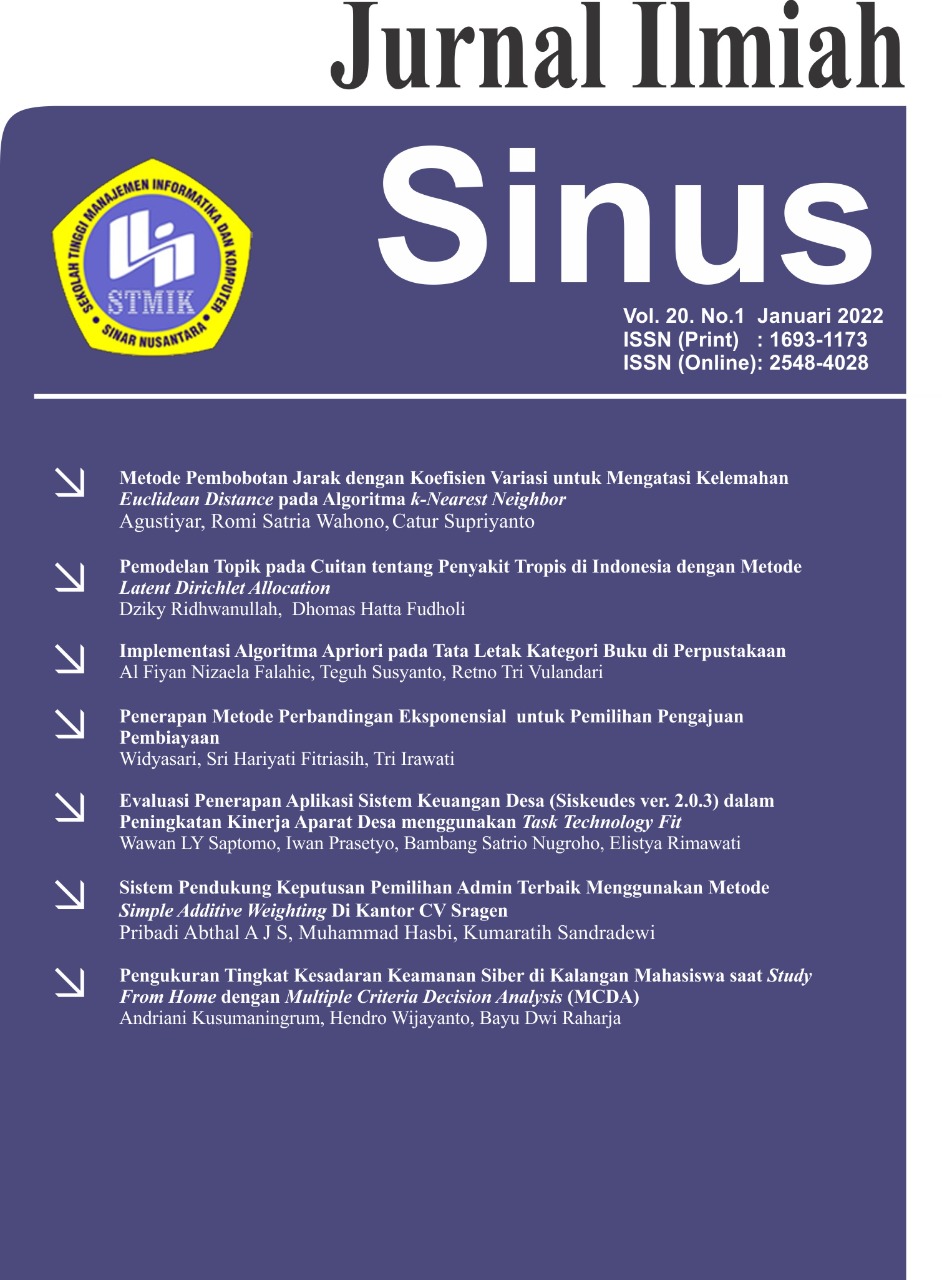
Evaluasi Penerapan Aplikasi Sistem Keuangan Desa (Siskeudes ver. 2.0.3) dalam Peningkatan Kinerja Aparat Desa menggunakan Task Technology Fit
DOI:
https://doi.org/10.30646/sinus.v20i1.580Keywords:
Performance Impact, Task Characteristics, Appropriateness of Task Technology, Village Financial System, SiskeudesAbstract
The Village Financial System (Siskeudes) is an information system that assists the village government in reporting transparent and accountable financial reports. On the other hand, there are adjustments to financial management during the Covid-19 pandemic, so Siskeudes application also needs to accommodate these adjustments. Moreover, various problems were found in this system such as delays in financial reporting and recording errors. One of the factors of the problem is the mismatch of tasks in operating the application. This study aims to analyze the causes and consequences of task mismatches using the Task Technology Fit (TTF) model. The study described in this paper used the technology-to-performance chain as a framework to address the question of how task–technology fit influences the performance impacts. Respondents in this study were 50 village officials in Boyolali district who had used Siskeudes Ver. 2.0.3. This study was analyzed using a questionnaire with closed questions and open questions. This research method used Partial Least Square (PLS) using SmartPls 3.3.3. In addition, the results of this study indicated that the task of the technology-fit model has a significant effect on Performance Impact. Villages also have apparatus in accordance with Siskeudes operations. In this case, the finance department (having knowledge in finance) have a better level of performance. However, there are some villages where the operation of Siskeudes assisted by non-financial officials so that utilization does not have a significant effect on improving the performance of the finance department.
References
BPKP. (2015). Petunjuk Pelaksanaan Bimbingan dan Konsultasi Pengelolaan Keuangan Desa. In Badan Pengawasan Keuangan dan Pembangunan (BPKP).
BPKP. (2018). Petunjuk Pengoperasian Aplikasi Sistem Keuangan Desa (SISKEUDES 2.0). Badan Pengawasan Keuangan dan Pembangunan.
BPKP, K. (2020). Kemendagri dan BPKP Luncurkan Aplikasi Siskeudes Rilis 2.0.3 . Http://Www.Bpkp.Go.Id/. http://www.bpkp.go.id/berita/read/26996/0/Kemendagri-dan-BPKP-Luncurkan-Aplikasi-Siskeudes-Rilis-2.0.3
Chin, W. W. (1998). The Partial Least Squares Approach to Structural Modeling. Modern Methods for Business Research, April, 295–336.
D’Ambra, J., Wilson, C. S., & Akter, S. (2013). Application of the task-technology fit model to structure and evaluate the adoption of E-books by academics. Journal of the American Society for Information Science and Technology, 64(1), 48–64. https://doi.org/10.1002/asi.22757
Dhany, E., Hanoum, S., & Soemarsono, M. (2020). Pengaruh Penggunaan IFS terhadap Kinerja dan Kreativitas Karyawan PT PAL Indonesia (Persero) dengan Pendekatan Task-Tchnology Fit (TTF) dan Technology Acceptance Model (TAM). Jurnal Sains Dan Seni ITS, 9(1). https://doi.org/10.12962/j23373520.v9i1.50834
Esposito Vinzi, V., Chin, W., Henseler, J., & Wang, H. (2010). Handbook of Partial Least Squares: Concepts, Methods and Applications. In International Journal of Nursing Studies - INT J NURS STUD. https://doi.org/10.1007/978-3-540-32827-8
Garson, G. D. (2015). Structural Equation Modeling. Statistical Associates Publishing.
Goodhue, D. L., & Thompson, R. L. (1995). Task-Technology Fit and Individual Performance. MIS Quarterly, 19(2), 213–236. https://doi.org/10.2307/249689
Henseler, J., Ringle, C. M., & Sarstedt, M. (2016). Testing Measurement Invariance Of Composites Using Partial Least Squares. International Marketing Review, 33(3), 405–431. https://doi.org/https://doi.org/10.1108/IMR-09-2014-0304
Maulina, C., & Siti Astuti, E. (2015). Pengaruh Karakteristik Tugas, Teknologi Informasi dan Individu Terhadap Task-Technology Fit (TTF), Utilisasi dan Kinerja. JISIP: Jurnal Ilmu Sosial Dan Ilmu Politik, 4(1), 108. www.publikasi.unitri.ac.id
Mayowan, Y. (2016). Penerapan Teknologi Informasi dan Komunikasi di Desa (Studi Kasus di Kabupaten Lamongan). Profit, 10(01), 14–23. https://doi.org/10.21776/ub.profit.2016.010.01.2
Permatasari, R. D. (2017). Sistem Informasi Manajemen Aset dengan Metode SDLC (Software Development Life Cycle). Jurnal Teknik Ibnu Sina (JT-IBSI), 2(2), 73–90. https://doi.org/10.36352/jt-ibsi.v2i2.65
Sedarmayanti. (2020). Membangun Sistem Manajemen Kinerja Guna Meningkatkan Produktivitas Menuju Good Governance. Jurnal Wacana Kinerja: Kajian Praktis-Akademis Kinerja Dan Administrasi Pelayanan Publik, 7(2), 1–16.
Shahreki, J., & Nakanishi, H. (2016). The Relationship between Task Technology Fit and Individual Performance : Case Study in Hotel Industry in Malaysia. Journal of Soft Computing and Decision Support Systems, 3(6), 1–15. www.jscdss.com/index.php/files%0D
Sumarto, S. W. (2020, September). Akuntabilitas Dana Desa. Badan Pengawas Keuangan Dan Pembangunan, Perwakilan Provinsi Jawa Tengah.
Tam, C., & Oliveira, T. (2016). Understanding the impact of m-banking on individual performance: DeLone & McLean and TTF perspective. Computers in Human Behavior, 61, 233–244. https://doi.org/10.1016/j.chb.2016.03.016
Tenenhaus, M., Vinzi, V. E., Chatelin, Y.-M., & Lauro, C. (2005). PLS Path Modeling. Computational Statistics & Data Analysis, 48(1), 159–205.
Widagdo, A. K., Widodo, A., & Ismail, M. (2016). Sistem Akuntansi Pengelolaan Dana Desa. Jurnal Ekonomi Dan Bisnis, 19(2), 323. https://doi.org/10.24914/jeb.v19i2.336
Yuhertiana, I., Widajatie, T. D., & Akbar, F. S. (2016). Financial confusion and corruption anxiety : A good village governance pressure. Simposium Nasional Akuntansi XIX, 1–15. http://lib.ibs.ac.id/materi/Prosiding/SNA XIX (19) Lampung 2016/
Downloads
Published
How to Cite
Issue
Section
Citation Check
License
Authors who publish with this journal agree to the following terms:
- Authors retain copyright and grant the journal right of first publication with the work simultaneously licensed under a Creative Commons Attribution License that allows others to share the work with an acknowledgement of the work's authorship and initial publication in this journal.
- Authors are able to enter into separate, additional contractual arrangements for the non-exclusive distribution of the journal's published version of the work (e.g., post it to an institutional repository or publish it in a book), with an acknowledgement of its initial publication in this journal.
- Authors are permitted and encouraged to post their work online (e.g., in institutional repositories or on their website) prior to and during the submission process, as it can lead to productive exchanges, as well as earlier and greater citation of published work (See The Effect of Open Access).
Â

This work is licensed under a Creative Commons Attribution-NonCommercial-ShareAlike 4.0 International License.