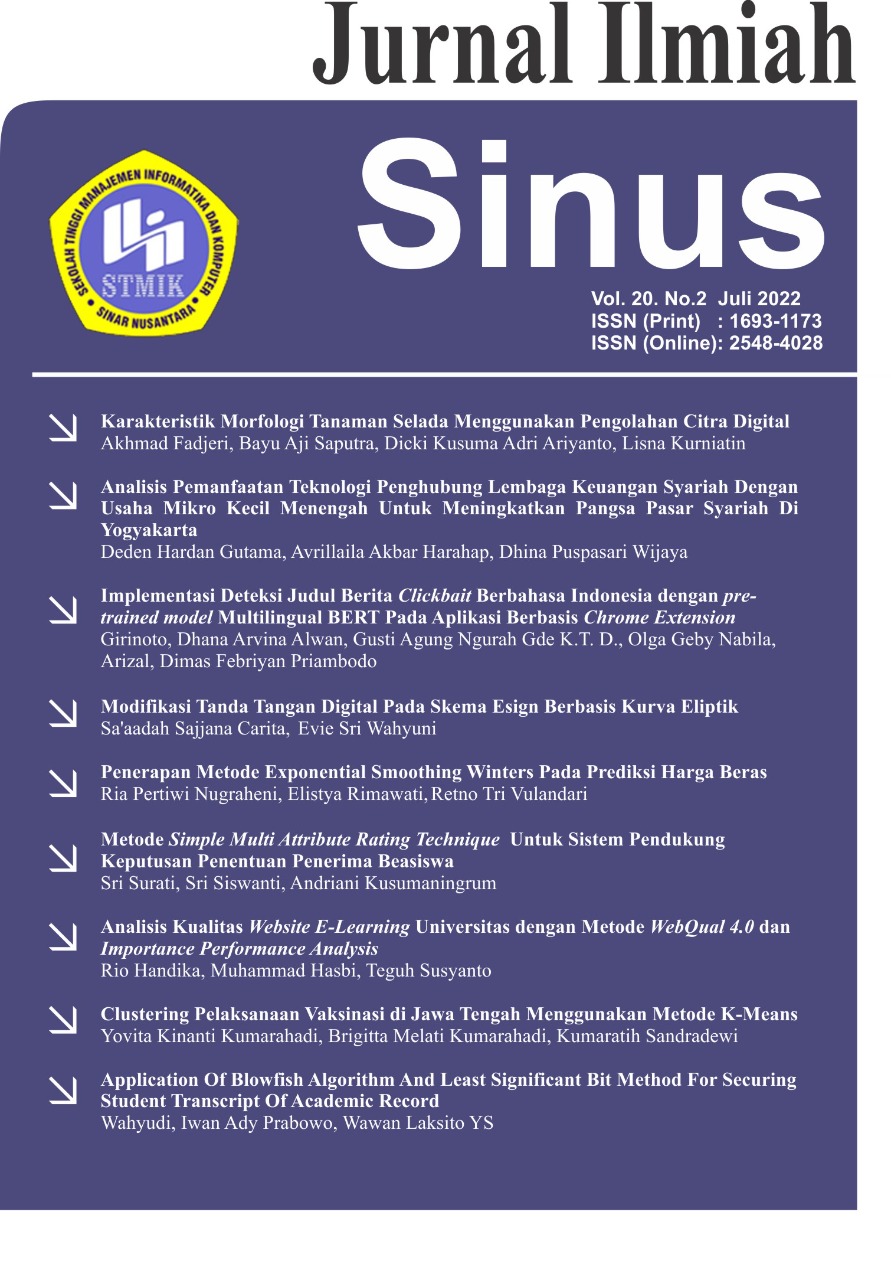
Modifikasi Tanda Tangan Digital Pada Skema Esign Berbasis Kurva Eliptik
DOI:
https://doi.org/10.30646/sinus.v20i2.625Keywords:
digital signature, elliptic curve cryptography, ESIGN schemeAbstract
Digital signature has an important role in the digital era, where more and more people are joining the paperless life. Many cryptographic researchers support digital development by creating cryptographic schemes that are safe to use, and one of them is digital signature. This paper proposes a digital signature scheme based on an elliptic curve defined over with , where  and   are private keys of prime number elements. This scheme utilizes the advantages of elliptic curve cryptography in terms of security by using points that satisfy the elliptic curve equation. Additionally, the shorter key size increases the speed, making this scheme faster in signature values generation and verification process.
This research was conducted to determine the differences between the modified ESIGN scheme based on elliptic curve and the original ESIGN scheme. The process of finding the point on the ring , with a large , resulted in a more complex key generation algorithm. However, the selection of two points in this key generation is precomputed. This means the actual signature value generation algorithm took significantly less time than the original. This is one of the advantages of the proposed scheme.
References
R. A. Kramer, "A Survey of ESIGN: State of the Art and Proof of Security," Oregon, 2017.
A. Khalique, K. Singh and S. Sood, "Implementation of Elliptic Curve Digital Signature Alhorithm," International Journal of Computer Applications, vol. II, 2010.
A. J. Menezes, V. Oorschot, C. Paul and S. A. Vanstone, Handbook of Applied Cryptography, Boca Raton: CRC Press, 1997.
A. Menezes, M. Qu, D. Stinson and Y. Wang, "Evaluation of Security Level of Cryptography: ESIGN Signature Scheme," 2001.
G. Pardo, "An Introduction to Elliptic Curve Cryptography," Introduction to Elliptic Curve Cryptography with Maple, Berlin Heidelberg, Springer-Verlag, 2013, pp. 611-676.
P. R. Varberg, Calculus, ninth edition, 2009.
T. Okamoto, A. Fujioka and E. Fujisaki, "An Efficient Digital Signature Scheme Based on an Elliptic Curve over the Ring Zn," Advance in Cryptography-CRYPTO'92, pp. 54-65, 1993.
Ahlswede, "Elliptic Curve Cryptosystem," in Hiding Data-Selected Topics, Switzerland, Springer International Publishing, 2016.
T. Okamoto and A. Shiraishi, "A Fast Signature Scheme Based on Quadratic Inequalities," IEEE, 1985.
J. H. Silverman, The Arithmetic of Elliptic Curves. New York: Springer, 2009.
ISARA, “Isogeny-Based Cryptography Tutorial,†2019. [Online]. Available: https://www.isara.com/resource-center/isogeny-based-cryptography-tutorial.html.
J. Hoffstein, J. Pipher and J. H. Silverman, Elliptic Curve and Cryptography, New York: Springer, 2014.
A. Blumenfeld, “Discrete Logarithms on Elliptic Curves,†J. Rose-Hulman Undergrad. Math. J., vol. 12, no. 1, pp. 30–57, 2011.
W. Stallings, Cryptography and Network Security: Priciples and Practice, Seventh Edition, New Jersey: Pearson Education, 2017.
R. Munir, Kompleksitas Algoritma, ITB, 2015.
Downloads
Published
How to Cite
Issue
Section
Citation Check
License
Authors who publish with this journal agree to the following terms:
- Authors retain copyright and grant the journal right of first publication with the work simultaneously licensed under a Creative Commons Attribution License that allows others to share the work with an acknowledgement of the work's authorship and initial publication in this journal.
- Authors are able to enter into separate, additional contractual arrangements for the non-exclusive distribution of the journal's published version of the work (e.g., post it to an institutional repository or publish it in a book), with an acknowledgement of its initial publication in this journal.
- Authors are permitted and encouraged to post their work online (e.g., in institutional repositories or on their website) prior to and during the submission process, as it can lead to productive exchanges, as well as earlier and greater citation of published work (See The Effect of Open Access).
Â

This work is licensed under a Creative Commons Attribution-NonCommercial-ShareAlike 4.0 International License.