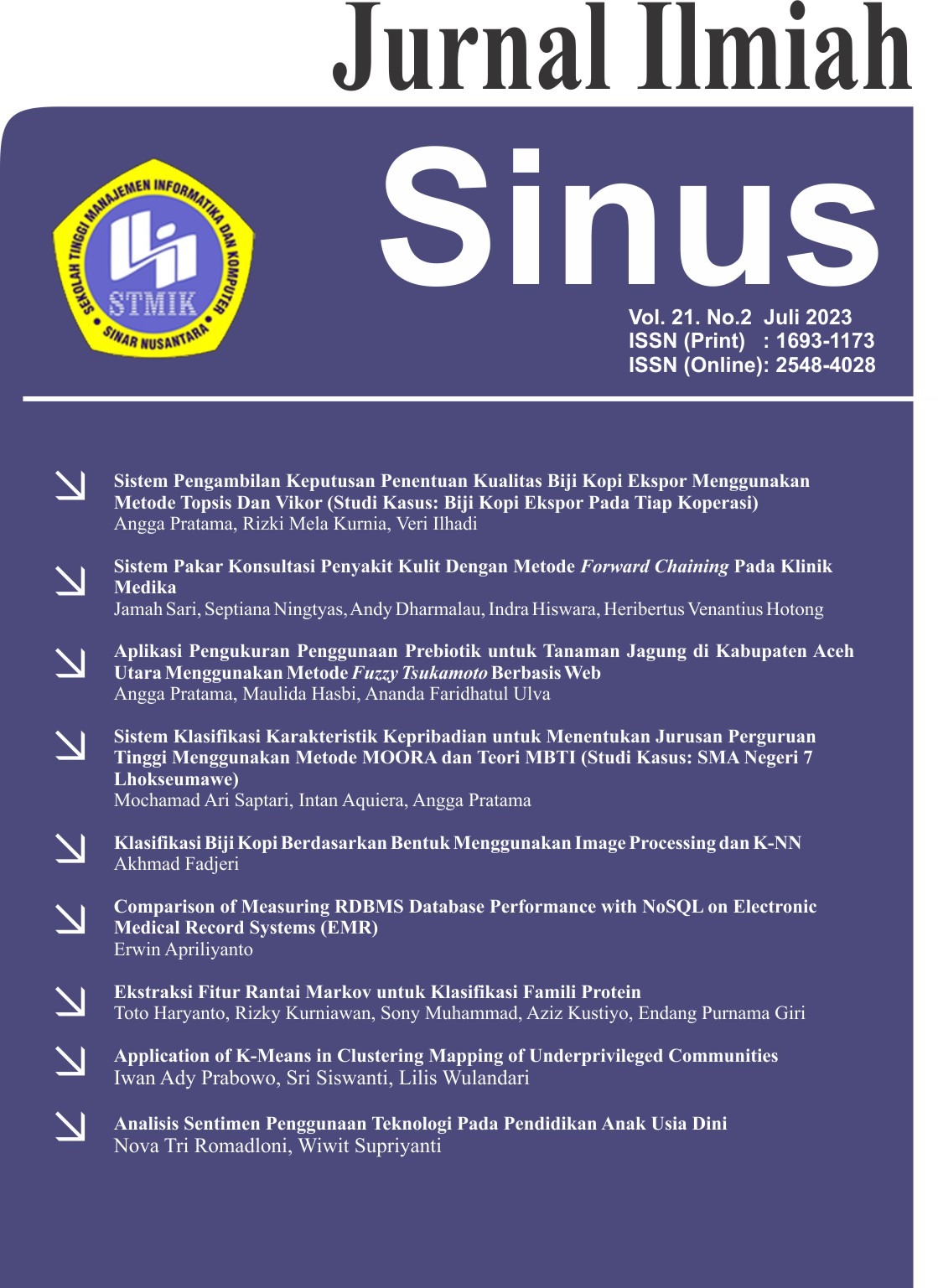
Sistem Pakar Konsultasi Penyakit Kulit Dengan Metode Forward Chaining Pada Klinik Medika
DOI:
https://doi.org/10.30646/sinus.v21i2.701Keywords:
Artificial Intelligence, Expert systems, Forward Chaining, Skin Consultation, Skin DiseaseAbstract
Expert systems have information gained through a combination of readings, training, and practical experience. As a result, professionals can make faster and more accurate decisions while tackling complicated situations than non-experts. Klinik Medika is a health-care organization that focuses on public health, particularly skin health issues. This clinic's services to patients for consultation and treatment need to be improved in terms of service time efficiency. For this reason, an expert system is required so that patients can consult online rather than visiting the clinic.
The goal of this research is to apply Forward Chaining method to create an expert system that can be used to consult on various skin conditions. Based on the results of the tests, the expert system can correctly diagnose the signs of skin disorders with a 90% accuracy. The system can also accept errors caused by differences in knowledge based on computational data and the experience of skin disease experts.
References
Agustina, D., Mustafidah, H., & Purbowati, M. R. (2016). Sistem Pakar Diagnosa Penyakit Kulit Akibat Infeksi Jamur. Juita, IV(2), 67–77.
Alhamri, R. Z., Izzah, A., & Eliyen, K. (2021). Pengembangan Sistem Pakar Berbasis Android Untuk Menentukan Obat Generik Pada Penyakit Kulit Menggunakan Metode Forward Chaining. Jurnal Invotek Polbeng, 6(1), 1–11.
Ashari, & Muniar, A. Y. (2016). Penerapan Sistem Pakar Untuk Mendiagnosa Penyakit Pencernaan Dengan Pengobatan Bahan Alami. Seminar Nasional Sains Dan Teknologi 2016, (November), 2407–1846.
Julianti, M. R., Asoka, E., & Syahtami, H. F. (2021). Sistem Pakar Diagnosis Penyakit Kulit Balita Menggunakan Forward Chaining Berbasis Web Pada Puskesmas Cisoka. Jurnal SISFOTEK GLOBAL, 11(1).
Kristiyan, Y. (2017). Sistem Pakar Diagnosa Penyakit Kulit. Jurnal Insand Comtech, 2(1), 21–26.
Kurniawansyah, K., Marthiawati, N., & Aryani, R. (2023). Rancang Bangun Sistem Pakar Diagnosa Penyakit Tanaman Pisang Canvendish Dengan Metode Forward Chaining. Sinus, 21(1), 13–26.
Perangin-angin, R. S., & Sagala, J. R. (2021). Sistem Pakar Penyakit Kulit Menggunakan Metode Certainty Factor. Jurnal Penelitian Teknik Informatika Universitas Prima Indonesia Medan, 4(2), 559–566.
Rizki, M. I. (2020). Sistem Pakar Diagnosa Penyakit Kulit Menggunakan Naïve Bayes Berbasis Web. Jurnal Transit, 8(4), 27–34.
Santi, I. H., & Septiawan, A. I. (2018). Metode Forward Chaining Pada Sistem Pakar Dalam Mendiagnosis Penyakit Kulit. Antivirus : Jurnal Ilmiah Teknik Informatika, 12(1), 1–12. https://doi.org/10.35457/antivirus.v12i1.438
Sesunan, M. F., & Darsin, D. D. (2022). Sistem Pakar Untuk Mendiagnosa Penyakit Gigi Dan Mulut Menggunakan Metode Forward Chaining (Studi Di Rsud Menggala). Jurnal Sistem Informasi Dan Sains Teknologi, 4(2). https://doi.org/10.31326/sistek.v4i2.1354
Wahyujana, D. T., Nugroho, D., & Hasbi, M. (2012). Sistem Pakar Untuk Diagnosa Penyakit Demam Berdarah. Jurnal Ilmiah SINUS, 10(1), 1–8.
Warno, & Fatihamli, R. (2022). Sistem Pakar Untuk Diagnosis Penyakit Hipertensi ( Studi Kasus Pada Klinik Sadar Medika Condet Jakarta Timur ). Jurnal Visualika, 8(1), 95–106.
Winardi, S., & Hajjah, A. (2021). Penerapan Metode Forward Chaining Untuk Mendiagnosa Penyakit Kulit Pada Manusia. Jurnal Mahasiswa Aplikasi Teknologi Komputer Dan Informasi, 2(2), 77–82.
Downloads
Published
How to Cite
Issue
Section
Citation Check
License
Authors who publish with this journal agree to the following terms:
- Authors retain copyright and grant the journal right of first publication with the work simultaneously licensed under a Creative Commons Attribution License that allows others to share the work with an acknowledgement of the work's authorship and initial publication in this journal.
- Authors are able to enter into separate, additional contractual arrangements for the non-exclusive distribution of the journal's published version of the work (e.g., post it to an institutional repository or publish it in a book), with an acknowledgement of its initial publication in this journal.
- Authors are permitted and encouraged to post their work online (e.g., in institutional repositories or on their website) prior to and during the submission process, as it can lead to productive exchanges, as well as earlier and greater citation of published work (See The Effect of Open Access).
Â

This work is licensed under a Creative Commons Attribution-NonCommercial-ShareAlike 4.0 International License.