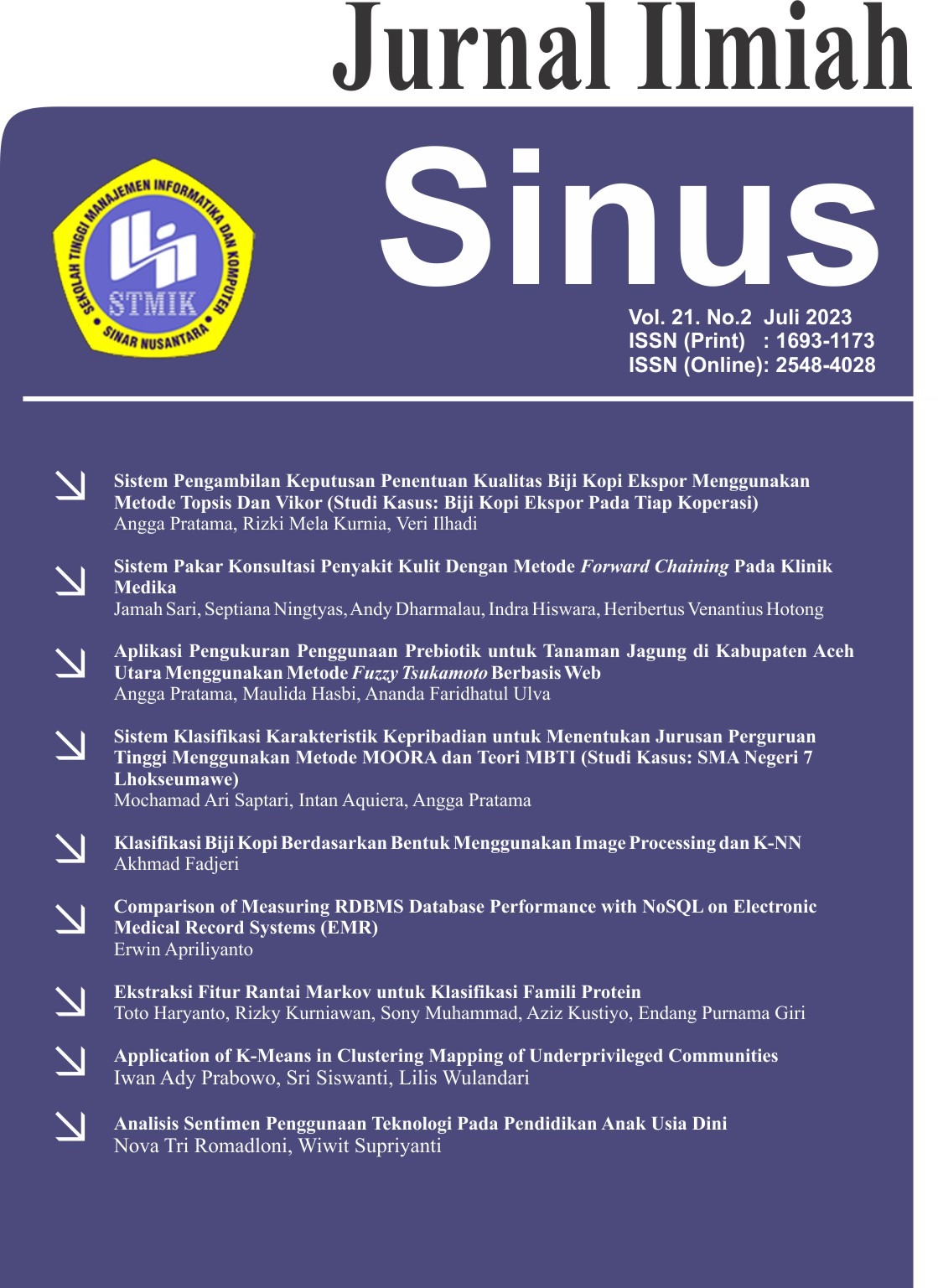
Analisis Sentimen Penggunaan Teknologi Pada Pendidikan Anak Usia Dini
DOI:
https://doi.org/10.30646/sinus.v21i2.759Keywords:
Early Childhood, Sentiment Analysis, Education, TechnologyAbstract
The era of disruption has caused many changes in people's lives, both in behavior and in system settings, where it is impossible to return to the previous era. Efforts are needed to face this era with revitalization, one of which is the urgency of early childhood education so that it remains based on Islamic values with technological developments that accompany the growth of the next generation of the Indonesian nation. The application of Islamic values from an early age is very necessary because it is the initial foundation for the generation of a religious nation by adapting itself according to the times that cannot be separated from technology. By realizing the goal that people are able to adapt to existing conditions, of course it is not easy because there are pros and cons that can be seen from social media which discusses several issues regarding the influence of Islamic values that are taught from an early age to the presence of technology. In this study using opinion mining found on social media to determine the positive or negative conditions that occur so that it is known how big the relationship between variables is. The discussion of data on this problem uses four machine learning algorithms including: decision tree, naïve Bayes, k-nn and svm. The results of data processing show that the decision tree algorithm gets the highest accuracy value of 78.20% among the other algorithms. The results of the study are used to determine strategies for improving human resources or the nation's next generation, starting with early improvements.
Downloads
Published
How to Cite
Issue
Section
Citation Check
License
Authors who publish with this journal agree to the following terms:
- Authors retain copyright and grant the journal right of first publication with the work simultaneously licensed under a Creative Commons Attribution License that allows others to share the work with an acknowledgement of the work's authorship and initial publication in this journal.
- Authors are able to enter into separate, additional contractual arrangements for the non-exclusive distribution of the journal's published version of the work (e.g., post it to an institutional repository or publish it in a book), with an acknowledgement of its initial publication in this journal.
- Authors are permitted and encouraged to post their work online (e.g., in institutional repositories or on their website) prior to and during the submission process, as it can lead to productive exchanges, as well as earlier and greater citation of published work (See The Effect of Open Access).
Â

This work is licensed under a Creative Commons Attribution-NonCommercial-ShareAlike 4.0 International License.