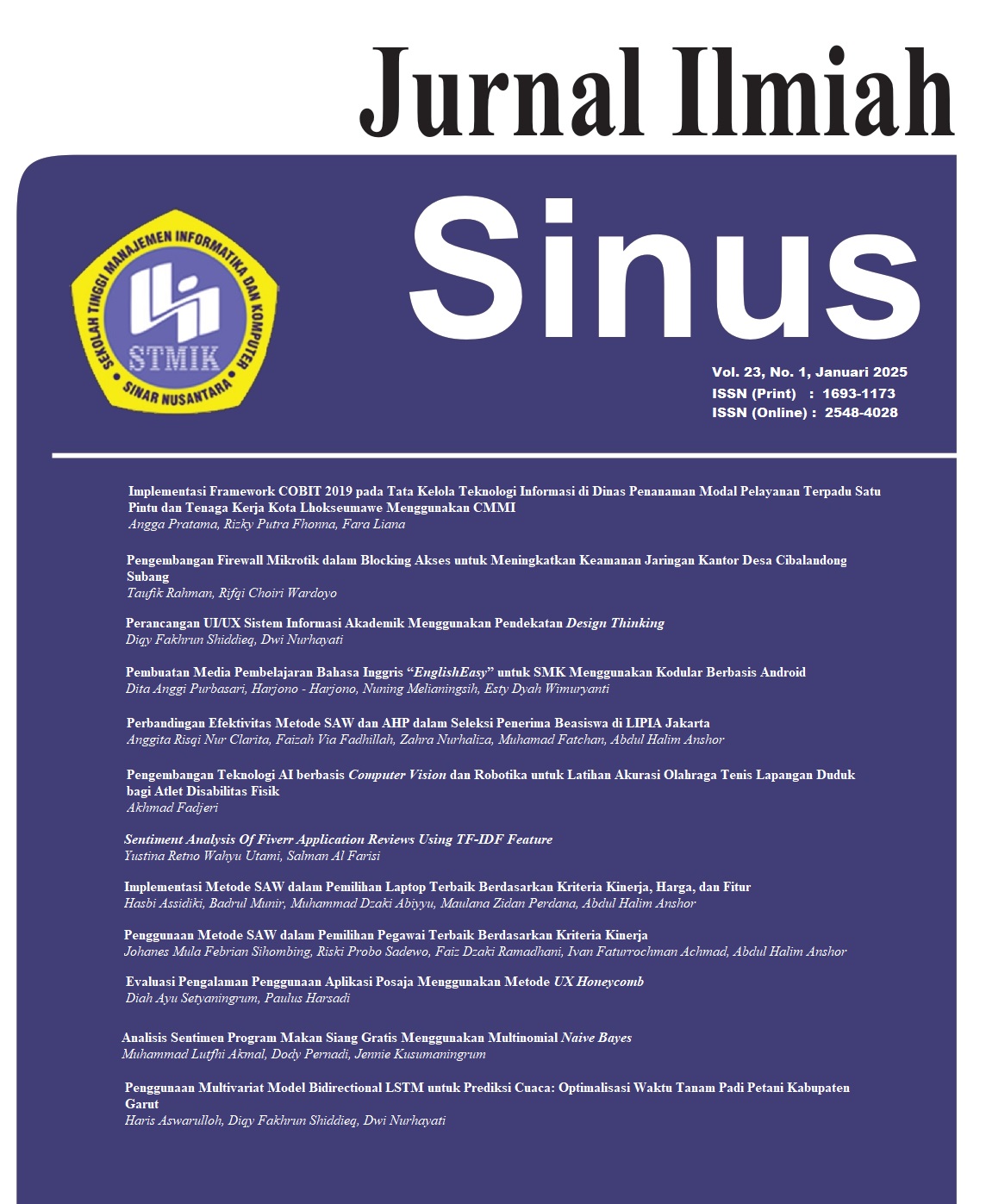
Perancangan UI/UX Sistem Informasi Akademik Menggunakan Pendekatan Design Thinking
DOI:
https://doi.org/10.30646/sinus.v23i1.862Keywords:
academic information system, UI/UX, design thinking, heart frameworkAbstract
References
Ansori, S., Hendradi, P., & Nugroho, S. (2023). Penerapan metode design thinking dalam perancangan UI/UX aplikasi mobile Sipropmawa. Journal of Information System Research (JOSH), 4(4), 1072–1081.
Arief, I., Farhandika, M., Indrapriyatna, A. S., Yulianto, A. A., & Meuthia, Y. (2023). Enhancing user interface and experience of the Bukalapak application: A sentiment analysis approach for improved usability and user satisfaction in Indonesia’s e-commerce sector. Jurnal RESTI (Rekayasa Sistem dan Teknologi Informasi), 7(5), 1192–1204. https://doi.org/10.29207/resti.v7i5.5184
Chauhan, M., & Agarwal, R. (2023). Impact of screens on how users think. In 2023 3rd International Conference on Intelligent Technologies (CONIT) (pp. 1–5). https://doi.org/10.1109/conit59222.2023.10205565
Dashko, Y., & Miroshnichenko, V. (2023). Information technologies in the educational process: Features and advantages. Pedagogical Sciences, (82), 46–51.
Farooqui, T., Rana, T., & Maqbool, A. (2021). Categorization of user experience and usability issues (UXUIS) and their prioritization w.r.t categorization for improving the UXU of interactive system (IS). In International Conference on Communication Technologies (COMTECH) (pp. 85–90).
Garcia, F. P. I. (2023). The platformization of higher education: Challenges and implications. Revista Pixelbit. https://revistapixelbit.com
Haryuda Putra, D., Asfi, M., & Fahrudin, R. (2021). Perancangan UI/UX menggunakan metode design thinking berbasis web pada Laportea Company. Jurnal Ilmiah Teknologi Informasi Terapan, 8(1), 111–117.
Hentati, A., Forsell, E., Ljótsson, B., Kaldo, V., Lindefors, N., & Kraepelien, M. (2021). The effect of user interface on treatment engagement in a self-guided digital problem-solving intervention: A randomized controlled trial. Internet Interventions, 26, 100448. https://doi.org/10.1016/j.invent.2021.100448
Hoyt, J. E. (2021). Student connections: The critical role of student affairs and academic support services in retention efforts. Journal of College Student Retention: Research, Theory & Practice, 25(3), 480–491.
Imin, J. H., Fajar, M., & Hasniati. (2024). Perancangan UI/UX website search buddy menggunakan pendekatan design thinking. Jurnal Ilmiah Media Sisfo, 18(1), 89–98.
Karlina, D., & Indah, D. R. (2022). Perancangan user interface dan user experience sistem informasi e-learning menggunakan design thinking. Jurnal Teknik Informatika dan Sistem Informasi, 8(3). https://doi.org/10.28932/jutisi.v8i3.5412
Malik, R. A., & Frimadani, M. R. (2022). UI/UX analysis and design development of Less-On digital startup prototype by using lean UX. Jurnal RESTI (Rekayasa Sistem dan Teknologi Informasi), 6(6), 958–965.
Nurhayati, D., Machmud, A., & Waspada, I. (2020). Technopreneurship intention: Studi kasus pada mahasiswa dipengaruhi entrepreneurial learning. Jurnal Ekonomi Pendidikan dan Kewirausahaan, 8(1), 79.
Puteri, Y. A., Aulia, D., Alya, A., & Sari, K. (2022). Implementasi metode design thinking pada perancangan user interface aplikasi online course. Jurnal Siliwangi, 8(2), 60–65.
Sastypratiwi, H., Yulianti, Y., Muhardi, H., & Ulumi, D. I. (2023). Incorporating user experience evaluation into application design for optimal usability. Matrik: Jurnal Manajemen, Teknik Informatika dan Rekayasa Komputer, 22(3), 529–538.
Setya Perdana, D., & Lintang Yuniar Banowosari. (2024). Evaluating the Bibit app: The heart framework approach in UX design. Jurnal RESTI (Rekayasa Sistem dan Teknologi Informasi), 8(2), 250–257. https://doi.org/10.29207/resti.v8i2.5714
Shiddieq, D. F., & Hilyah, A. (2024). Pengembangan dashboard interaktif untuk meningkatkan pemahaman dan pengambilan keputusan. J-Ensistec (Journal of Engineering and Sustainable Technology), 10(02), 999–1004.
Sintia, P., Supratman, E., & Bina Darma University. (2023). Desain UI/UX pengelolaan sampah sebagai media pembayaran SPP taman kanak-kanak menggunakan metode design thinking. Joisie Journal of Information System and Informatics Engineering, 7(2), 193–203.
Sugiyono. (2019). Metodelogi penelitian kuantitatif dan kualitatif dan R&D. Bandung: Alfabeta.
Yulia, R., Candra, R. M., Irsyad, M., Darmizal, T., Sultan, N. I., & Kasim, S. (2022). UI/UX redesign of Inhil Dukcapil application using the design thinking method. Jurnal Infokum, 10(05), 481–488. https://infor.seaninstitute.org/index.php/infokum/index
Downloads
Published
How to Cite
Issue
Section
Citation Check
License
Authors who publish with this journal agree to the following terms:
- Authors retain copyright and grant the journal right of first publication with the work simultaneously licensed under a Creative Commons Attribution License that allows others to share the work with an acknowledgement of the work's authorship and initial publication in this journal.
- Authors are able to enter into separate, additional contractual arrangements for the non-exclusive distribution of the journal's published version of the work (e.g., post it to an institutional repository or publish it in a book), with an acknowledgement of its initial publication in this journal.
- Authors are permitted and encouraged to post their work online (e.g., in institutional repositories or on their website) prior to and during the submission process, as it can lead to productive exchanges, as well as earlier and greater citation of published work (See The Effect of Open Access).
Â

This work is licensed under a Creative Commons Attribution-NonCommercial-ShareAlike 4.0 International License.