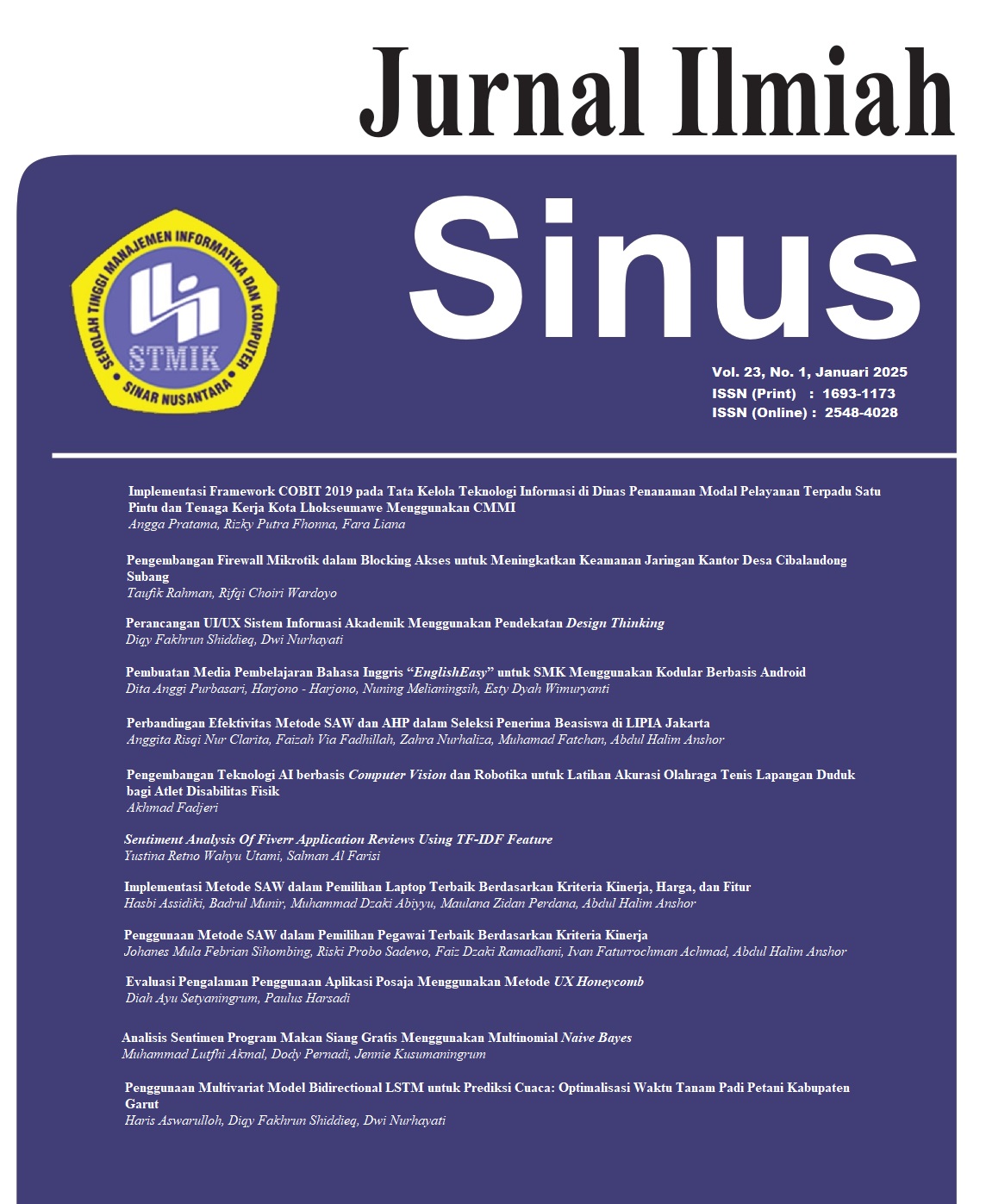
Pembuatan Media Pembelajaran Bahasa Inggris “EnglishEasy†untuk SMK Menggunakan Kodular Berbasis Android
DOI:
https://doi.org/10.30646/sinus.v23i1.869Keywords:
English, Learning Media Application, Android, KodularAbstract
The purpose of this research is to design android application as English learning media for vocational high school by using Kodular. Based on the pre-observation, the researchers found out that the students had limit resources to learn English since they only have one source from the book, the students demanded to have learning sources that can be used anytime and everywhere. Besides, it is expected that it is able to help the students to learn more about TOEIC. The researchers decided to design android application as English learning media by using Kodular. It can be applied to students’ smartphone and will be able to be accessed anytime and everywhere. Research & Development is used as research method. There are several steps to be conducted, they are: 1) analyze students’ need; 2) collecting data; 3) designing prototype; 4) trying out product; 5) final product. The result of this research is English android application based on Kodular, namely EnglishEasy.  Â
References
Andriani, R., & Suratman, A., 2021, Media Pembelajaran Berbasis Android Untuk Meningkatkan Motivasi dan Hasil Belajar Siswa, Jurnal Analisa 7 no.1:64.
Arikunto, S., 2010, Prosedur Penelitian Suatu Pendekatan Praktik, Jakarta: Rineka Cipta
Arsyad, M.M., 2018, Penerapan Media Pembelajaran Berbasis Multimedia Interaktif Terhadap Mahasiswa IKIP Budi Utomo Malang, Jurnal Sejarah dan Pembelajarannya, 8(2), pp.188-198
Herlianus, H., & Gunadi, G., 2022, Pengembangan Media Pembelajaran Organ Gerak Hewan dan Manusia Berbasis Android Menggunakan Kodular, Informatik: Jurnal Ilmu Komputer, 18(1), 88-96
Fauziawati, L., Listiawati, M. & Maryanti, S., 2021, Pengembangan Media Pembelajaran Berbasis Booklet Materi Sistem Reproduksi Manusia Kelas XI SMA, Prosiding Seminar Nasional Pendidikan Biologi
Ikhbal M, & Musril H.A., 2020, Perancangan Media Pembelajaran Fisika berbasis Android, Information Management for Educators and Professionals: Journal of Information Management, 5(1), pp.15-24
Kumala, A. & Winardi, S., 2020, Aplikasi Pencatatan Perbaikan Kendaraan Bermotor Berbasis Android, Jurnal Intra Tech, 4(2), pp.112-120
Matthew B. Miles & A. Michael Huberman., 2014, Analisis Data Kualitatif, Jakarta: Universitas Indonesia Press
Ming, A.K, 2021, Tampilan Dashboard Lebih ke Design UI/UX
Okra, R. & Novera, Y., 2019, Pengembangan Media Pembelajaran Digital IPA di SMP N 3 Kecamatan Pangkalan, Journal Educative: Journal of Education Studies. 4(2), p.121
Pratama, E. A., Maryani, I., Imaniawan, F. F. D., & Maarif, V., 2023, Pelatihan Pembuatan Konten Digital Dalam Merdeka Belajar Sebagai Sarana Pendukung Promosi Desa Wisata Pangebatan, Jurnal Abdimas Ekonomi dan Bisnis, 3(2), 131-141
Purnama, W. C., Annas, F., Musril, H. A., & Darmawati, G, 2023, Perancangan Media Pembelajaran PAI Berbasis Android Menggunakan Kodular Kelas X di SMA N 1 IV Koto, JATI (Jurnal Mahasiswa Teknik Informatika), 7(2), 1304-1311
Safitri, A., 2021, Aplikasi Mobile Learning pada Mata Pelajaran Ekonomi Kelas X Berbasis Android Sebagai Media Pembelajaran Efektif, Jurnal Manajemen Pendidikan Al Multazam NISSN: 2656-3258 JMPA, Vol.3, No. 1, 10-11
Sugiyono, 2019. Metode Penelitian Kuantitatif, Kualitatif, dan R&D. Bandung: Alfabeta
Downloads
Published
How to Cite
Issue
Section
Citation Check
License
Authors who publish with this journal agree to the following terms:
- Authors retain copyright and grant the journal right of first publication with the work simultaneously licensed under a Creative Commons Attribution License that allows others to share the work with an acknowledgement of the work's authorship and initial publication in this journal.
- Authors are able to enter into separate, additional contractual arrangements for the non-exclusive distribution of the journal's published version of the work (e.g., post it to an institutional repository or publish it in a book), with an acknowledgement of its initial publication in this journal.
- Authors are permitted and encouraged to post their work online (e.g., in institutional repositories or on their website) prior to and during the submission process, as it can lead to productive exchanges, as well as earlier and greater citation of published work (See The Effect of Open Access).
Â

This work is licensed under a Creative Commons Attribution-NonCommercial-ShareAlike 4.0 International License.