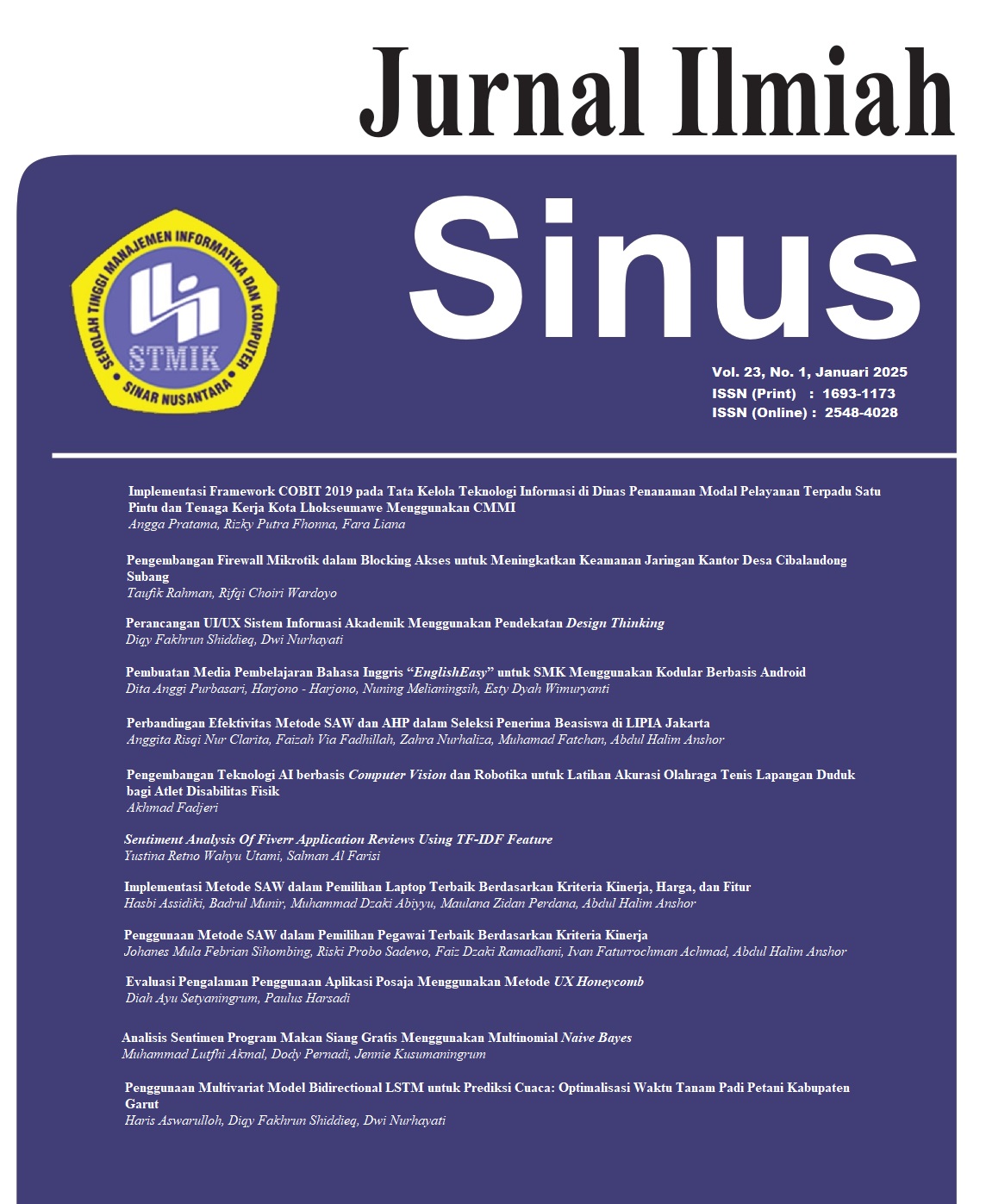
Penggunaan Multivariat Model Bidirectional LSTM untuk Prediksi Cuaca: Optimalisasi Waktu Tanam Padi Petani Kabupaten Garut
DOI:
https://doi.org/10.30646/sinus.v23i1.891Keywords:
Bidirectional LSTM, weather forecasting, rice planting, time series analysis, climate resilienceAbstract
References
Andini, N., & Utomo, W. H. (2021). Climate Prediction Using RNN LSTM to Estimate Agricultural Products Based on Koppen Classification. JISA(Jurnal Informatika Dan Sains), 4(2), 96–99. https://doi.org/10.31326/jisa.v4i2.911
Hochreiter, S., & Schmidhuber, J. (1997). Long Short-Term Memory. Neural Computation, 9(8), 1735–1780. https://doi.org/10.1162/neco.1997.9.8.1735
Huda, A. M., Choiruddin, A., Budiarto, O., & Sutikno. (2012). Peramalan Data Curah Hujan Dengan Seasonal Autoregressive Integrated Moving Average (Sarima) Dengan Deteksi Outlier Sebagai Upaya Optimalisasi Produksi Pertanian Di Kabupaten Mojokerto. Seminar Nasional : Kedaulatan Pangan Dan Energi.
Ju, J., & Liu, F. A. (2021). Multivariate time series data prediction based on ATT-LSTM network. Applied Sciences (Switzerland), 11(20). https://doi.org/10.3390/app11209373
Malhotra, R., & Sharma, A. (2021). Threshold benchmarking for feature ranking techniques. Bulletin of Electrical Engineering and Informatics, 10(2), 1063–1070. https://doi.org/10.11591/eei.v10i2.2752
Milad, A., Adwan, I., Majeed, S. A., Yusoff, N. I. M., Al-Ansari, N., & Yaseen, Z. M. (2021). Emerging Technologies of Deep Learning Models Development for Pavement Temperature Prediction. IEEE Access, 9, 23840–23849. https://doi.org/10.1109/ACCESS.2021.3056568
Nketiah, E. A., Chenlong, L., Yingchuan, J., & Aram, S. A. (2023). Recurrent neural network modeling of multivariate time series and its application in temperature forecasting. PLoS ONE, 18(5 May), 1–18. https://doi.org/10.1371/journal.pone.0285713
Olivya, M. I., & Syari, M. (2020). Pemodelan Atribut Cuaca Menggunakan Long Short Term Memory Dalam Perancangan Kalender Tanam. Teknik Komputer & Jaringan, 179–183.
Park, I., Kim, H. S., Lee, J., Kim, J. H., Song, C. H., & Kim, H. K. (2019). Temperature prediction using the missing data refinement model based on a long short-term memory neural network. Atmosphere, 10(11), 1–16. https://doi.org/10.3390/atmos10110718
Patel, M., Patel, A., & Ghosh, D. R. (2018). Precipitation Nowcasting: Leveraging bidirectional LSTM and 1D CNN. 1–7. http://arxiv.org/abs/1810.10485
Rahman, N., Rahman, M., Baten, M., Hossain, M., Hassan, S., Ahmed, R., Hossain, M., Hossain, A., Aziz, M., Haque, M., Halder, T., Mamun, M., Bhuiyan, M., Khan, M., Chowdhury, A., Qayum, M., Sarkar, M., Salam, M., & Kabir, M. (2021). Weather Forecast Based Rice Advisory Services in Bangladesh. Bangladesh Rice Journal, 25(1), 51–74. https://doi.org/10.3329/brj.v25i1.55179
Sanusi, A. R., Taufik, M., & I Putu Santikayasa. (2021). The Use of Weather Research and Forecasting Model to Predict Rainfall in Tropical Peatland: 1. Model Parameterization. Agromet, 35(1), 49–59. https://doi.org/10.29244/j.agromet.35.1.49-59
Surmaini, E., & Syahbuddin, H. (2016). Kriteria Awal Musim Tanam: Tinjauan Prediksi Waktu Tanam Padi Di Indonesia. Jurnal Penelitian Dan Pengembangan Pertanian, 35(2), 47. https://doi.org/10.21082/jp3.v35n2.2016.p47-56
Weather - 2023 - Hirons - Experiences of coâ€producing subâ€seasonal forecast products for agricultural application in Kenya.pdf. (n.d.).
Wulan Suci, K., & Irhamah. (2017). Peramalan Curah Hujan Sebagai Pendukung Vector Regression dan Genetic Algorithm- SVR. Jurnal Sains Dan Seni ITS, 6(1).
Zhao, K., He, Z., Hung, A., & Zeng, D. (2024). Dominant Shuffle: A Simple Yet Powerful Data Augmentation for Time-series Prediction. 1–16. http://arxiv.org/abs/2405.16456
Zoremsanga, C., & Hussain, J. (2024). An Evaluation of Bidirectional Long Short-Term Memory Model for Estimating Monthly Rainfall in India. Indian Journal Of Science And Technology, 17(18), 1828–1837. https://doi.org/10.17485/ijst/v17i18.2505
Kementerian Pertanian Republik Indonesia. (2019). Pedoman fasilitasi perlindungan lahan pertanian pangan berkelanjutan (PLP2B). Jakarta: Kementerian Pertanian Republik Indonesia.
Downloads
Published
How to Cite
Issue
Section
Citation Check
License
Authors who publish with this journal agree to the following terms:
- Authors retain copyright and grant the journal right of first publication with the work simultaneously licensed under a Creative Commons Attribution License that allows others to share the work with an acknowledgement of the work's authorship and initial publication in this journal.
- Authors are able to enter into separate, additional contractual arrangements for the non-exclusive distribution of the journal's published version of the work (e.g., post it to an institutional repository or publish it in a book), with an acknowledgement of its initial publication in this journal.
- Authors are permitted and encouraged to post their work online (e.g., in institutional repositories or on their website) prior to and during the submission process, as it can lead to productive exchanges, as well as earlier and greater citation of published work (See The Effect of Open Access).
Â

This work is licensed under a Creative Commons Attribution-NonCommercial-ShareAlike 4.0 International License.