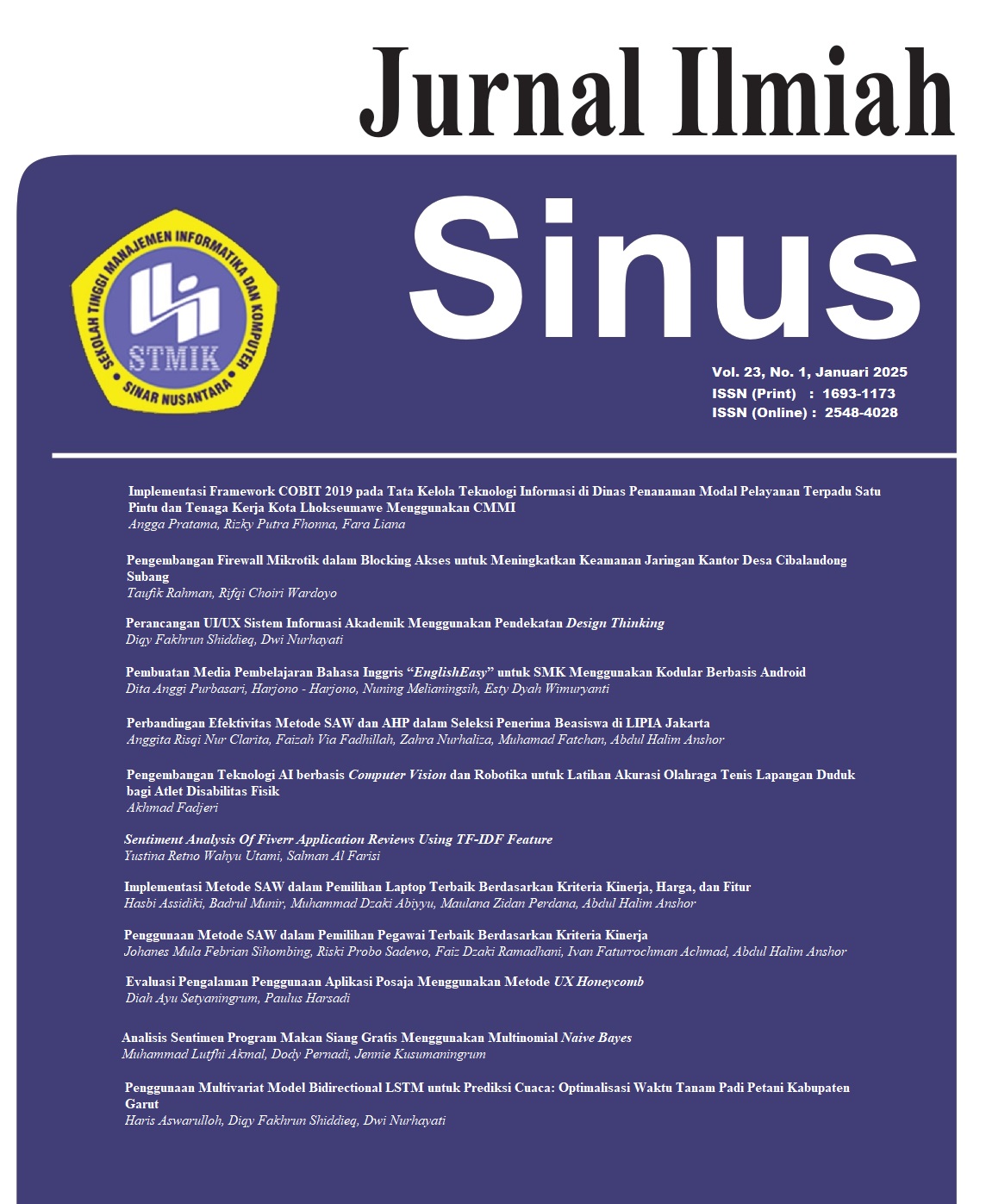
Evaluasi Pengalaman Penggunaan Aplikasi Posaja Menggunakan Metode UX Honeycomb
DOI:
https://doi.org/10.30646/sinus.v23i1.893Keywords:
Evaluation, UX HoneycombAbstract
PT Pos Indonesia is one of the state-owned companies in Indonesia engaged in postal and logistics services. Pos Indonesia launched a new innovation by creating the PosAja application which aims to facilitate customers in sending packages and letters. However, there are features of PosAja that need to be improved based on the results of reviews from users, including a lack of understanding of the features of the PosAja application, users find it difficult to track the position of goods and the delivery flow is not clear or the position of the goods is not mentioned. Therefore, it is necessary to evaluate the PosAja application so that it can be even better in its future services. This research uses the UX Honeycomb method to improve user experience in a digital product or service. The system design uses the Unified Modeling Language and is implemented using the PHP programming language and MySQL database. The results of the user experience evaluation of the PosAja application with the UX Honeycomb method show that the average value of variables that can be accessed is 3.57, can be found by 3.93, can be used by 3.76, useful by 4.05, valuable by 3.95, desirable by 4.19, and credible. by 3.82 which means that the value is included in the good category. Desirable, useful and valuable variables have a high average value which indicates that this application is needed by users and the variable accessed has the lowest average which indicates that this application needs improvement and improvement in terms of access speed. The results of the above research can provide recommendations to PT. POS to increase access speed so that users find it easier to use the application even though it is through cellphone media with insufficient signal due to geographical factors of users.
References
Andikarama Prasida, Satrio Hadi Wijoyo, & Retno Indah Rokhmawati3. (2021). Evaluasi User Experience Pada Website Progate.Com Menggunakan Indikator UX Honeycomb (Vol. 5, Issue 7). http://j-ptiik.ub.ac.id
Andreas, J. A., Misael, J., & Arifin, A. (2024). Evaluasi User Experience Pada Aplikasi SignalPolri Menggunakan Metodologi UX Honeycomb. Jurnal Pendidikan Dan Teknologi Indonesia, 3(11). https://doi.org/10.52436/1.jpti.344
Budiarti, A. T., Wahyudi, F., & Ratnasari, N. (2022). Analisis Pengaruh User Experience Terhadap Kepuasan Pengguna Pada Aplikasi Gojek Menggunakan UX Honeycomb. Jurnal Sistem Informasi Dan Informatika (JUSIFOR), 1(2), 104–111. https://doi.org/10.33379/jusifor.v1i2.1634
Idrus L. (2019). Evaluasi Dalam Proses Pembelajaran. ADAARA : Jurnal Manajemen Pendidikan Islam , 9.
Kusuma Wirahadi, Rokhmawati Indah Retno, & Ananta Tri Mahardeka. (2019). Evaluasi Pengalaman Pengguna pada Aplikasi Mobile Learning dengan menggunakan UX Honeycomb. Jurnal Pengembangan Teknologi Informas Dan Ilmu Komputer, 3, 5756–5764. http://j-ptiik.ub.ac.id
Mz Yumarlis, L. S. ,Trinugraha Y. I. K. Y. (2023). Analisis Pengaruh Penerapan CRM Pada Aplikasi PosAja Terhadap Loyalitas Pengguna. Jurnal Informasi Interaktif, 8, 1–44. http://e-journal.janabadra.ac.id/
Ramdhani Muhammad Rizal, Muslimah Az-Zahra Hanifah, & Wijoyo Satrio Hadi. (2019). Evaluasi Perbandingan Ranking Antara Proposed Value dan Perceived Value Terhadap Crowdfunding Berdasarkan Model UX Honeycomb. Jurnal Pengembangan Teknologi Informasi Dan Ilmu Komputer, 3(8), 7458–7466. http://j-ptiik.ub.ac.id
Reno Fithri Meuthia, F. dan G. (2021). Analisis User Experience Pada Aplikasi E-Kelurahan Menggunakan Model UX Honeycomb. Jurnal Akuntansi Keuangan Dan Bisnis, 14(2), 342–351. https://doi.org/doi.org/10.35143/jakb.v14i2.5167
Rindiasari, P., Hidayat, W., & Yuliani, W. (2021). Uji Validitas dan Reliabilitas Angket Kepercayaan Diri. FOKUS (Kajian Bimbingan & Konseling Dalam Pendidikan), 4(5), 367. https://doi.org/10.22460/fokus.v4i5.7257
Widodo, S. S. , M. K. , S., Ladyani, M. K. , Dr. F., Asrianto, SKM. , M. K. , L. O., Ns. Rusdi., S. Kep. , M. K., Khairunnisa, SKM. , MM. , M. K., Puji Lestari, M. Pd. K. dr. S. M. ., Devrianya, S. M. K. , A., Wijayanti, D. R., Hidayat, M. P. , A., dr. Dalfian, M. Kes. , S. K., Nurcahyati, SKM. , M. E. , S., Sjahriani, dr. , M. Kes. , Dr. T., Ns. Armi, S. Kep. , M. K., Widya, S. Si. , M. S. , N., & Ns. Rogayah, Sk. M. K. (2023). BUKU AJAR METODE PENELITIAN (Seto. M. Sudirman, Ed.; 2023rd ed.). Science Techno.
Downloads
Published
How to Cite
Issue
Section
Citation Check
License
Authors who publish with this journal agree to the following terms:
- Authors retain copyright and grant the journal right of first publication with the work simultaneously licensed under a Creative Commons Attribution License that allows others to share the work with an acknowledgement of the work's authorship and initial publication in this journal.
- Authors are able to enter into separate, additional contractual arrangements for the non-exclusive distribution of the journal's published version of the work (e.g., post it to an institutional repository or publish it in a book), with an acknowledgement of its initial publication in this journal.
- Authors are permitted and encouraged to post their work online (e.g., in institutional repositories or on their website) prior to and during the submission process, as it can lead to productive exchanges, as well as earlier and greater citation of published work (See The Effect of Open Access).
Â

This work is licensed under a Creative Commons Attribution-NonCommercial-ShareAlike 4.0 International License.