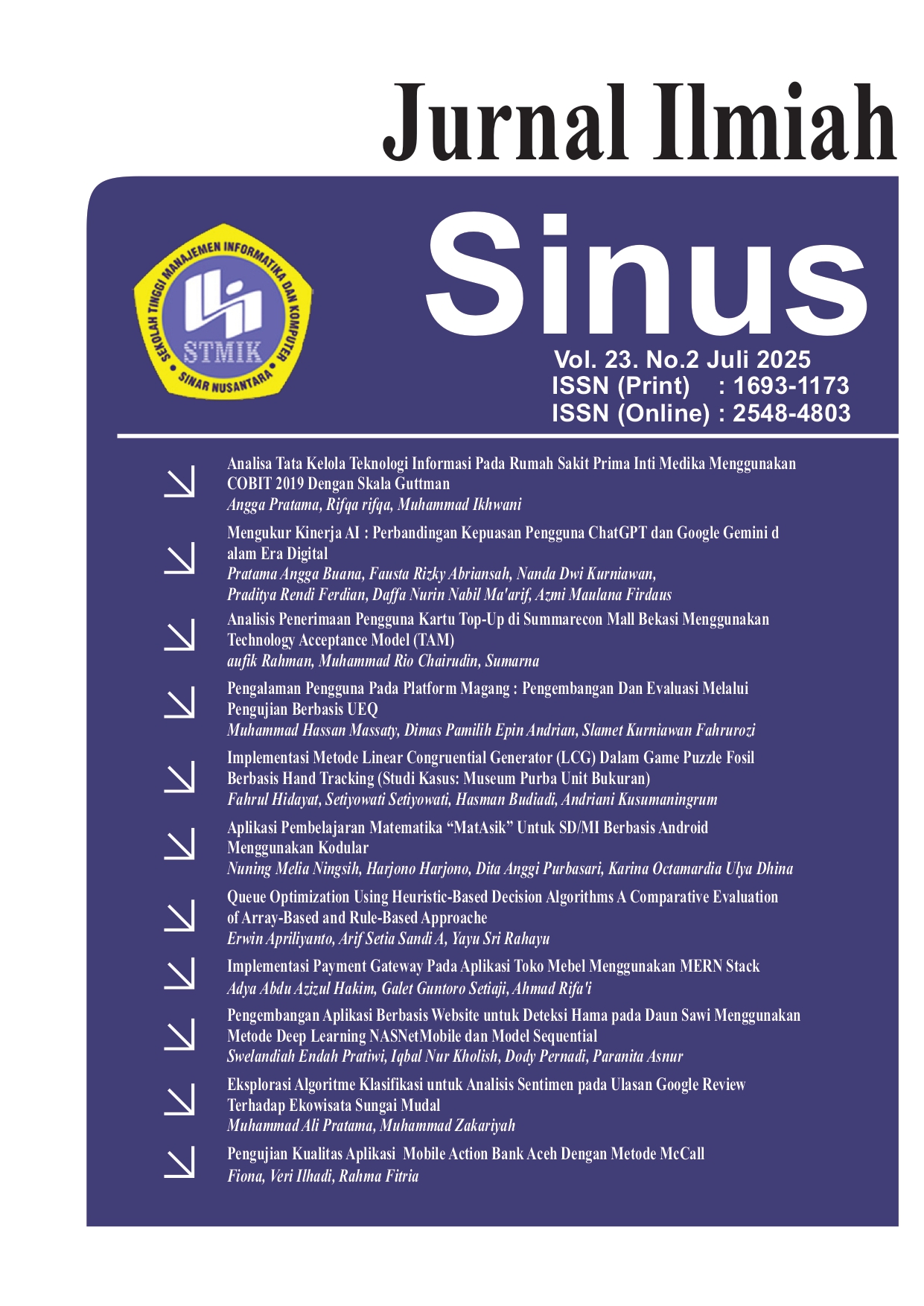
Implementasi Metode Linear Congruential Generator (LCG) Dalam Game Puzzle Fosil Berbasis Hand Tracking (Studi Kasus: Museum Purba Unit Bukuran)
DOI:
https://doi.org/10.30646/sinus.v23i2.954Keywords:
Puzzle Game, Linear Congruential Generator (LCG), Hand TrackingAbstract
In the digital era, the use of interactive technology is increasingly widespread, including in the fields of education and entertainment. This study aims to develop a fossil Puzzle Game based on Hand Tracking at the Museum Purba Unit Bukuran using the Linear Congruential Generator (LCG) method to generate varied and random challenges. The implementation of LCG in this Game is expected to enhance the variation and randomization of Puzzle pieces, providing a more engaging and immersive learning experience for visitors. The Hand Tracking method is chosen to offer a more natural and intuitive interaction, allowing users to interact with the Game using hand gestures without the need for additional devices such as a mouse or keyboard. This technology not only increases user comfort but also adds an interactive element that brings the virtual experience closer to reality. The results of the study show that the use of LCG successfully randomizes Puzzle pieces with great variation, thus increasing the Game's replayability. Additionally, the integration of Hand Tracking in the Game enhances user engagement and satisfaction. Trials conducted on a group of museum visitors showed positive responses, with the majority of participants finding the Game enjoyable and interactive.
References
Fadli, R., Syaputra, H., Mirza, A. H., & Oktaviani, N. (2022). Perancangan Artificial Intelegence Hand Tracking menggunakan Algoritma Pyramidal Lucas-Kanade Optical Flow. Jurnal Pendidikan Dan Konseling, 4(4), 79. https://core.ac.uk/download/pdf/322599509.pdf
Fahrezi, A., Salam, F. N., Ibrahim, G. M., Syaiful, R. R., & Saifudin, A. (2022). Pengujian Black Box Testing pada Aplikasi Inventori Barang Berbasis Web di PT. AINO Indonesia. LOGIC : Jurnal Ilmu Komputer Dan Pendidikan , 1(1), 1–5. https://journal.mediapublikasi.id/index.php/logic
I Komang Setia Buana. (2020). Implementasi Aplikasi Speech to Text untuk Memudahkan Wartawan Mencatat Wawancara dengan Python. Jurnal Sistem Dan Informatika (JSI), 14(2), 135–142. https://doi.org/10.30864/jsi.v14i2.293
Khasyi Atisomya -, A. (2023). Aplikasi Algoritma Divide and Conquer Pada Hand Tracking Sederhana. https://informatika.stei.itb.ac.id/~rinaldi.munir/Stmik/2020-
Putra, H. E., & Harianto, K. (2018). Implementasi Linear Congruential Generator untuk Pengacakan Gambar Pada Permainan Puzzle. SATIN - Sains Dan Teknologi Informasi, 4(1), 89–96. https://doi.org/10.33372/stn.v4i1.302
Rakhmawati, D. R. (2020). Artikel Ilmiah Artikel Ilmiah. STIE Perbanas Surabaya, 101, 0–16.
Safitri, D. N. (2021). Implementasi Metode Linear Congruential Generator pada Game Puzzle Kesenian Tari. JATISI (Jurnal Teknik Informatika Dan Sistem Informasi), 8(1), 129–140. https://doi.org/10.35957/jatisi.v8i1.632
Wulandari, Nofiyani, & Hasugian, H. (2023). User Acceptance Testing (Uat) Pada Electronic Data Preprocessing Guna Mengetahui Kualitas Sistem. Jurnal Mahasiswa Ilmu Komputer, 4(1), 20–27.
Yunanto, D. (2021). Game Edukasi Puzzle Rumah Adat Tradisional Indonesia Berbasis Android. Jurnal Informatika Dan Rekayasa Perangkat Lunak, 2(3), 414–420. https://doi.org/10.33365/jatika.v2i3.1254
Downloads
Published
How to Cite
Issue
Section
Citation Check
License
Authors who publish with this journal agree to the following terms:
- Authors retain copyright and grant the journal right of first publication with the work simultaneously licensed under a Creative Commons Attribution License that allows others to share the work with an acknowledgement of the work's authorship and initial publication in this journal.
- Authors are able to enter into separate, additional contractual arrangements for the non-exclusive distribution of the journal's published version of the work (e.g., post it to an institutional repository or publish it in a book), with an acknowledgement of its initial publication in this journal.
- Authors are permitted and encouraged to post their work online (e.g., in institutional repositories or on their website) prior to and during the submission process, as it can lead to productive exchanges, as well as earlier and greater citation of published work (See The Effect of Open Access).
Â

This work is licensed under a Creative Commons Attribution-NonCommercial-ShareAlike 4.0 International License.