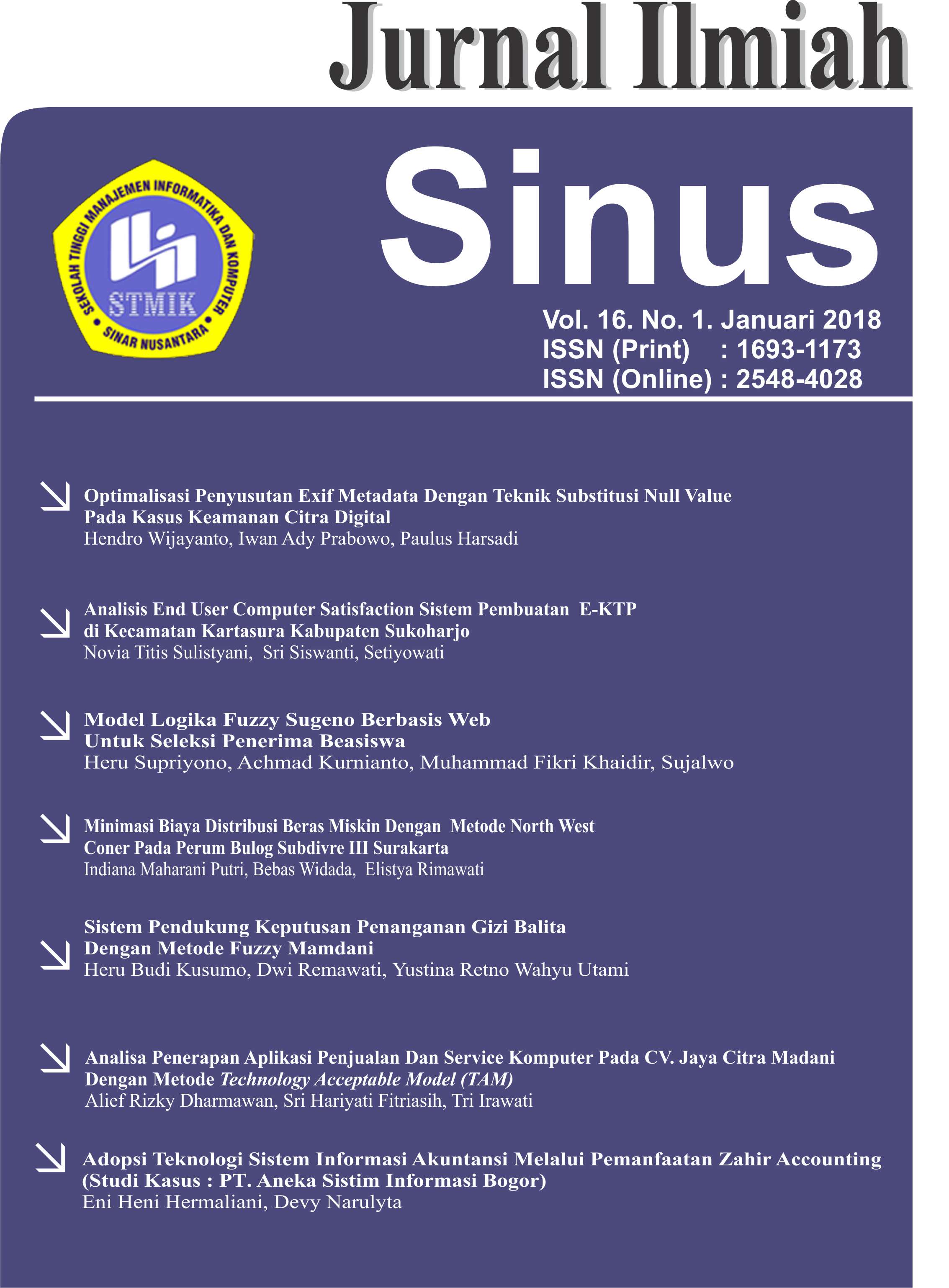
ANALISIS END USER COMPUTER SATISFACTION SISTEM PEMBUATAN E-KTP DI KECAMATAN KARTASURA KABUPATEN SUKOHARJO
DOI:
https://doi.org/10.30646/sinus.v16i1.328Keywords:
e- ID card, EUCS, SPSS, Classic assumption test, T-test, F-testAbstract
The e-ID card service in Kecamatan Kartasura, Sukoharjo District has been running well, but people feel less satisfied with the service of making e-ID card by the sub-district officer. So it is necessary to know what factors affect the dissatisfaction. The research titled End User Computer Satisfaction analysis of e-ID card system in Kecamatan Kartasura Sukoharjo District was conducted to evaluate e-ID card making system in Kecamatan Kartasura Sukoharjo District.
Factors in the process of making e-ID card is the influence of perception of content, accuracy, ease, and influence of timely perception toward the satisfaction of society. The method used in this system analysis is End User Computer Satisfaction. Population and sample of the research are 120 population in Kecamatan Kartasura Sukoharjo District. The result of the questionnaires is analyzed by using SPSS 15 with the classical assumption test, multiple linear regression, coefficient of determination and T-test and F-test.
The results of the analysis revealed that 58.6% of the 4 independent variables of content, ease and timely affect the satisfaction of the population, while the accuracy does not affect the satisfaction of the population about the e-ID card system.
Â
Â
Â
References
Camilla, D. R. D. (2013). Pengaruh Tingkat Kepuasan Pengguna Sistem Dengan Metode End User Computing Satisfaction Terhadap Kinerja Individu Pengguna Sistem(Studi Kasus Pada Pengguna Sistem Aplikasi TiCARES PT Telekomunikasi Indonesia, Tbk).
Doll, W. J., & Torkzadeh, G. (1991). The measurement of end-user computing satisfaction: theoretical and methodological issues. MIS Quarterly Society for Information Management and The Management Information Systems Research Center Minneapolis, MN, USA, 15(Issue 1), 5–10. https://doi.org/10.2307/249429
Febriharini, M. P. (2016). Pelaksanaan Program e KTP Dalam Rangka Tertib Administrasi Kependudukan. Serat Acitya –Jurnal Ilmiah UNTAG Semarang, Vol. 5(No. 2), 17–30.
Ilias, A. (2009). End-User Computing Satisfaction ( EUCS ) in Computerised Accounting System ( CAS ): Which the Critical Factors ? A Case in Malaysia, 2(1), 18–24.
Kumolo, T. (2016). Surat Edaran Mendagri Nomor 470/296/SJ Tentang KTP-el Berlaku Seumur Hidup (Untuk Gubernur, Bupati/Walikota). Retrieved June 14, 2016, from http://www.dukcapil.kemendagri.go.id/peraturan/detail/75/surat-edaran-mendagri-nomor-470296SJ-tentang-ktp-el-berlaku-seumur-hidup--untuk-gubernur-bupatiwalikota.
Mohamed, A. (2006). The Study of End-User Computing Satisfaction ( EUCS ) on Computerised Accounting System ( CAS ) Among Peninsular Malaysia Public Universities : A Survey in Bursar ’ s Office. Labuan E-Journal of Muamalat and Society , 2(October 2015), 594–608. Retrieved from http://wwwkal.ums.edu.my/LJMS/Volume_1_2007/LJMS_vol1_2007_1-13[1].pdf
Prihadi, S. D. (2017). Mengenal Fungsi Biometrik & Chip di e-KTP. Retrieved December 1, 2017, from https://www.cnnindonesia.com/teknologi/20170309140234-185-198990/mengenal-fungsi-biometrik-chip-di-e-ktp
Profil Kecamatan Kartasura Kabupaten Sukoharjo. (2016). Retrieved June 14, 2016, from http://www.kartasura.sukoharjokab.go.id/
Rewah, J., Studi, P., Informasi, S., & Klabat, U. (2017). Analisis Efektifitas Sistem Informasi E-Ktp Di Dinas Kependudukan Dan Pencatatan Sipil ( Dispendcapil ) Minahasa Utara Effectivity Analysis of e-Ktp Information System at Dinas Kependudukan Dan Pencatatan Sipil ( Dispencapil ) North Minahasa. Cogito Smart Journal, Vol 3, No., 222–229.
Downloads
Published
How to Cite
Issue
Section
Citation Check
License
Authors who publish with this journal agree to the following terms:
- Authors retain copyright and grant the journal right of first publication with the work simultaneously licensed under a Creative Commons Attribution License that allows others to share the work with an acknowledgement of the work's authorship and initial publication in this journal.
- Authors are able to enter into separate, additional contractual arrangements for the non-exclusive distribution of the journal's published version of the work (e.g., post it to an institutional repository or publish it in a book), with an acknowledgement of its initial publication in this journal.
- Authors are permitted and encouraged to post their work online (e.g., in institutional repositories or on their website) prior to and during the submission process, as it can lead to productive exchanges, as well as earlier and greater citation of published work (See The Effect of Open Access).
Â

This work is licensed under a Creative Commons Attribution-NonCommercial-ShareAlike 4.0 International License.