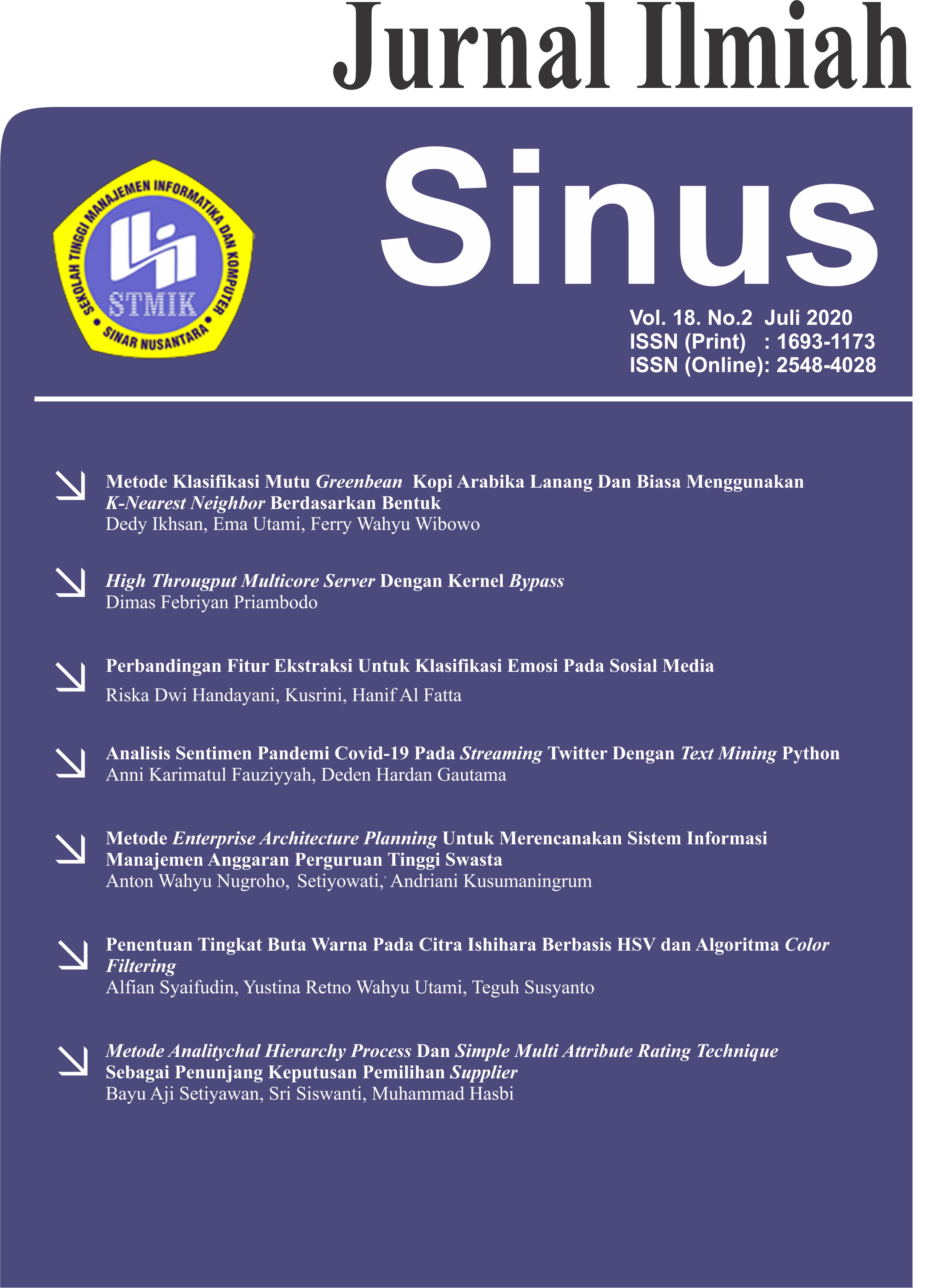
Penentuan Tingkat Buta Warna Pada Citra Ishihara Berbasis HSV Dan Algoritma Color Filtering
DOI:
https://doi.org/10.30646/sinus.v18i2.485Keywords:
color blind test, Color Filtering, Hue Saturation Value (HSV), color spaceAbstract
References
Andriessen, D. R. (2013). Pengendalian Mobile Robot Berbasis Webcam Menggunakan Perintah Isyarat Tangan. STIKOM Surabaya.
Atmojo, H. S. (2016). Aplikasi Diagnosa Kebutaan Warna Menggunakan Metode Ishihara untuk Android. Universitas Muhammadiyah Surakarta.
Kadir, A., & Susanto, A. (2013). Teori dan Aplikasi Pengolahan Citra, Yogyakarta. Andi.
Mutrofin, S., Kurniawan, E., & Agustiawan, Y. (2015). Ekstraksi Fitur Warna Menggunakan Hue Saturation Value Untuk Klasifikasi Tumbuhan Berdasarkan Citra Daun. https://doi.org/10.13140/RG.2.2.24846.66884
Nana, A., Rosmala, D., Ichwan, M., & Indarko, R. W. (2016). Implementasi Algoritma Color Filtering Pada Aplikasi Gitar Virtual. Selisik, 2503–2844(Selisik), 254–262.
Prabawati, P. (2015). Sistem Pakar Diagnosa Buta Warna Berbasis Android. Universitas Negeri Semarang.
Purnamasari, P. (2015). Tes Buta Warna Metode Ishihara Berbasis Komputer. Jurnal Komputer, 38–45.
Sulistyawati, D. H. (2018). Analisa Citra Parasit Malaria Dalam Ruang Warna Hue Saturation Value ( HSV ). Jurnal Hasil Penelitian LPPM Untag Surabaya, 03(01), 63–
Downloads
Published
How to Cite
Issue
Section
Citation Check
License
Authors who publish with this journal agree to the following terms:
- Authors retain copyright and grant the journal right of first publication with the work simultaneously licensed under a Creative Commons Attribution License that allows others to share the work with an acknowledgement of the work's authorship and initial publication in this journal.
- Authors are able to enter into separate, additional contractual arrangements for the non-exclusive distribution of the journal's published version of the work (e.g., post it to an institutional repository or publish it in a book), with an acknowledgement of its initial publication in this journal.
- Authors are permitted and encouraged to post their work online (e.g., in institutional repositories or on their website) prior to and during the submission process, as it can lead to productive exchanges, as well as earlier and greater citation of published work (See The Effect of Open Access).
Â

This work is licensed under a Creative Commons Attribution-NonCommercial-ShareAlike 4.0 International License.