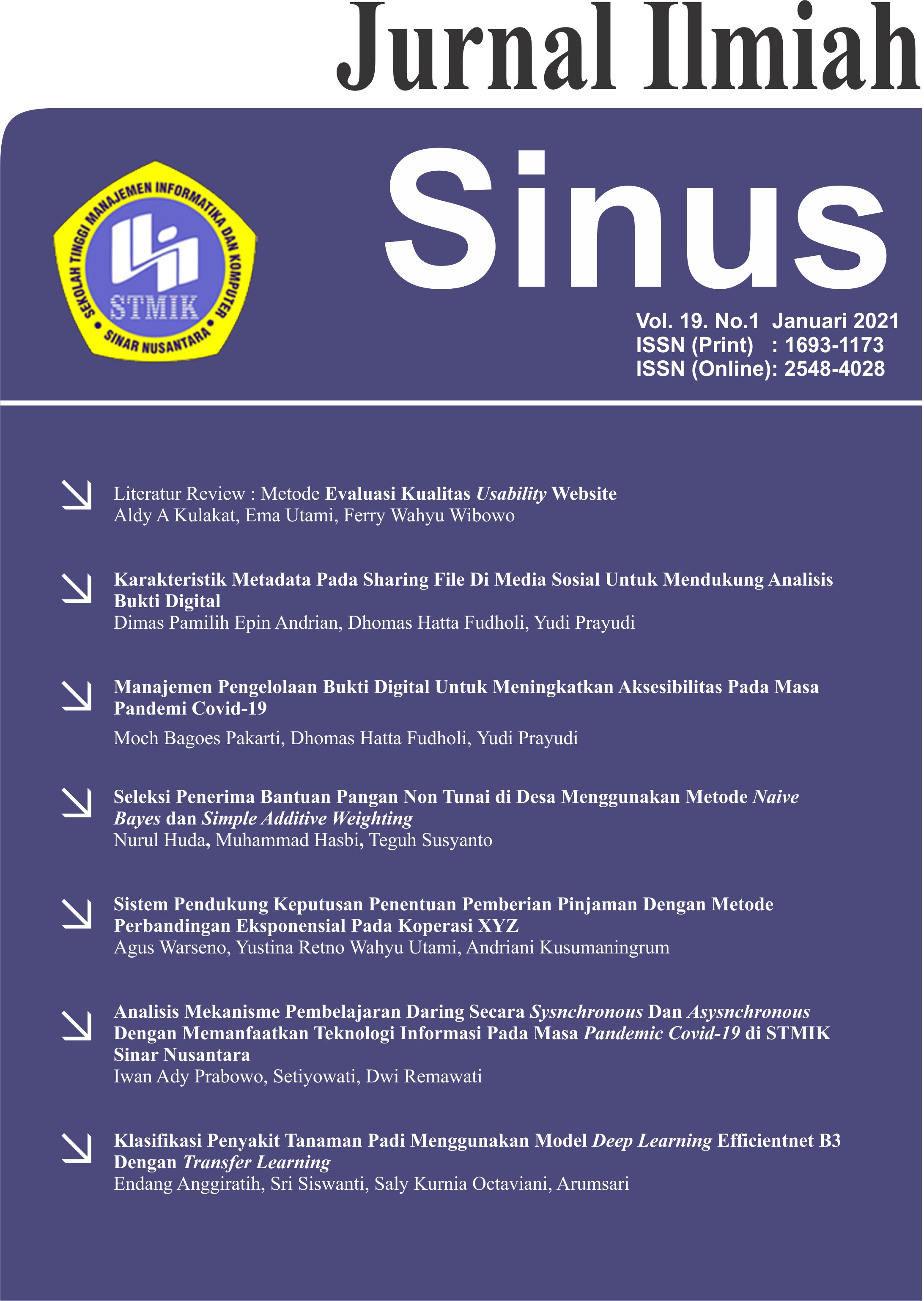
Analisis Mekanisme Pembelajaran Daring Secara Sysnchronous dan Asysnchronous dimasa Pandemic Covid-19 di STMIK Sinar Nusantara
DOI:
https://doi.org/10.30646/sinus.v19i1.524Keywords:
online learning, synchronous learning, asynchronous learning, corona virus Disease Covid-19 learningAbstract
Circular Number 05/SEK/STMIK-SN/IV/2020 in STMIK Sinar Nusantara Surakarta regulates implementation of learning, midterm exams, and even thesis / final exams. Hence, STMIK Sinar Nusantara took a policy for the implementation of synchronous learning and asynchronous learning. Synchronous learning (one time: teleconference, chatting) applies (1) Google Meeting by sinus.ac.id account, (2) Virtual meeting as Skype and Zoom, and (3) Discussion in Classroom. Meanwhile, asynchronous learning (time difference) uses (1) handouts, (2) tutorials, (3) videos, and (4) simple exercises. The purpose of this study was to determine the mechanisms in online learning (E-Learning) during Covid-19 Pandemic at STMIK Sinar Nusantara. This research only focuses on Synchronous and Asynchronous E-learning mechanism at STMIK Sinar Nusantara in even semester of 2019/2020. This research was conducted using 49 lecturers as respondents. The research method was descriptive statistical analysis. The results of the study by sampling 49 respondents as lecturers in online learning during Covid-19 Pandemic at STMIK Sinar Nusantara can be concluded that Synchronous learning (Conference by Google Meet, Skype, Zoom, Youtube Live, Umeetme) reached 57% and those who did not apply Synchronous learning (no conference) reached 43%. Meanwhile, the results of analysis in Asynchronous learning (handouts, tutorials, exercises / discussions, and videos) reached 88% and those who did not apply Asynchronous learning reached 12%.
ÂReferences
Anderson, T. (2011). The theory and practice of online learning. (2 nd Edition). Edmonton: AB: AU Press.
Azhari, A. (2009). Media Pembelajaran. Jakarta: PT. Raja Grafindo.
Bosch, C. (2016). Promoting Self-Directed Learning through the Implementation of Cooperative Learning in a Higher Education Blended Learning Environment. Johannesburg. NorthWest : SA: Doctoral dissertation at NorthWest University. Nd.
Ditjen Dikti. (2020). Ringkasan Statistik Pendidikan Tinggi. 1.
Downes, S. (2010). New technology supporting informal learning. Journal of Emerging Technologies in Web Intelligence. 2(1), 27-33.
Garrison, D., Anderson, T., & Archer, W. (2003). A theory of critical inquiry in online distance education. In M. G.
Hartanto, A. A., & Purbo, O. W. (2002). Buku pintar internet teknologi e-learning berbasis PHP dan MySQL. Jakarta: PT Elex Media Komputindo Kelompok Gramedia.
Hosier, A. (2013). Using Team-Based Learning in an Online, Asynchronous Information Literacy Course. Journal of library innovation Vol 4, 2.
Lewis, J., & A, C. (2009). Synchronous Learning and Web-Based Communication With Adobe Acrobat. Multimedia Information & Technology 35 (04), 8-9.
Siemens, G. (2005). Connectivism: A learning theory for the digital age. International Journal of Instructional Technology and Distance Learning. 2(1), 3-10.
Downloads
Additional Files
Published
How to Cite
Issue
Section
Citation Check
License
Authors who publish with this journal agree to the following terms:
- Authors retain copyright and grant the journal right of first publication with the work simultaneously licensed under a Creative Commons Attribution License that allows others to share the work with an acknowledgement of the work's authorship and initial publication in this journal.
- Authors are able to enter into separate, additional contractual arrangements for the non-exclusive distribution of the journal's published version of the work (e.g., post it to an institutional repository or publish it in a book), with an acknowledgement of its initial publication in this journal.
- Authors are permitted and encouraged to post their work online (e.g., in institutional repositories or on their website) prior to and during the submission process, as it can lead to productive exchanges, as well as earlier and greater citation of published work (See The Effect of Open Access).
Â

This work is licensed under a Creative Commons Attribution-NonCommercial-ShareAlike 4.0 International License.