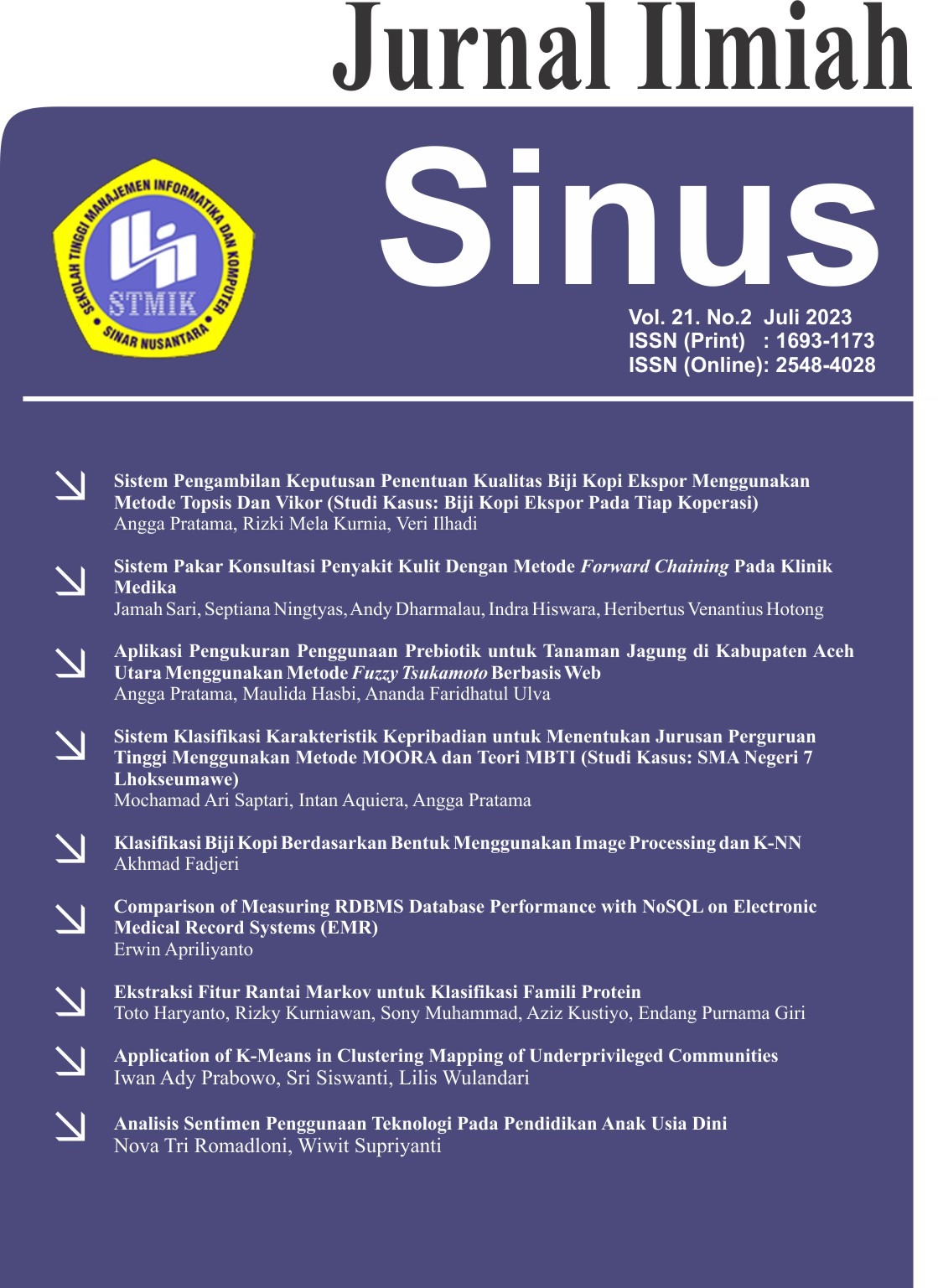
Aplikasi Pengukuran Penggunaan Prebiotik untuk Tanaman Jagung di Kabupaten Aceh Utara Menggunakan Metode Fuzzy Tsukamoto Berbasis Web
DOI:
https://doi.org/10.30646/sinus.v21i2.707Keywords:
Applications, Measurement of Prebiotics, Corn Plants, Fuzzy TsukamotoAbstract
Corn, along with rice and wheat, is one of the world's most significant food crops. Crop failures are a common concern for farmers, and one of the causes is the use of unsuitable fertilizers, which can limit the growth of organs and plant structure as a whole. Because good corn plant growth and high yields require the use of good and appropriate fertilizer for corn plants, this system is designed to recommend fertilization for plants based on the variables required by plants, namely soil pH, air temperature, humidity, rainfall, rainy days, altitude area, solar radiation, and land area, as determined by the agricultural service. Where each value is calculated using a specified set of each criterion, namely little, medium, and high. The outcomes of these computations are the final result of this decision system, namely suggestions for fertilizer usage in liters to assist farmers in analyzing fertilizer use for corn plants in North Aceh District. As in prior works, Tsukamoto's fuzzy technique is applied in this decision-making system to handle data values with a very high level of uncertainty or ambiguity.
References
Cooper Donald R, & Schindler Pamela S. (2017). Metode penelitian bisnis (Gina Gania (ed.); 12th ed.).
Eko, A. (2017). Perancangan Aplikasi Fuzzy Logic Dalam Menentukan Volume Produksi Dengan Menggunakan Metode Mamdani. Jurnal Teknologi Informasi & Pendidikan, 10(1), 72–83.
Hardati, P. (2016). Hierarki Pusat Pelayanan Di Kecamatan Ungaran Barat Dan Ungaran Timur Kabupaten Semarang. Jurnal Geografi : Media Informasi Pengembangan Dan Profesi Kegeografian, 13(2), 204–215.
Hermawan Rudi & Hidayat. (2016). 603-1288-4-Pb. Indonesian Journal on Software Engineering Audit, 2(1), 31–38.
Hidayatullah, R., Rubiati, N., Kurniawan, R., & Sekolah Tinggi Manajemen Informatika dan Komputer Dumai Utama Karya Bukit Batrem Kec Dumai Timur Kode, K. J. (2017). I N F O R M a T I K a Implementasi Fuzzy Logic Penentuan Kelayakan Karyawan Mendapat Reward Ditoko Roti Mengunakan Metode Tsukamoto. Jurnal Informatika, Manajemen Dan Komputer, 10(2), 56–65.
Indarwati, S., Respati, S. M. B., & Darmanto, D. (2019). Kebutuhan Daya Pada Air Conditioner Saat Terjadi Perbedaan Suhu Dan Kelembaban. Jurnal Ilmiah Momentum, 15(1), 91–95. https://doi.org/10.36499/jim.v15i1.2666
Informasi, F. T., & Pasuruan, U. M. (2017). Sistem Pakar Deteksi Tingkat Kesuburan Tanah Menggunakan Fuzzy Logic. 2(2), 91–95.
Kosanke, R. M. (2019).
Kurniawan, M. A. (2020). 150-Article Text-335-1-10-20200708. 13(1), 60–67.
Moleong. (2017). Metode Penelitian Kualitatif (36th ed.). PT. Remaja Rosdakarya Offset.
Muhammad Elifant Yuggotomo, Evi Gusmayanti, & Dadan Kusnandar. (2020). Perubahan Lama Penyinaran Matahari Tahun 1990-2019 di Kalimantan Barat. Jurnal Meteorologi Klimatologi Dan Geofisika , 7(3), 58–65.
Mulyono, D. (2016). Analisis Karakteristik Curah Hujan Di Wilayah Kabupaten Garut Selatan. Jurnal Konstruksi, 12(1), 1–9. https://doi.org/10.33364/konstruksi/v.12-1.274
Rahim, R., Asniawaty, Martosenjoyo, T., Amin, S., & Hiromi, R. (2016). Karakteristik Data Temperatur Udara dan KenyamananTermal di Makassar. Prosiding Temu Ilmiah IPLBI, 1(1), 75–79.
Rahmat, I. (2018). Manajemen Sumber Daya Manusia Islam: Sejarah, Nilai Dan Benturan. Jurnal Ilmiah Syi’ar, 18(1), 23. https://doi.org/10.29300/syr.v18i1.1568
Rohi Abdulloh. (2018). Pemrograman Web untuk Pemula.
Sedo, R., Mudjirahardjo, P., & Yudaningtyas, E. (2019). Identifikasi Takaran Pupuk Nitrogen Berdasarkan Tingkat Kehijauan Daun Tanaman Padi Menggunakan Metode Histogram of s-RGB dan Fuzzy Logic. Jurnal EECCIS, 13(1), 31–37.
Siswoyo, B., & Zaenal, A. (2018). Model Peramalan Fuzzy Logic. Jurnal Manajemen Informatika (JAMIKA), 8(1), 1–14. https://doi.org/10.34010/jamika.v8i1.897
Sonata, F.-. (2019). Pemanfaatan UML (Unified Modeling Language) Dalam Perancangan Sistem Informasi E-Commerce Jenis Customer-To-Customer. Jurnal Komunika : Jurnal Komunikasi, Media Dan Informatika, 8(1), 22. https://doi.org/10.31504/komunika.v8i1.1832
Subrata, K. (2018). Flowchart Jurnal. In Academia.edu.
Suhimarita, J., & Susianto, D. (2019). Aplikasi Akutansi Persediaan Obat pada Klinik Kantor Badan Pemeriksa Keuangan Perwakilan Lampung. Jurnal Sistem Informasi Akuntansi (JUSINTA), 2(1), 24–33.
Suryatini, F., Pancono, S., Bhaskoro, S. B., & Muljono, P. M. S. (2021). Sistem Kendali Nutrisi Hidroponik berbasis Fuzzy Logic berdasarkan Objek Tanam. ELKOMIKA: Jurnal Teknik Energi Elektrik, Teknik Telekomunikasi, & Teknik Elektronika, 9(2), 263. https://doi.org/10.26760/elkomika.v9i2.263
Tedyyana, A., & Kurniati, R. (2016). Membuat Web Server Menggunakan Dinamic Domain Name System Pada IP Dinamis. Jurnal Teknologi Informasi & Komunikasi Digital Zone, 7(1), 1–10.
Ummah, I., Yannuansa, N., Mufarrihah, I., Elektro, T., Hasyim, U., Informatika, T., & Hasyim, U. (n.d.). Pengaruh Penentuan Domain , Fungsi Keanggotaan Dan Rule Dalam Membangun Sistem Fuzzy diperhatikan adalah mengubah himpunan crips menjadi himpunan fuzzy pengaruh penentuan jumlah fungsi keanggotaan ataupun memilih jenis.
Wahyudin, A., Ruminta, R., & Nursaripah, S. A. (2017). Pertumbuhan dan hasil tanaman jagung (Zea mays L.) toleran herbisida akibat pemberian berbagai dosis herbisida kalium glifosat. Kultivasi, 15(2), 86–91. https://doi.org/10.24198/kultivasi.v15i2.11867.
Downloads
Published
How to Cite
Issue
Section
Citation Check
License
Authors who publish with this journal agree to the following terms:
- Authors retain copyright and grant the journal right of first publication with the work simultaneously licensed under a Creative Commons Attribution License that allows others to share the work with an acknowledgement of the work's authorship and initial publication in this journal.
- Authors are able to enter into separate, additional contractual arrangements for the non-exclusive distribution of the journal's published version of the work (e.g., post it to an institutional repository or publish it in a book), with an acknowledgement of its initial publication in this journal.
- Authors are permitted and encouraged to post their work online (e.g., in institutional repositories or on their website) prior to and during the submission process, as it can lead to productive exchanges, as well as earlier and greater citation of published work (See The Effect of Open Access).
Â

This work is licensed under a Creative Commons Attribution-NonCommercial-ShareAlike 4.0 International License.